
Real Madrid Dominates Oviedo with 2-0 Victory
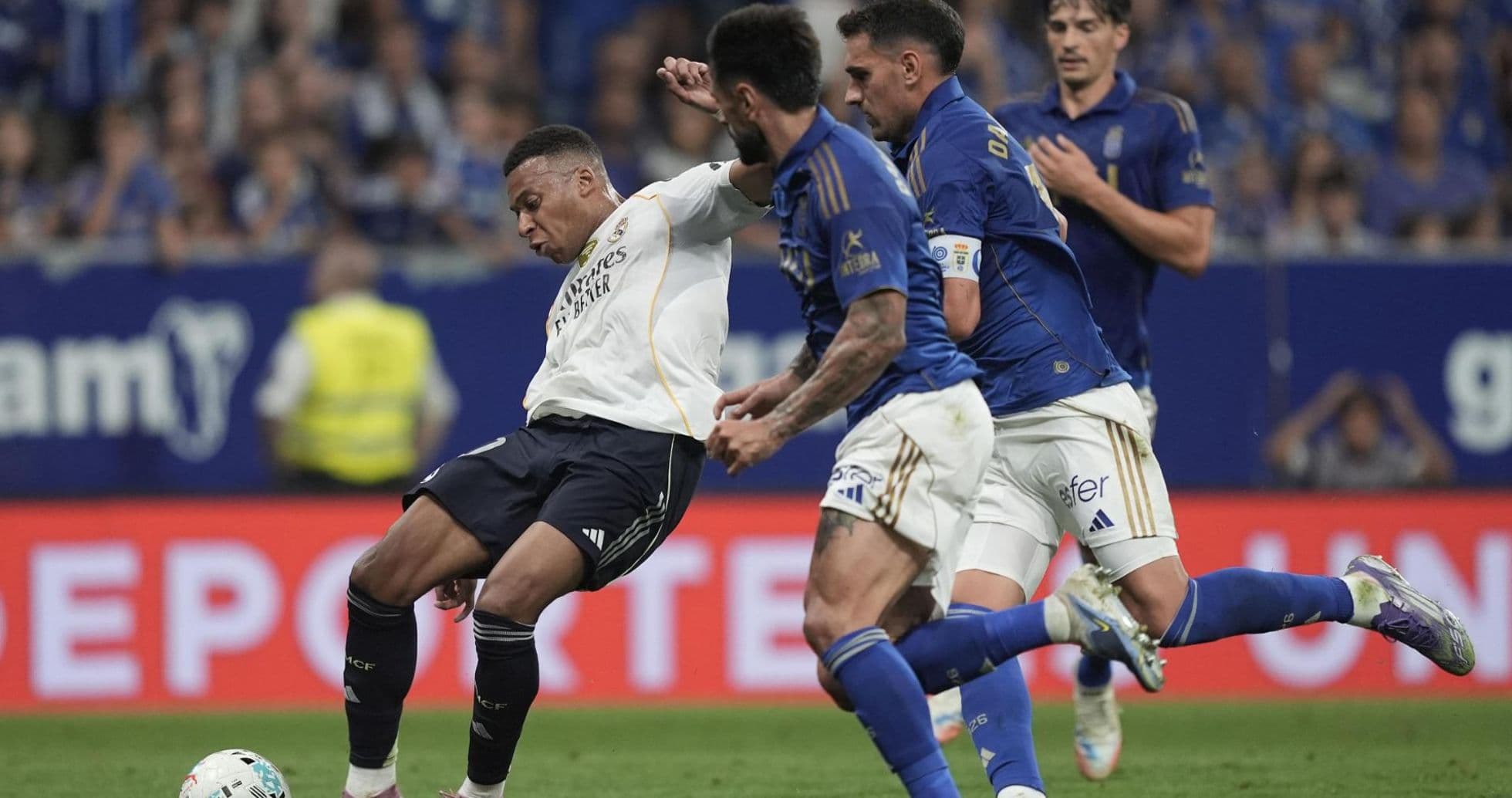
Real Madrid’s 2-0 win over Oviedo at Estadio Santiago Bernabéu was a controlled, system-driven performance in which structure and passing security gradually suffocated the visitors. In a La Liga match where the hosts enjoyed 65% possession and a 19–9 shot advantage, the scoreboard broadly reflected the underlying dynamics: Real Madrid’s xG of 1.46 versus Oviedo’s 1.03 shows the home side created slightly better chances but, more importantly, dictated where and how the game was played. Oviedo’s 4-3-3 was forced into long phases of low, narrow defending and sporadic counter-attacks that never truly destabilised the home back four.
I. Executive Summary
Alvaro Arbeloa set Real Madrid up in a 4-4-2 that behaved like a flexible 2-4-4 in possession, using the full-backs and double pivot to lock Oviedo in their own half. With 616 total passes and 570 accurate (93%), the hosts built a platform of near-total control, conceding only one shot on target and requiring Thibaut Courtois to make just a single save. Oviedo, under Guillermo Almada Alves Jorge, tried to use a 4-3-3 to spring transitions through the front three, but their 325 passes (275 accurate, 85%) and 35% possession underlined how infrequently they could sustain attacks in advanced zones.
II. Scoring Sequence & Disciplinary Log
There were no cards in this match; discipline was notable mainly for its asymmetry in fouls: Real Madrid committed 7, Oviedo 14, but without any bookings.
The breakthrough came at 44'. G. Garcia (Real Madrid) — assisted by B. Diaz — finished a well-constructed move, rewarding the hosts’ territorial dominance just before half-time. That goal set the half-time score at 1-0, fully consistent with the shot volume and the way Real Madrid were pinning Oviedo back.
In the second half, substitutions altered profiles rather than the fundamental pattern. Oviedo first tried to inject creativity at 54' when S. Cazorla (IN) came on for I. Chaira (OUT), hinting at a desire to get more touches between the lines. Arbeloa responded with a double change at 64': D. Carvajal (IN) came on for T. Alexander-Arnold (OUT), and J. Bellingham (IN) came on for A. Tchouameni (OUT), adding ball-carrying and late-box presence from midfield while refreshing the right flank.
At 69', K. Mbappe (IN) replaced G. Garcia (OUT) for Real Madrid, while Oviedo brought on H. Hassan (IN) for T. Fernandez (OUT), both moves aimed at adding vertical threat. Real Madrid then completed their offensive reshaping at 77': C. Palacios (IN) came on for B. Diaz (OUT) and D. Yanez (IN) for F. Mastantuono (OUT), preserving energy and pressing intensity in the wide and central channels. Oviedo answered with a double change at 79', L. Ahijado (IN) for N. Vidal (OUT) and P. Agudin (IN) for N. Fonseca (OUT), trying to freshen both right-back and midfield.
The decisive second goal arrived at 80'. J. Bellingham (Real Madrid) — assisted by K. Mbappe — converted to make it 2-0, a direct payoff from Arbeloa’s mid-game reconfiguration of his attacking structure. No VAR interventions or disciplinary events altered the flow; the match ran cleanly to full time at 2-0.
III. Tactical Breakdown & Personnel
Real Madrid’s 4-4-2 was built on stability at the back and fluidity ahead of the ball. Courtois, with 1 save and 0.16 goals prevented, was largely protected by the back four: T. Alexander-Arnold, R. Asencio, D. Alaba and A. Carreras. With Oviedo managing just 1 shot on target from 9 attempts, the central pairing of Asencio and Alaba controlled depth, while the full-backs could step high to support wide midfielders without exposing large spaces behind.
In midfield, the initial trio of F. Mastantuono, E. Camavinga, A. Tchouameni and B. Diaz provided a balance of ball progression and control. Camavinga and Tchouameni anchored the central lanes, recycling possession and ensuring Real Madrid’s 65% share of the ball translated into territorial dominance. The 616 passes, at a 93% completion rate, reflect how rarely they were forced into rushed or vertical desperation balls; instead, they could circulate until a gap appeared, particularly toward the right where Alexander-Arnold and Diaz combined.
Up front, G. Garcia and Vinicius Junior operated with complementary roles. Vinicius stretched the left channel, pinning Oviedo’s back line deep, while Garcia worked more centrally, often dropping to link play. His goal at 44' was emblematic: Real Madrid advanced methodically, used width to move Oviedo’s 4-3-3 block, and then found Garcia in a scoring zone with Diaz’s support.
The second-half substitutions subtly shifted the attacking geometry. Carvajal maintained width and defensive security on the right but with a slightly more conservative crossing profile than Alexander-Arnold. Bellingham’s introduction for Tchouameni tilted the midfield toward an 8–10 hybrid, adding late runs into the box and more direct vertical ball-carrying. That adjustment was key to the second goal, where Mbappe’s pace — coming in for Garcia — stretched Oviedo’s centre-backs, opening interior corridors for Bellingham to exploit.
Oviedo’s 4-3-3, with A. Escandell in goal (5 saves, 0.16 goals prevented), defended deep for long stretches. The back four of N. Vidal, E. Bailly, D. Costas and R. Alhassane were forced to compress centrally, leaving space out wide that Real Madrid patiently used. Their midfield three — N. Fonseca, S. Colombatto and A. Reina — struggled to get pressure on the ball consistently; Real Madrid’s superior passing accuracy and rotations pulled them out of shape, especially once Cazorla entered and tried to orchestrate from deeper zones.
The front line of I. Chaira, F. Vinas and T. Fernandez rarely received the ball in advantageous positions. With only 35% possession and 9 total shots, most Oviedo attacks were either direct balls into the channels or quick counters after turnovers. The 14 fouls committed underline their reliance on disrupting Real Madrid’s rhythm rather than imposing their own.
IV. The Statistical Verdict
From a metrics standpoint, Real Madrid’s 2-0 win sits slightly above the pure xG expectation (1.46 vs 1.03), but the territorial and structural control justifies the margin. The hosts’ 19 shots to Oviedo’s 9, plus a 7–1 advantage in shots on goal, show a clear edge in chance volume and quality of finishing positions. Courtois’ low involvement and the back line’s suppression of clear chances align with a strong Defensive Index performance, while the attack converted efficiently from a modest but well-managed xG base.
Oviedo’s 1.03 xG indicates they did fashion some potentially dangerous moments, but their inability to turn these into frequent shots on target — and Escandell’s requirement to make 5 saves — emphasises the imbalance. Real Madrid’s season-level profile as a possession-heavy side is reinforced by the 65–35 possession split and high passing accuracy; Oviedo’s more reactive, counter-based approach is consistent with their lower pass volume and higher foul count. Overall, the data and tactical patterns converge on the same conclusion: a controlled, deserved home win, built on structure, circulation and well-timed attacking substitutions.
Related News
Barcelona Dominates Sevilla in Tactical Showdown
Atletico Madrid vs Real Madrid: A Tactical Derby Analysis
La Liga Officials Admit Refereeing Mistake in Madrid Derby Over Lee Kang-in's Tackle on Federico Valverde

Elche vs Real Madrid: A Clash of Opposites in La Liga
Atletico Madrid Dominates Osasuna 4-0 in La Liga Showdown
Barcelona's Dominance: 7-2 Triumph Over Racing Santander