
Valencia and Rayo Vallecano Draw 1–1: Match Analysis
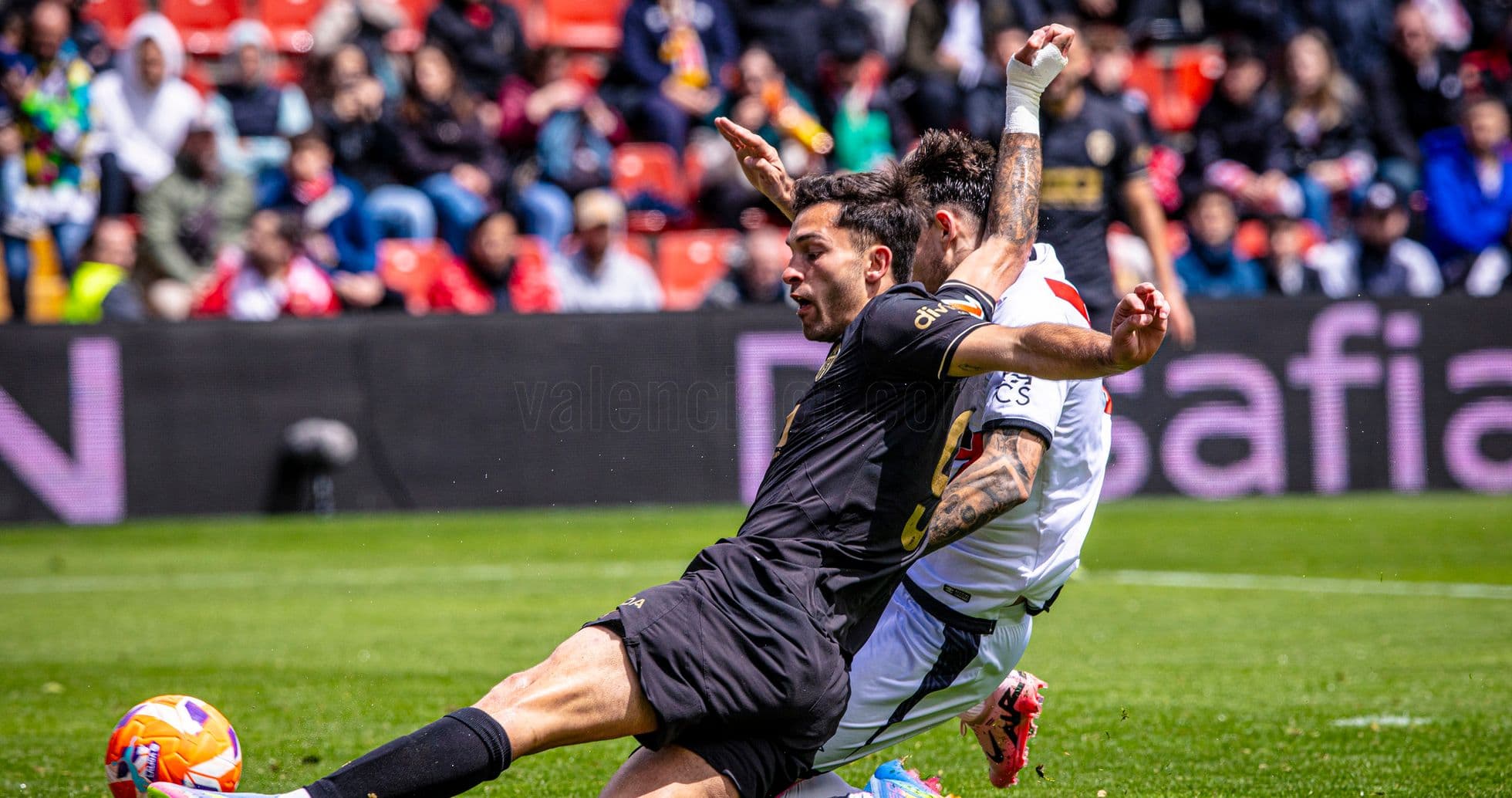
The evening at Estadio de Mestalla ended with the scoreboard locked at 1–1, a result that felt entirely in character for two sides whose seasons have been defined by fine margins rather than dominance. Following this result, Valencia sit 11th in La Liga on 43 points, while Rayo Vallecano edge them in 10th with 44. Over 36 matches, Valencia’s overall goal difference stands at -12 (39 scored, 51 conceded), Rayo’s at -6 (37 scored, 43 conceded) – numbers that speak to mid-table resilience more than relegation peril, but also to the limitations that this match laid bare.
I. The Big Picture – Structures and Seasonal DNA
Carlos Corberan went with his most trusted shape: a 4-4-2 that has been his default in 22 league games. S. Dimitrievski started in goal behind a back four of Renzo Saravia, C. Tarrega, E. Comert and José Gayà. Across midfield, D. Lopez and Pepelu formed the central axis, flanked by G. Rodriguez on the right and Luis Rioja on the left, with H. Duro and Javi Guerra as the front two.
It is a system that mirrors Valencia’s broader season profile: at home they average 1.3 goals scored and 1.2 conceded, rarely blowing teams away but usually keeping contests tight. Their 7 home wins and 6 draws in 18 matches underline Mestalla as a solid, if not impregnable, base.
Inigo Perez answered with a 4-2-3-1, the shape that has underpinned 22 of Rayo’s league outings. A. Batalla was protected by a back line of I. Balliu, F. Lejeune, Nobel Mendy and P. Chavarria. The double pivot of O. Valentin and G. Gumbau sat behind a trio of F. Perez, P. Diaz and Pacha, with R. Nteka as the lone striker.
Rayo’s season has been one of contrast: at home they are tight and controlled, conceding just 0.8 goals per game; away, they open up, scoring 0.8 but also conceding 1.6. That duality was visible here – brave enough to trade punches, but never fully secure.
II. Tactical Voids – Absences and Discipline
Both benches were shaped by conspicuous absentees. Valencia were without L. Beltran (knee), J. Copete (ankle), M. Diakhaby (muscle) and D. Foulquier (knee). The knock-on effect was a thinner rotation in defensive and midfield zones, forcing Corberan to lean heavily on Pepelu’s positional intelligence and Gayà’s leadership on the left.
Rayo’s list was even more structurally disruptive. I. Akhomach and D. Mendez (both muscle and knee injuries respectively), A. Garcia and Luiz Felipe (injuries), and, crucially, Isi Palazón (suspended after a red card) all missed out. Palazón’s absence was more than symbolic: he is both a creative outlet and a disciplinary flashpoint. Across the season he has collected 10 yellow cards and 1 red, and his record includes 1 missed penalty – a reminder that his high-impact style cuts both ways.
In his place, the creative load shifted towards F. Perez and P. Diaz between the lines, but without Isi’s gravity, Rayo’s right side lacked its usual menace. Meanwhile, Rayo’s broader disciplinary profile hovered over the contest: overall they have amassed yellow cards most densely between 46–75 minutes (19 in each of those 15-minute windows) and a worrying spread of reds from 46’ onwards, with 1 in 46–60’, 2 in 61–75’, 2 in 76–90’ and 3 in 91–105’. That history encouraged Valencia to keep the tempo high in the second half, probing for errors rather than simply space.
Valencia, by contrast, are card-heavy but more predictable: their yellow-card peak comes late, with 22.86% of bookings arriving between 76–90’. That late aggression framed the final quarter-hour, where Gayà – who has 6 yellows and 1 red this season – again walked the line between defensive edge and disciplinary risk.
III. Key Matchups – Hunter vs Shield, Engine Room Battles
The “Hunter vs Shield” narrative naturally gravitated towards Rayo’s primary scorer, Jorge de Frutos, even though he started on the bench. With 10 league goals and 1 assist, plus 47 shots (26 on target), he is Rayo’s sharpest edge. His presence among the substitutes was a tactical card for Perez to play against a Valencia defence that, overall, concedes 1.4 goals per game and has been particularly fragile on their travels. At home, however, Valencia’s 1.2 goals conceded per match suggested a back line capable of surviving long spells under pressure.
Instead, the attacking responsibility fell on R. Nteka and the advanced midfield trio. Their challenge was to unsettle a central pairing of Tarrega and Comert that, while not flawless, benefits from the protective screen of Pepelu. The Valencia midfielder’s season numbers – 4-4-2 as the most-used shape, nine overall clean sheets for the team and only 3 home games without scoring – highlight how important control in the middle is to their identity.
In the “Engine Room” duel, Luis Rioja and Javi Guerra were central. Rioja, with 6 assists and 37 key passes in La Liga, is Valencia’s primary creative conduit from the left. His 61 dribble attempts (35 successful) and 215 duels (100 won) show a winger who mixes craft with graft. Guerra, nominally a forward here but a midfielder by trade, brings 6 assists and 29 key passes of his own, plus 6 blocked shots and 23 interceptions – a hybrid between creator and presser.
Opposite them, Rayo’s control unit of Gumbau and Valentin had to suffocate those channels. Gumbau’s left foot and positional sense were tasked with steering Rayo out of pressure and into transitions, while Valentin’s job was to track Guerra’s roaming and deny him the pockets he thrives in.
Behind them, Nobel Mendy embodied the “Shield” concept. Across the season he has blocked 21 shots and added 21 interceptions, combining aerial presence with last-ditch interventions. In this match, his duel with Duro – a classic penalty-box forward – was a constant subplot: Mendy’s aggression occasionally bordered on over-commitment, but his ability to step out and block efforts was vital in keeping Valencia to a single goal.
IV. Statistical Prognosis – What This Draw Tells Us
Following this result, the numbers reinforce the story of two sides whose ceilings are modest but whose floors are relatively stable. Valencia’s overall record of 11 wins, 10 draws and 15 defeats, coupled with 9 clean sheets and 9 games without scoring, paints a picture of a team that lives on the knife-edge of one-goal margins. Their penalty record – 5 taken, 5 scored, 0 missed – underlines a rare area of clinical reliability.
Rayo, with 10 wins, 14 draws and 12 defeats, are even more draw-prone. They have kept 11 clean sheets overall, but have failed to score in 12 matches, including 9 away. On their travels, they average 0.8 goals for and 1.6 against, so emerging from Mestalla with a 1–1 feels like overperformance in attack and par in defence.
In xG terms – even without the exact figures – the pattern is clear. Valencia’s home profile (1.3 scored, 1.2 conceded) versus Rayo’s away profile (0.8 scored, 1.6 conceded) suggests that, on balance, Valencia should shade chances in such fixtures, but rarely by a margin wide enough to guarantee victory. The draw here fits neatly within that statistical band.
Tactically, the match underlined three key truths going forward. First, Valencia’s 4-4-2 remains structurally sound, but their reliance on Rioja and Guerra for creativity makes them predictable; better opponents will tilt their pressing traps towards that left-sided axis. Second, Rayo’s away fragility persists, but the depth provided by players like de Frutos – whether starting or from the bench – keeps them dangerous in transition even when they are out-possessed. Third, discipline will continue to define Rayo’s ceiling: their late-game red-card pattern, combined with the absence of volatile figures like Isi Palazón in this fixture, hints at how thin the line is between their combative identity and self-destruction.
In the end, 1–1 at Mestalla felt less like a missed opportunity and more like a faithful reflection of who these teams have been all season: organized, competitive, but still searching for the extra layer of quality that turns stalemates into statements.
Related News

Barcelona Dominates Sevilla in Tactical Showdown
Atletico Madrid vs Real Madrid: A Tactical Derby Analysis
La Liga Officials Admit Refereeing Mistake in Madrid Derby Over Lee Kang-in's Tackle on Federico Valverde
Elche vs Real Madrid: A Clash of Opposites in La Liga
Atletico Madrid Dominates Osasuna 4-0 in La Liga Showdown
Barcelona's Dominance: 7-2 Triumph Over Racing Santander