
Valencia vs Rayo Vallecano: Tactical Stalemate Ends in 1-1 Draw
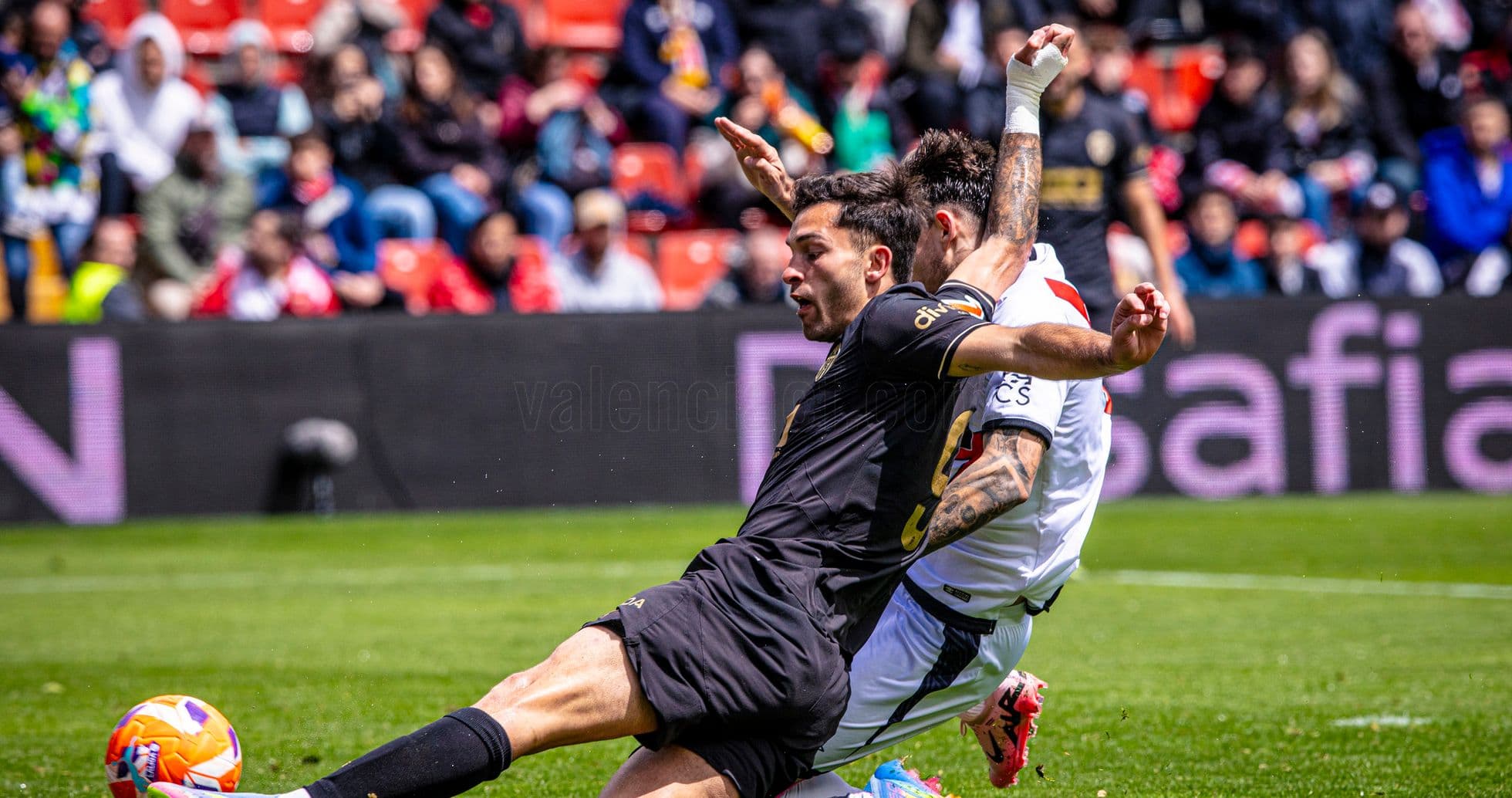
Valencia and Rayo Vallecano shared a 1-1 draw at Estadio de Mestalla in a match where structure and control outweighed chaos and volume. The hosts edged possession with 53% and produced 12 total shots to Rayo’s 6, but the underlying numbers tell a different story: Valencia’s xG of 0.69 trailed Rayo’s 1.21, underlining how the visitors created the clearer chances despite spending more time without the ball. Both goalkeepers faced 3 shots on target and made 2 saves, and with neither side able to tilt the balance in either box, the scoreline ultimately mirrored a tactical stalemate rather than an attacking shootout.
Executive Summary
Valencia set up in a 4-4-2 under Carlos Corberan, looking to use wide midfielders and a dual-forward line to pin Rayo back and control territory through structured build-up. Inigo Perez responded with a 4-2-3-1, prioritising compactness in the double pivot and vertical access to R. Nteka as the lone forward. The game finished 1-1, with Rayo striking first and Valencia equalising before half-time. The second half became a battle of adjustments and substitutions rather than chances, as both coaches reshaped their midfields and flanks without fundamentally breaking the opponent’s defensive organisation.
Scoring Sequence & Disciplinary Log
The disciplinary tone was set early. At 6', Renzo Saravia (Valencia) received a yellow card — Foul, an early warning that shaped his aggression on the right flank and likely influenced his early substitution.
Rayo struck first from a set pattern of using their centre-backs in advanced situations. At 20', Florian Lejeune (Rayo Vallecano) scored for the visitors — assisted by G. Gumbau. The goal reflected Rayo’s ability to generate high-quality moments from limited shot volume, leaning on delivery and timing rather than sustained pressure.
Valencia responded before the interval. At 40', Diego Lopez (Valencia) levelled the match — assisted by Javi Guerra. The equaliser was consistent with Valencia’s territorial control and use of midfield runners from their 4-4-2, with Guerra stepping into pockets between Rayo’s lines to supply the final pass.
The only second-half booking came as Rayo tried to raise the emotional and physical intensity. At 56', Randy Nteka (Rayo Vallecano) was shown a yellow card — Argument, a flashpoint that underlined Rayo’s frustration as they battled for territory and decisions.
Card totals were therefore: Valencia 1, Rayo Vallecano 1, Total 2.
Tactical Breakdown & Personnel
Valencia’s 4-4-2 was clearly designed to control central zones through the pairing of Pepelu and D. Lopez, with G. Rodriguez and L. Rioja providing width and J. Guerra supporting H. Duro as a second forward. With 445 total passes and 356 accurate (80%), Valencia circulated the ball reliably, using the back four — J. Gaya, E. Comert, C. Tarrega and Saravia — as a stable platform. Their 12 total shots, split evenly between inside and outside the box (6 each), showed a balance between patient probing and willingness to shoot from range when Rayo’s block held firm.
The early yellow card for Saravia at 6' — Foul — had direct tactical consequences. His defensive risk profile on the right became problematic, and at 32' U. Nunez (IN) came on for Renzo Saravia (OUT), giving Valencia fresher legs and fewer constraints in duels on that side. It was a proactive adjustment by Corberan to prevent a second booking from destabilising the back line.
Rayo’s 4-2-3-1 relied on the double pivot of O. Valentin and G. Gumbau to shield the defence and launch transitions. Despite only 404 total passes with 315 accurate (78%) and just 47% possession, Rayo were more efficient in chance creation, as reflected in their higher xG of 1.21 from only 6 shots. Five of those came inside the box, highlighting a clear emphasis on working the ball into high-value zones rather than shooting from distance.
The goal from Lejeune at 20', assisted by Gumbau, typified Rayo’s use of set or semi-set situations to involve their centre-backs offensively. With P. Chavarria and N. Mendy also in the back four, Rayo had the aerial and physical profile to threaten from dead balls while remaining compact in defensive phases.
In goal, S. Dimitrievski for Valencia made 2 saves from 3 shots on target, with a goals prevented value of -0.61, indicating he conceded slightly more than the model expected from the chances faced. At the other end, A. Batalla for Rayo matched that line — 2 saves from 3 shots on target and the same goals prevented figure of -0.61 in his team’s statistics block — suggesting that both goalkeepers were marginally below the expected shot-stopping benchmark, but not decisively so.
The 40' equaliser from D. Lopez, assisted by J. Guerra, came from Valencia’s best structural pattern: midfielders breaking lines from a stable base. Guerra, operating as a forward on paper but functionally a hybrid 10, dropped into the half-spaces to receive between Rayo’s midfield and defence, then released Lopez’s run. It was a direct reward for Valencia’s superior passing rhythm and their ability to stretch Rayo’s double pivot horizontally.
The second half became a rolling tactical chess match from 60' onwards. Rayo’s triple substitution wave at 60–61' and 67–73' — Alemao (IN) for R. Nteka (OUT), J. de Frutos (IN) for F. Perez (OUT), P. Ciss (IN) for O. Valentin (OUT), U. Lopez (IN) for G. Gumbau (OUT), and A. Ratiu (IN) for I. Balliu (OUT) — refreshed the spine and wide threat, turning the 4-2-3-1 into a more vertical, transition-oriented version. Fresh legs in advanced midfield and full-back roles allowed Rayo to press selectively and attack space more aggressively, even if it did not translate into a higher shot count.
Corberan mirrored the reshaping with a triple substitution at 61' — U. Sadiq (IN) for H. Duro (OUT), F. Ugrinic (IN) for Pepelu (OUT), and L. Ramazani (IN) for J. Guerra (OUT) — followed by J. Vazquez (IN) for J. Gaya (OUT) at 63'. These changes subtly altered Valencia’s attacking profile: Sadiq offered more depth running than Duro, Ugrinic added a more progressive passing angle from midfield, and Ramazani introduced direct dribbling threat between the lines and out wide. Vazquez at left-back maintained energy on the flank as Gaya departed. Despite these moves, Rayo’s compact mid-block and disciplined back line restricted Valencia mostly to low-quality shooting positions, consistent with the modest xG of 0.69.
The Statistical Verdict
The statistical contrast is instructive. Valencia, with more possession (53%), more total shots (12 vs 6) and more corners (5 vs 1), looked like the territorial protagonist. Their passing volume and accuracy — 445 passes, 356 accurate (80%) — underpinned a controlled, methodical approach. Yet their xG of 0.69 reveals that this control rarely translated into truly dangerous chances, a reflection of Rayo’s compactness and ability to protect the central box.
Rayo, by comparison, accepted a lower share of the ball and a higher foul count (20 vs Valencia’s 9) as the cost of disrupting Valencia’s rhythm. Their 404 passes with 315 accurate (78%) were sufficient to support quick, focused attacks that produced an xG of 1.21 from just 6 shots, 5 of them inside the box. This efficiency in chance quality, combined with the early goal from Lejeune and the structural tweaks via substitutions, justified their point away from home.
Discipline remained under control with only two yellow cards — Saravia’s Foul and Nteka’s Argument — and no reds, allowing both coaches to fully execute their substitution plans. With both goalkeepers slightly underperforming their expected shot-stopping and neither side able to engineer a decisive late moment, the 1-1 at Estadio de Mestalla was a fair reflection of a match where tactical structure and defensive organisation held sway over attacking risk.
Related News
Barcelona Dominates Sevilla in Tactical Showdown
Atletico Madrid vs Real Madrid: A Tactical Derby Analysis
La Liga Officials Admit Refereeing Mistake in Madrid Derby Over Lee Kang-in's Tackle on Federico Valverde
Elche vs Real Madrid: A Clash of Opposites in La Liga
Atletico Madrid Dominates Osasuna 4-0 in La Liga Showdown
Barcelona's Dominance: 7-2 Triumph Over Racing Santander