
Villarreal vs Sevilla: Tactical Analysis of a 2-3 Defeat
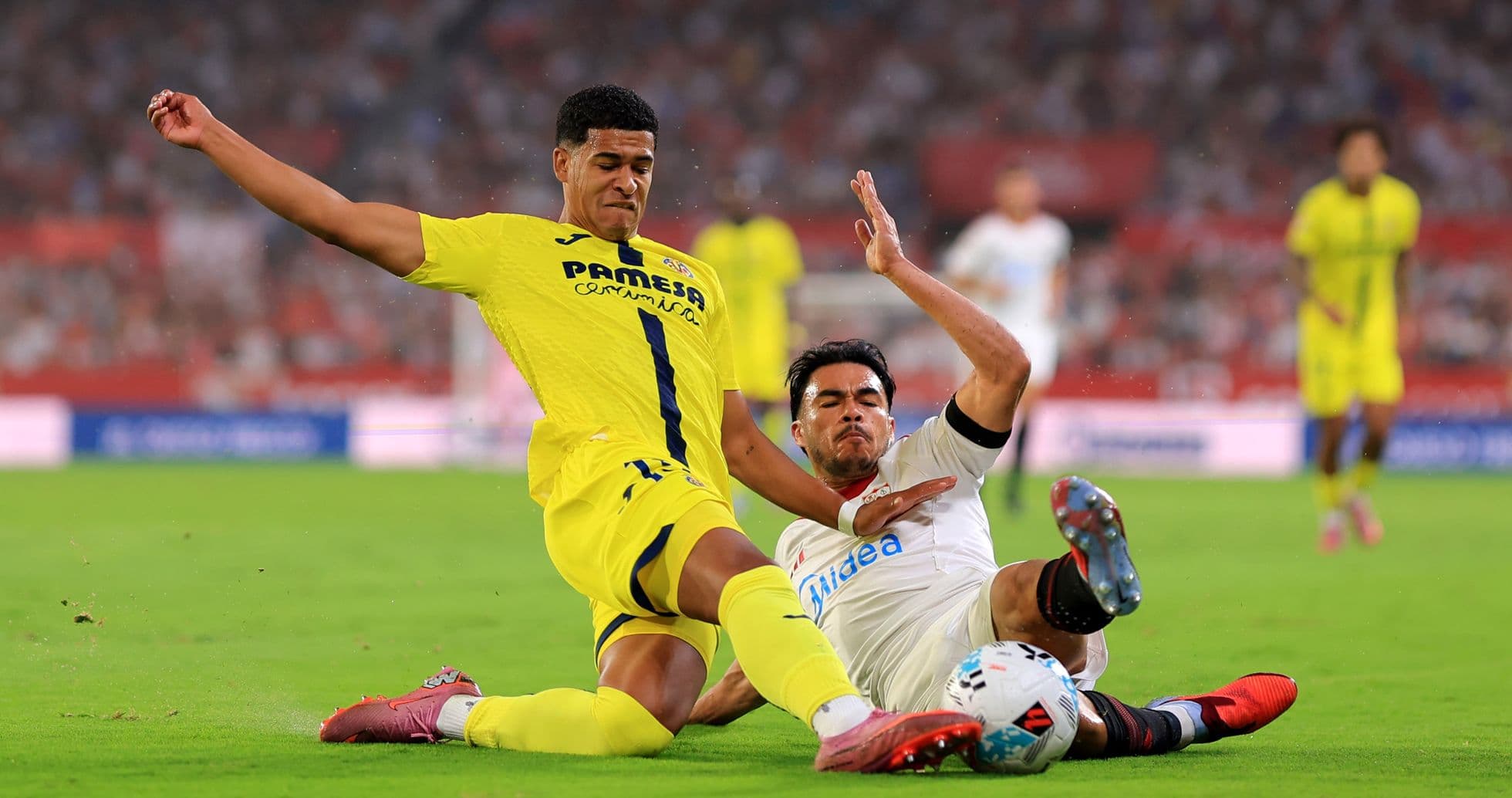
Villarreal’s 2-3 defeat to Sevilla at Estadio de la Ceramica was a study in contrasting game models: territorial dominance and ball circulation from Marcelino’s 4-4-2 against Luis Garcia Plaza’s compact 5-3-2 built for vertical punches. Despite leading 2-0 and finishing with 63% possession and 554 passes (499 accurate, 90%), Villarreal were gradually dismantled by Sevilla’s structural adjustments, superior penalty-box occupation, and more efficient shot profile.
The scoring pattern underlines the tactical story. On 13', Gerard Moreno exploited Villarreal’s early control, finishing a move created by a dropping forward: G. Moreno (Villarreal) — assisted by G. Mikautadze. Seven minutes later, the front two combined again, this time with the roles reversed: on 20', G. Mikautadze (Villarreal) — assisted by A. Moleiro. Villarreal’s 4-4-2 functioned cleanly at this stage: double pivot access, wide midfielders tucking in, and both strikers alternating between pinning the back line and dropping into half-spaces.
Sevilla’s response came not through possession but through exploiting spaces around Villarreal’s centre-backs. On 36', Oso (Sevilla) — assisted by L. Agoume — struck from Sevilla’s first meaningful central progression, a move that exposed the gap between Villarreal’s back four and midfield line. Then, just before the interval on 45', K. Salas (Sevilla) — assisted by R. Vargas — converted from another well-targeted delivery, with Sevilla attacking the far-post zones against Villarreal’s zonal structure. The 2-2 half-time score reflected Sevilla’s efficiency rather than control.
Second Half
The second half hinged on the benches and how each coach reinterpreted midfield control. Marcelino’s double substitution on 60' was clearly aimed at refreshing central energy and wide ball progression: T. Partey (IN) came on for P. Gueye (OUT), and T. Buchanan (IN) came on for N. Pepe (OUT). Partey was supposed to stabilize circulation and protect transitions, while Buchanan added directness on the flank. However, the change subtly altered Villarreal’s balance: with Partey more focused on first-phase buildup, the distances between midfield and back line sometimes stretched, especially when full-backs advanced.
Luis Garcia Plaza’s response was more directly tied to transition threat. On 68', J. Sanchez (IN) came on for R. Vargas (OUT), injecting fresh legs into midfield. Villarreal then doubled down on fresh possession profiles at 70', when S. Comesana (IN) came on for D. Parejo (OUT) and A. Perez (IN) came on for G. Mikautadze (OUT). Losing Parejo’s tempo and Mikautadze’s link play simultaneously reduced Villarreal’s capacity to create high-quality chances between the lines; they kept the ball, but their attacking structure became more predictable and wing-oriented.
Sevilla’s decisive blow came at 72', immediately after their second change in the front line: A. Sanchez (IN) came on for N. Maupay (OUT). Within that same minute, A. Adams (Sevilla) — assisted by D. Sow — completed the turnaround for 2-3. The move encapsulated Sevilla’s tactical edge: quick vertical progression, runners attacking the inside channels of Villarreal’s full-backs, and a forward line that consistently targeted the spaces behind an advanced defense. Villarreal’s high line, combined with their full-backs pushing on, left A. Tenas exposed more often than the raw shot volume suggests.
Discipline and Game Management
Discipline and game management further shaped the closing phases. Villarreal collected two yellow cards, Sevilla one, all tightly linked to game context:
- 81' Ayoze Pérez (Villarreal) — Foul
- 90+2' Renato Veiga (Villarreal) — Foul
- 90+3' José Ángel Carmona (Sevilla) — Time wasting
Total cards: Villarreal 2, Sevilla 1, overall 3. Ayoze Pérez’s booking reflected Villarreal’s increasing desperation to recover possession after turnovers; Renato Veiga’s late Foul came as Villarreal pushed numbers forward and were forced into riskier defensive interventions. José Ángel Carmona’s Time wasting card was emblematic of Sevilla’s game state management once they had the 2-3 lead, deliberately slowing restarts to break Villarreal’s rhythm.
Match Analysis
From a structural standpoint, Villarreal’s 4-4-2 was ball-dominant but box-light. Their 6 total shots included only 4 on target, with 4 inside the box, and their xG of 0.81 shows that, despite territorial control, they struggled to generate repeated clear-cut chances. The wide midfielders, especially A. Moleiro, gave good support in the half-spaces early on, but once Parejo and Mikautadze departed, the team lacked a consistent connector between midfield and the remaining forward, Gerard Moreno. Crosses and late runs became more speculative, easier for Sevilla’s back five to manage.
Sevilla’s 5-3-2, by contrast, was built around compactness and punch. With just 37% possession and 325 passes (276 accurate, 85%), they accepted long spells without the ball. Yet they produced 13 total shots, 5 on target, with 7 from inside the box, and a slightly higher xG of 0.88. Their wing-backs and outside centre-backs stepped out aggressively when Villarreal’s wide players received, while the midfield trio of R. Vargas, L. Agoume, and D. Sow (before his 86' substitution, when N. Gudelj (IN) came on for D. Sow (OUT)) focused on screening central lanes and springing vertical counters. The late change of Castrin (IN) for A. Adams (OUT) at 86' further reinforced their defensive line to protect the lead.
In goal, A. Tenas for Villarreal made 2 saves, with a goals prevented figure of -0.22, indicating that he conceded slightly more than the post-shot profile suggested; Sevilla’s O. Vlachodimos, with 1 save and the same -0.22 goals prevented, was rarely tested after the early double blow, as his defense increasingly controlled Villarreal’s low-value attempts. The defensive index difference is stark: Villarreal allowed 13 shots despite their possession dominance, while Sevilla conceded only 6 and blocked 5 of them, underscoring the effectiveness of their penalty-box defense.
Statistically and tactically, the match confirmed contrasting identities. Villarreal’s overall form in possession remains strong, but their inability to convert control into sustained high-quality chances, and their vulnerability in defensive transitions, cost them. Sevilla, with fewer passes and less of the ball, leveraged a compact 5-3-2, vertical running, and intelligent game management to turn a 0-2 deficit into a 2-3 away win, fully aligned with the underlying xG balance and their defensive resilience in the final third.
Related News

Barcelona Dominates Sevilla in Tactical Showdown
Atletico Madrid vs Real Madrid: A Tactical Derby Analysis

La Liga Officials Admit Refereeing Mistake in Madrid Derby Over Lee Kang-in's Tackle on Federico Valverde

Elche vs Real Madrid: A Clash of Opposites in La Liga

Atletico Madrid Dominates Osasuna 4-0 in La Liga Showdown

Barcelona's Dominance: 7-2 Triumph Over Racing Santander