
Barcelona Dominates Athletic Club in La Liga Clash
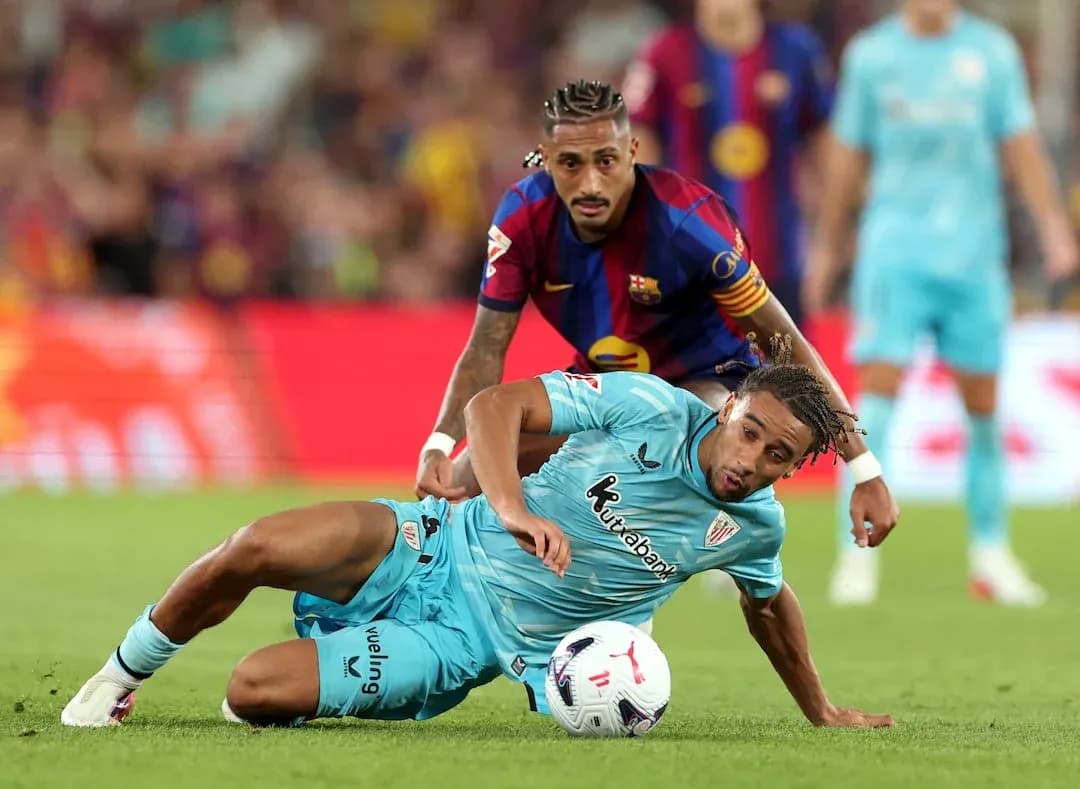
Under the Camp Nou lights, this was billed as a meeting of opposites: a Barcelona side already humming under Hansi Flick, and an Athletic Club still searching for their footing under Edin Terzic. Ninety minutes later, the scoreboard – 2-0 to Barcelona – simply confirmed what the early-season numbers had been whispering.
Heading into this game, Barcelona were already shaping La Liga in their image. Two wins from two, seven goals scored and none conceded overall, a goal difference of +7, and a perfect split between home and away dominance. At home, they had scored 2 and conceded 0; on their travels, they had gone one better with 5 scored and 0 against. Athletic arrived from the opposite end of the table, 19th with no points, one goal scored and five conceded overall, a goal difference of -4. Their only home outing had ended 1-3, their lone away trip 2-0 against them.
Flick’s selection told its own story. The 4-3-3 he trusted here has already become a structural reference point of this new Barcelona: J. Garcia in goal; a back four of X. Espart, G. Martin, P. Cubarsi and E. Garcia; a midfield triangle of Pedri, M. Bernal and Fermín; and a front line of Lamine Yamal, Raphinha and A. Gordon. It is a blueprint that fuses academy precision with high-end recruitment.
Across from them, Terzic stayed loyal to a 4-2-3-1 that has yet to yield a point. U. Simon anchored a back line of J. Louis-Jean, A. Laporte, Y. Alvarez and H. Rincon. In front, M. Jauregizar and P. Canales formed the double pivot, with an aggressive three of N. Williams, O. Sancet and I. Williams behind G. Guruzeta.
The absentees framed the tactical voids. Barcelona were without F. de Jong and Gavi through knee injuries, and R. Bardghji also sidelined with a knee problem. D. Livakovic was listed as inactive, while M. Casado and H. Fort were omitted by coach’s decision. Flick therefore leaned fully into Pedri’s orchestration and Fermín’s verticality to replace the missing control and aggression that De Jong and Gavi usually provide between the lines.
Athletic’s problems were more structural. U. Egiluz (knee), A. Gorosabel (muscle injury), B. Prados Diaz (thigh) and D. Vivian (hamstring) all weakened Terzic’s defensive options, while N. Serrano was left out by choice. For a side that had already conceded 3 at home and 2 away, losing defensive depth was the last thing they needed at Camp Nou.
The disciplinary backdrop added another layer. Barcelona’s season to this point had been remarkably clean: only one yellow card overall, and that arriving between minutes 16-30. No reds, no late spikes. Athletic, by contrast, carried the scars of a chaotic start. Their yellow cards were spread evenly – 25.00% of them in each of the 16-30, 46-60, 61-75 and 76-90 windows – and, more tellingly, they had already seen a red card in the opening 0-15 minutes of a match. Yuri’s dismissal in just 11 minutes of his only league appearance, with a rating of 3, hung over this fixture like a warning about the risks of over-committing against superior technical sides.
Within that context, the “Hunter vs Shield” duel was always likely to tilt blaugrana. Barcelona’s attack has been ruthless: 3.5 goals per game overall, with 2.0 at home and an outrageous 5.0 away. They had converted their only penalty of the campaign, Raphinha scoring from the spot as part of a broader attacking clinic: 3 league goals, 1 assist, and an 8.9 average rating from just 143 minutes. Fermín, from midfield, had also struck 3 times in 183 minutes, matching Raphinha’s scoring output while adding 76 completed passes at 82% accuracy and the work rate of 3 tackles and an interception.
Athletic’s shield, by contrast, has been porous. They have conceded 5 goals overall in just two matches, with an average of 3.0 against at home and 2.0 away. They have yet to keep a clean sheet either at San Mamés or on their travels, and have already failed to score once away. Gorka Guruzeta, their centre-forward, has been more visible in the disciplinary tables than on the scoresheet: 2 yellow cards in 139 minutes, no goals, and a rating of 6.6. His duels – 19 contested, 8 won – show effort, but not incision.
The engine room battle was where Barcelona quietly won this match before the scoreboard confirmed it. Without De Jong and Gavi, the responsibility fell on Pedri, Fermín and M. Bernal. Pedri, as the left-sided interior, orchestrated the tempo, dropping to link with G. Martin and X. Espart to evade Athletic’s first line. Fermín, already one of La Liga’s standout midfield scorers, attacked the half-spaces behind Canales and Jauregizar, forcing Athletic’s double pivot to turn and run rather than dictate. Bernal’s role was the glue: screening transitions, offering the first outlet under pressure and allowing the full-backs to step into midfield zones.
For Athletic, M. Jauregizar and P. Canales were asked to cover enormous horizontal ground against Barcelona’s three-man midfield and full-backs. With both I. Williams and N. Williams pushed high to threaten on the break, the Basque double pivot was repeatedly exposed, especially when Raphinha and Lamine Yamal received between the lines and drove diagonally at Laporte and Y. Alvarez.
Out wide, the matchups were brutal. On Barcelona’s left, A. Gordon – already on 2 assists this season with a 7.45 rating – combined with G. Martin to overload H. Rincon. Gordon’s ability to carry and combine, reflected in 3 successful dribbles from 3 attempts so far this campaign, forced Athletic’s right-back into reactive defending, pinning N. Williams deeper than Terzic would have liked.
On the opposite flank, Raphinha and Lamine Yamal alternated between hugging the touchline and driving inside. With Raphinha already contributing 6 key passes and 4 shots on target this season, A. Laporte and Y. Alvarez were constantly dragged into uncomfortable channels. Guruzeta, who has committed only 1 foul but drawn 3, could not provide enough first-line pressure to slow Barcelona’s build-up, leaving Athletic’s midfield to chase shadows.
The late-game patterns told their own story. Barcelona, with 2 clean sheets overall and no goals conceded either at home or away, were never likely to collapse once ahead. Their calm disciplinary record meant no self-inflicted chaos. Athletic, whose yellow cards are evenly distributed all the way through to the 76-90 period, again risked late indiscipline as they chased the game.
Statistically and structurally, the prognosis was always going to lean heavily toward Barcelona. An attack averaging 3.5 goals per game overall against a defence conceding 2.5 per match, a side with two clean sheets against one with none, and a midfield led by Pedri and Fermín against a double pivot already stretched in previous fixtures. The 2-0 scoreline at Camp Nou felt less like a surprise and more like the logical expression of two trajectories: Barcelona accelerating toward the summit, Athletic still wrestling with their own shape in the shadows of the table.
Related News

Barcelona vs Rayo Vallecano: Predicted Lineups and Team News

Barcelona vs Rayo Vallecano: La Liga Clash Preview

Real Madrid Dominates Real Sociedad 4-1 in La Liga Showdown

Barcelona vs Rayo Vallecano Prediction: Key Stats and Betting Tips

Real Madrid vs Malaga Predicted Lineups: Team News and Match Insights

Real Madrid vs Malaga: La Liga Clash Preview