
Barcelona Dominates Real Madrid in Title Decider
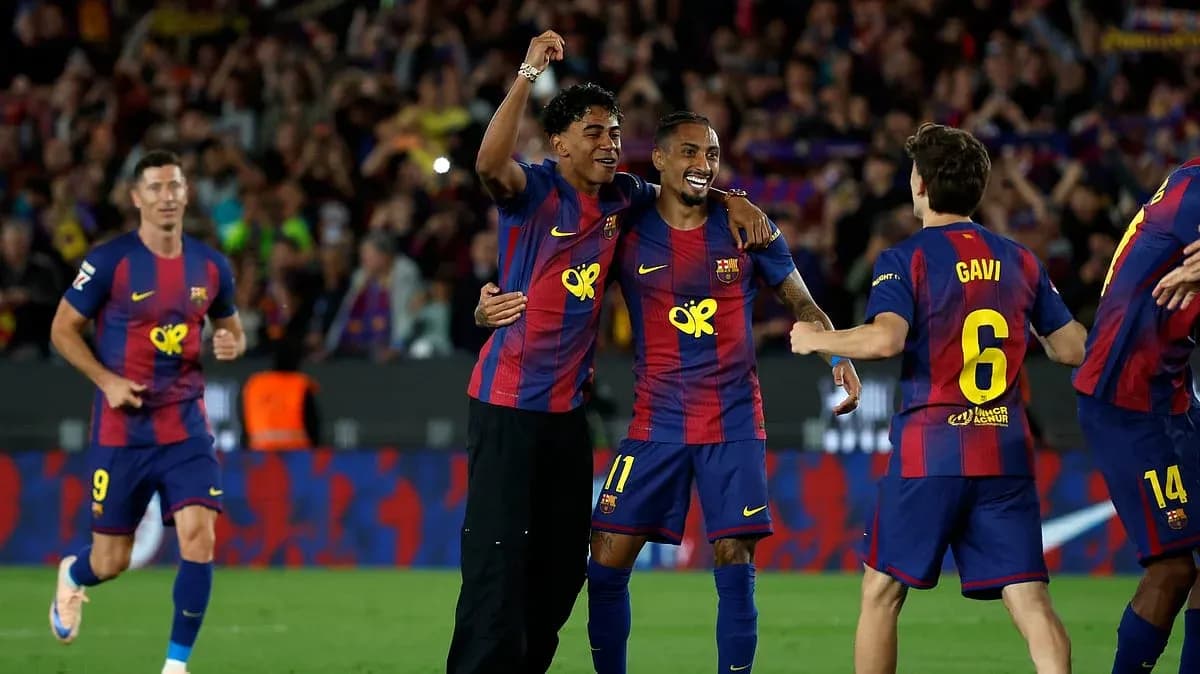
Under the Camp Nou lights, this clásico did not just tilt the title race; it underlined the structural gap between a complete side and an improvised one. Barcelona, already top of La Liga, arrived as a machine in full flow, and a 2–0 win over Real Madrid in regular time felt like the logical expression of their season-long superiority.
Heading into this game, the table told a stark story. Barcelona sat 1st on 91 points after 35 matches, with a remarkable overall goal difference of +60, built from 91 goals scored and 31 conceded. At home they had been flawless: 18 wins from 18, 54 goals for and only 9 against, averaging 3.0 goals for and 0.5 against at Camp Nou. Real Madrid, 2nd with 77 points, carried a strong but clearly inferior profile: overall goal difference +37 from 70 scored and 33 conceded, and on their travels 10 wins, 4 draws, 4 defeats with 31 goals for and 19 against, an away average of 1.7 scored and 1.1 conceded.
I. The Big Picture – A heavyweight clash, one-sided in structure
Both coaches mirrored each other on paper with a 4-2-3-1, but the shapes behaved very differently. Hansi Flick’s Barcelona were built around control and vertical precision. J. Garcia in goal sat behind a back four of J. Cancelo, P. Cubarsi, E. Garcia and G. Martin, with Gavi and Pedri as the double pivot. Ahead of them, Fermín and Dani Olmo worked between the lines, M. Rashford attacked the weak side, and Ferran Torres led the line.
Alvaro Arbeloa’s Real Madrid also lined up 4-2-3-1: T. Courtois in goal; a back four of F. Garcia, A. Rudiger, R. Asencio and T. Alexander-Arnold; E. Camavinga and A. Tchouameni as the screening pair; B. Diaz, J. Bellingham and Vinicius Junior behind G. Garcia up front. On paper it was a talented side, but crucial absences twisted the tactical balance.
II. Tactical Voids – Absences and discipline reshape the contest
Both teams had to live without key pieces. Barcelona were missing A. Christensen (knee injury) and the electric Lamine Yamal (thigh injury), stripping Flick of his most explosive right-sided outlet and a high-volume creator who had produced 16 goals and 11 assists in La Liga. Yet their squad depth softened the blow: Rashford, Ferran Torres, Raphinha and R. Lewandowski on the bench gave Flick multiple profiles to mimic Yamal’s threat in different ways.
Real Madrid’s voids were far more destabilising. Arbeloa entered this fixture without D. Carvajal, D. Ceballos, Eder Militao, A. Guler, K. Mbappe, F. Mendy, Rodrygo and F. Valverde. That list strips out his natural right-back, two central defenders or hybrid defenders, his chief creative midfielder in A. Guler, his league-leading scorer Kylian Mbappé (24 goals, 4 assists, and 1 missed penalty this season), a starting left-back, a primary wide forward in Rodrygo, and a box-to-box engine in Valverde.
The knock-on effect was everywhere. T. Alexander-Arnold, a natural playmaking full-back, had to balance build-up duties with defensive work against Rashford and G. Martin’s overlaps. A. Rudiger and R. Asencio anchored a centre-back pairing missing Militao’s recovery speed. Higher up, J. Bellingham had to shoulder more creative burden without Guler and Valverde, while Vinicius Junior became the primary outlet, carrying into traffic without the usual gravity of Mbappé or Rodrygo to share attention.
Disciplinary trends added another layer. Heading into this game, Barcelona’s yellow-card distribution showed a mid-to-late game spike: 27.59% of their yellows came between 46–60 minutes and 20.69% between 76–90, with a late flurry of 15.52% between 91–105. Real Madrid’s yellows peaked between 61–75 minutes at 22.06%, then 19.12% from 31–45 and 17.65% in both the 46–60 and 76–90 windows. Both sides therefore tended to get more reckless as intensity rose after half-time, but Real Madrid’s red-card profile was particularly alarming, with dismissals spread from 31–45, 61–75, 76–90 and heavily concentrated at 91–105 (28.57%). In a high-stakes clásico, that volatility was always a tactical risk.
III. Key Matchups – Hunter vs Shield, Engine Room vs Enforcer
Hunter vs Shield
With Mbappé absent, the pure “top scorer vs defence” narrative shifted. Barcelona’s main league scorer Ferran Torres (16 goals, 1 assist) started as the central forward against a Real Madrid defence that, on their travels, had conceded 19 goals in 18 matches. That away figure – 1.1 goals against on average – is solid but not elite, especially against a Barcelona side averaging 3.0 goals for at home. Torres’ movement between A. Rudiger and R. Asencio forced constant re-adjustments, especially when Olmo and Fermín flooded the half-spaces.
On the other side, Vinicius Junior arrived with 15 league goals and 5 assists, a dribbling profile of 189 attempts with 86 successes, and 80 fouls drawn. His duel with J. Cancelo and P. Cubarsi was the purest “Hunter vs Shield” on the pitch. Vinicius thrives in broken phases; Barcelona’s home defensive average of 0.5 goals conceded per match, and 10 home clean sheets, suggested they would try to deny him transitions altogether rather than win every individual duel.
Engine Room – Playmaker vs Enforcer
In midfield, Pedri was Barcelona’s metronome: 1908 passes this season at 91% accuracy, 59 key passes and 8 assists. Alongside Gavi’s intensity, he controlled tempo and vertical access into Olmo and Fermín. Real Madrid’s counterweight was A. Tchouameni and E. Camavinga, the enforcer duo tasked with compressing central spaces and protecting a back line stripped of Militao and Mendy.
But the structural numbers were against them. Overall, Barcelona averaged 2.6 goals for and only 0.9 against per match, with 15 clean sheets and no league penalties missed (7 scored from 7). Real Madrid’s overall averages of 2.0 goals for and 0.9 against are strong, yet they lacked the same territorial dominance away from home, and their creative hub Guler was absent. J. Bellingham had to bridge lines almost alone, while B. Diaz drifted in search of pockets rather than pinning Barcelona’s full-backs.
IV. Statistical Prognosis – Why 2–0 fits the season’s logic
Following this result, the 2–0 scoreline felt like a statistical and tactical confirmation rather than a surprise. Barcelona’s perfect home record, their 54 home goals and 9 conceded, and their repeated use of the 4-2-3-1 (25 league matches in that shape) all pointed to a side that knows exactly how to manage big nights. Real Madrid, for all their quality, were forced into a patched XI that removed their most dangerous scorer, their primary creative midfielder, and key defenders.
In Expected Goals terms, the pre-match profiles suggested Barcelona were more likely to generate sustained, high-quality chances: a home side averaging 3.0 goals at Camp Nou against an away defence conceding 1.1, versus a Real Madrid attack without Mbappé and Rodrygo facing a home defence conceding just 0.5. The clean-sheet probability leaned heavily towards Barcelona, especially with Real Madrid’s red-card volatility and Barcelona’s capacity to suffocate games once ahead.
The narrative of the night – control, pressure, and two decisive strikes – mirrored the numbers. Barcelona’s squad coherence, even with Lamine Yamal absent, outweighed Real Madrid’s individual brilliance hampered by injuries. In a clásico framed as a title decider, the champions-elect played like a finished product; their rivals, like a side one or two pieces short of truly matching them.
Related News

Barcelona Dominates Sevilla in Tactical Showdown
Atletico Madrid vs Real Madrid: A Tactical Derby Analysis
La Liga Officials Admit Refereeing Mistake in Madrid Derby Over Lee Kang-in's Tackle on Federico Valverde

Elche vs Real Madrid: A Clash of Opposites in La Liga

Atletico Madrid Dominates Osasuna 4-0 in La Liga Showdown

Barcelona's Dominance: 7-2 Triumph Over Racing Santander