
Boavista: A Celtic Foe Lost to Football’s Harshest Reality
Boavista are gone. Not relegated, not restructured, not bumped down a division to lick their wounds. Extinguished. A court order has told one of Portugal’s great outliers to switch off the lights by 31 July and hand over the keys. After 123 years, the club that once crashed the Lisbon–Porto duopoly has been pushed into history by debts it could no longer outrun.
For Celtic supporters, the name Boavista will always stir something. A flicker of green-and-white memories. A semi-final roar. A looping header in Porto that felt like destiny.
But before Henrik Larsson wrote his chapter, there was another story.
The first meetings and a small piece of Celtic history
Celtic first ran into Boavista in the 1975 Cup Winners’ Cup. It was a different European landscape then, and Boavista were far from the snarling, awkward semi-finalists they would later become. The tie began with a 0-0 draw in Porto, a disciplined away performance that set up the return leg at Celtic Park.
Two weeks later, under the Parkhead lights, Celtic did the job. A 3–1 win, with goals from Kenny Dalglish, Shuggie Edvaldsson and Dixie Deans, carried them through 3–1 on aggregate. Deans’ finish and Edvaldsson’s strike are etched into the old photographs: grainy images of a Celtic side striding through Europe with familiar swagger.
That night carried another small landmark. It was the first time Celtic had worn squad numbers on the back of those famous hooped jerseys. A subtle change, but one that tied the club’s traditions to the modern game in a way supporters barely noticed at the time. The football mattered more. Celtic had handled Boavista and moved on.
Boavista, though, were not done with them.
Larsson, a semi-final, and the night in Porto
Fast-forward to 2003 and the UEFA Cup. Martin O’Neill’s Celtic were a force, driving through Europe with a blend of grit, quality and sheer will. The semi-final draw paired them with Boavista again, by now a hardened, awkward side from Porto, and recent champions of Portugal.
The first leg at Celtic Park finished 1-1. Boavista, organised and stubborn, snatched a valuable away goal. Yet it was Henrik Larsson who defined the tie. He scored the equaliser that night in Glasgow, a reminder that in the biggest moments, Celtic’s greatest modern striker usually found a way.
Two weeks later at the Estádio do Bessa, the tension was suffocating. Celtic needed something, anything, to crack a Boavista team built to frustrate. The breakthrough finally came from the man everyone expected. Larsson again, scoring the only goal in a 1-0 win that sent Celtic into a European final for the first time since 1970, and 2-1 up on aggregate.
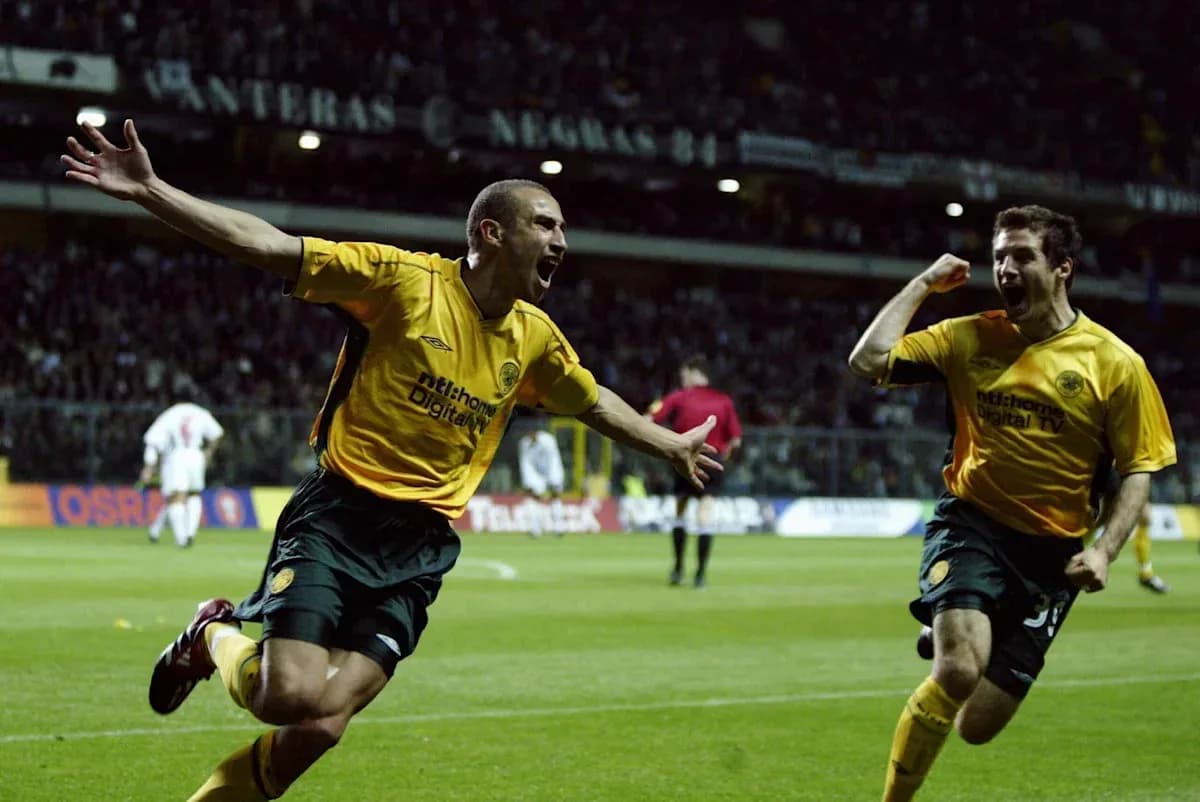
That goal remains one of the iconic images of the O’Neill era: Larsson wheeling away, team-mates surging towards him, a pocket of travelling Celtic fans losing themselves in disbelief and joy. The prize was a final against Boavista’s city neighbours, Porto. What happened in Seville still stings, and perhaps always will, but the semi-final in Porto stands as one of Celtic’s great European nights.
For Boavista, it was a peak they would never climb again.
The club that broke the big three
Boavista were never meant to be ordinary. Founded in 1903, they built a reputation as a snarling, streetwise club from Porto’s Bessa district, a side that refused to accept its place beneath Benfica, Porto and Sporting.
In 2001, they did the unthinkable. Boavista won the Primeira Liga, becoming the first – and still the only – team outside Portugal’s big three to be crowned champions. Nine major honours in total, but that title was the jewel. It proved that a well-run, fiercely competitive club could break the established order.
That made their slow collapse all the more brutal.
From transfer bans to freefall
The warning signs came long before the final blow. Financial problems stalked the club for years, dragging Boavista into disputes, sanctions and instability. The Portuguese authorities hit them with a ban on signing players across five transfer windows, a punishment that cut deep into their ability to compete and rebuild.
When the restrictions finally eased, Boavista lurched the other way. In February 2025, they signed nine players in a single day, a frantic attempt to patch holes and stay afloat. It felt desperate. It was.
The 2024/25 season ended in humiliation. On the final day, Boavista were hammered 4–1 away to Arouca, finishing bottom and dropping out of the top flight. Around 2,000 travelling fans had made the journey; some invaded the pitch at full-time, a raw, chaotic reaction to watching their club slide towards the abyss.
Relegation should have meant a reset in Liga Portugal 2. Instead, the league authorities barred Boavista from competing. Oliveirense, who had been relegated, were handed a reprieve. Boavista were left in limbo.
The slide continued. The club were refused registration in 2025 for both the third tier and the fourth-tier Campeonato de Portugal. That forced a change of company structure and a strange compromise: a new entity starting in the Liga Pro, the elite league run by the Porto Football Association, while the club itself entered a team in the fourth division of the district leagues.
On paper, it kept the badge alive. In reality, it was chaos. The club-run side began defaulting on fixtures, simply failing to turn up. By the end of October, that team withdrew from competition altogether. The supporters’ group that had tried to hold things together could only watch as the institution they loved crumbled under the weight of unpaid bills and mismanagement.
The final whistle
On 16 July 2026, the inevitable became official. A court order instructed Boavista to cease all activities by 31 July and to hand over their premises. Years of financial difficulty had finally caught up with them. Attempts to restructure debts had failed. Creditors wanted what they were owed, and the law sided with them.
Strip away the legal language and it comes down to something brutally simple: Boavista failed to pay their debts. A league champion, a European semi-finalist, a club that once stood toe-to-toe with the giants of Portugal and Europe, brought down not by a single result but by a long, grinding collapse off the pitch.
There will be talk of rebirth. Of a “new” Boavista, a phoenix club, a Boavista FC with fresh registration and a familiar black-and-white chequered shirt. Supporters rarely let history die quietly. The name, the badge, the memories of 2001 and 2003 – those things still carry power.
For Celtic fans, Boavista’s demise lands differently. This was a club woven into two distinct eras of European adventure: the Dalglish and Deans generation in the ’70s, and the Larsson-led charge to Seville. Opponents, yes, but also markers on the road of Celtic’s own story.
Now one of those markers has vanished from the professional map. The Bessa stands will fall silent, at least for a while. The club that once blocked Celtic’s path, and then fell to them on the way to a European final, has been reduced to a cautionary tale about what happens when football romance collides with financial reality.
The question is no longer what Boavista can win. It’s whether the name will ever truly return.
Related News

UFC 332 Preview: Natalia Silva vs. Wang Cong Fight Card, Odds, Start Time, and Details
Andy Roddick Responds to Andre Agassi’s Comments on Alexander Zverev at the Laver Cup

Knicks Prepare for Flexible Roles in Title Defense

Rui Hachimura Swaps Lakers Fans to Clippers in Surprising Jersey Exchange

Who Will Be the NBA's Next First-Time All-Stars? Top Picks and Long Shots for 2027
How Strong Is Your Team at Home? Check Out the 2026 Brasileirão Home Standings