
Enzo Maresca Takes Charge at Manchester City: Following Guardiola's Legacy
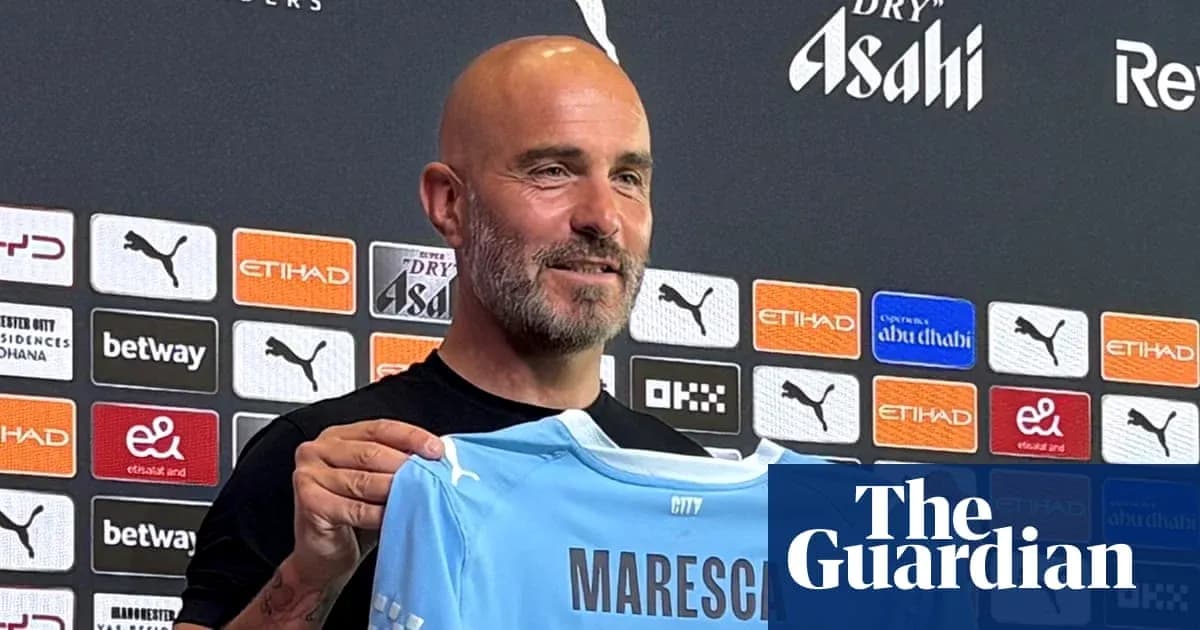
Enzo Maresca walked into his first day as Manchester City manager with his eyes wide open. He knows exactly what – and who – he is following.
Replacing Pep Guardiola, the architect of City’s modern era and winner of 17 major trophies in a decade, is not just a job. It is a judgement. On the club. On the squad. On him.
“It’s a privilege because the club decided to go for me,” the Italian said, sitting in the chair Guardiola made his own. He did not try to dilute the scale of the task. He leaned into it. “I consider Pep probably the best coach in the world in the last 20, 25 years.”
That is the weight on his shoulders. And he has studied what happens when giants leave.
Lessons from Ferguson and Wenger
Maresca did not need prompting to bring up Manchester United and Arsenal. The scars of their post-legend eras still run deep across English football.
David Moyes walked into Old Trafford in 2013 with Ferguson’s 26 and a half years looming over him. Unai Emery stepped into Arsenal in 2018 after 22 years of Arsène Wenger. Both inherited institutions shaped almost entirely in one man’s image. Both struggled to live inside that shadow.
“The history of the manager with many years in the same club always struggled a little bit,” Maresca said. “After Sir Alex, after Arsène.”
He knows that is the cautionary tale. Longevity at the top can leave a vacuum when it ends. The question is whether City are built differently.
For Maresca, the answer lies in the structure.
A club built on continuity
Where United lurched from one philosophy to another and Arsenal needed years to redefine themselves, City have preached stability. Maresca was quick to highlight it.
“The organisation is the main thing,” he said. “This club, this organisation, they had three managers in 17 years.”
Roberto Mancini, Manuel Pellegrini, Pep Guardiola. Three very different characters, one clear line of succession. Titles, style, identity – all layered, not ripped up.
“This is not normal. It doesn’t happen often,” Maresca added. He sounded almost reassured by the numbers, as if they were a shield against the turbulence that swallowed others.
“I’m confident that we can do a great job. We can continue to do the job that has been done since Roberto was here, then after Manuel and for 10 years Pep.”
That word – continue – is the key. Maresca is not here to detonate what Guardiola built. He is here to extend it, tweak it, protect it. The challenge, as he put it, is “to try to do the right things immediately for this organisation, for the fans, for everyone.”
There will be no grace period. Not at this club. Not after this decade.
Rodri blow and Real Madrid noise
Maresca’s first significant setback arrived before a ball has been kicked. Rodri, the metronome of City’s midfield and arguably their most irreplaceable outfield player, will undergo back surgery on Monday and is set to miss the start of the season.
For a new manager looking for early rhythm, losing the anchor of his side is a brutal opening note.
Around Rodri there is also the familiar swirl of speculation. Real Madrid are watching, as they always do when a world-class Spanish player reaches his peak. Maresca, though, refused to be dragged into anxiety.
“Around big players there is always speculation. I’m not worried about that,” he said. Spain’s recent triumph – Maresca referenced them winning the World Cup and Rodri being the best or one of the best players – has only sharpened the interest, but also underlined why City are desperate to keep him.
“I think every manager wants to have Rodri because he’s a top player,” Maresca added. For now, the focus is recovery. “He needs holiday, rest. Then he will be back here with us.”
City’s season will likely be defined in part by how quickly that “then” comes.
Futures in flux: Grealish and Trafford
Beyond Rodri, Maresca’s first press conference also offered a glimpse into a summer of decisions.
Jack Grealish is back at City after last season’s loan at Everton, his future once again a talking point rather than a certainty. Leeds are interested in James Trafford, the second-choice goalkeeper who previously worked under Maresca with City’s Under-23s in 2020-21.
Neither man was pushed out of the door. Neither was nailed to the floor.
“Jack, at the moment, he’s a Man City player,” Maresca said. That phrase – “at the moment” – carried the realism of a coach who understands how modern windows work. “In any club I join, I like to know if there are players that belong to the club, it’s my duty to try to coach them. Then we see what happens.”
On Trafford, the tone was similar, if a touch more personal. “I know James because he was my keeper when I was with the City Under-23s,” he said. There is trust there, familiarity, but no guarantees.
“When the transfer window is open now, January, anything can happen. So we see. But at the moment, he’s one of our keepers.”
That is the reality of taking over an elite squad: talent everywhere, certainty nowhere.
Maresca has chosen to embrace the scale of what he inherits – Guardiola’s legacy, the expectation of instant success, the scrutiny that swallowed those who followed Ferguson and Wenger. The privilege, as he called it, comes laced with risk.
City believe their structure will protect him from the chaos that engulfed others. The question now is simple: can the man who once studied Guardiola up close write a chapter of his own in a book the Catalan seemed to finish?
Related News
UFC 332 Preview: Natalia Silva vs. Wang Cong Fight Card, Odds, Start Time, and Details
Andy Roddick Responds to Andre Agassi’s Comments on Alexander Zverev at the Laver Cup
Knicks Prepare for Flexible Roles in Title Defense
Rui Hachimura Swaps Lakers Fans to Clippers in Surprising Jersey Exchange

Who Will Be the NBA's Next First-Time All-Stars? Top Picks and Long Shots for 2027
How Strong Is Your Team at Home? Check Out the 2026 Brasileirão Home Standings