
Fantasy Premier League Reclassification: Key Player Changes for 2026/27
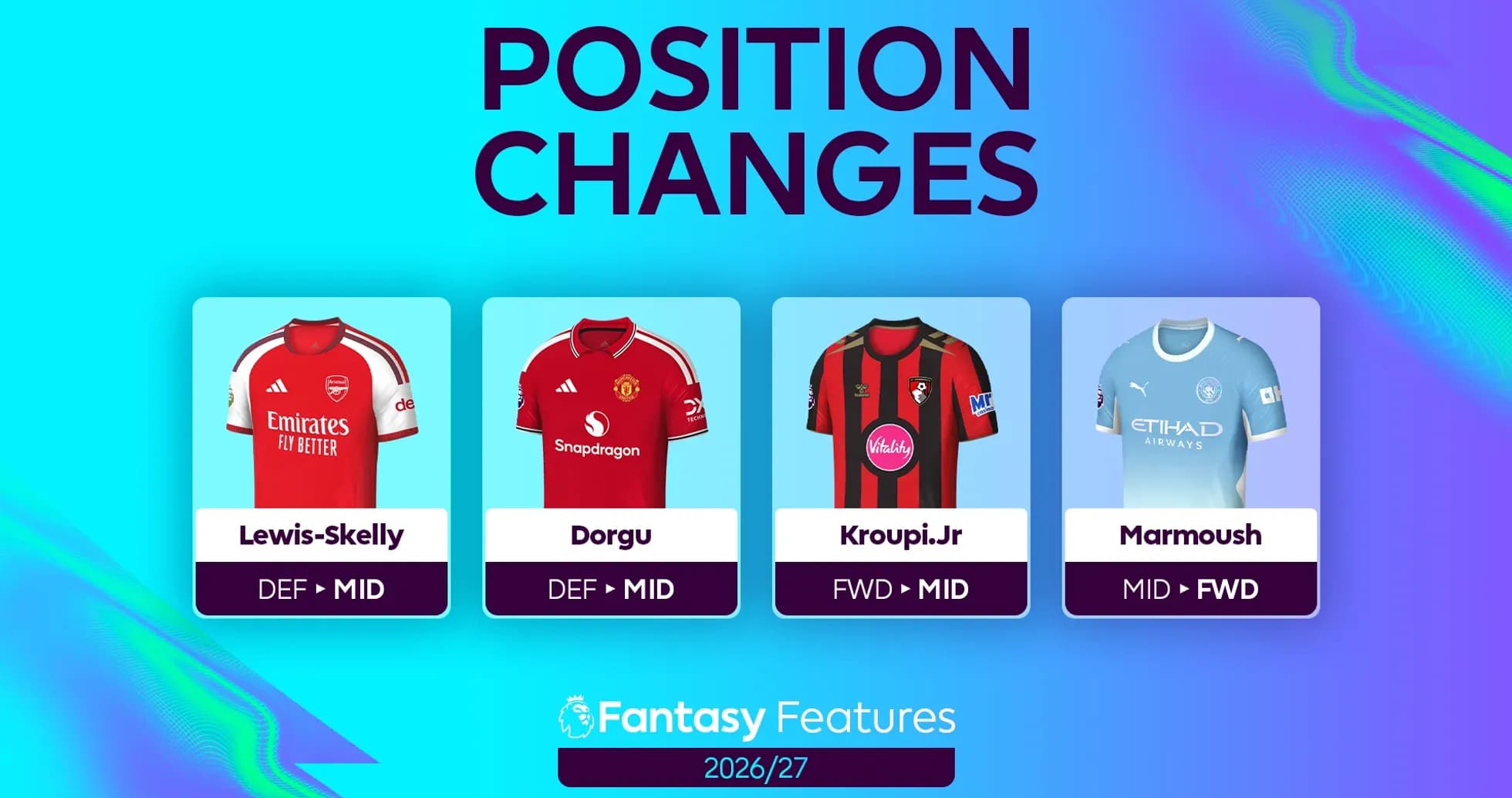
Fantasy Premier League’s reclassification day rarely passes quietly. This time, it drops a handful of names straight into the spotlight.
The Scout has confirmed 11 players whose positions have been reset for the 2026/27 season, a shake-up that could redraw plenty of draft boards before a ball is kicked.
At the heart of it all: Junior Kroupi, Patrick Dorgu and Omar Marmoush.
Kroupi’s promotion: from finisher to Fantasy gold
Bournemouth’s Junior Kroupi was already a breakout story. Now he might become a problem for anyone who doesn’t own him.
Listed as a forward last season, Kroupi has been reclassified as a midfielder after operating mainly as a No 10 behind Evanilson. The role suited him. He delivered 13 goals in 33 appearances in 2025/26, numbers that would look strong for a striker and are downright dangerous for a midfielder.
His underlying output underlines just how sharp he was. Kroupi scored every 134.0 minutes. Among regular midfield starters, only Antoine Semenyo came close, and even he lagged well behind at 188.2 minutes per goal.
Now the scoring system tilts further in Kroupi’s favour. As a midfielder, every goal is worth more points, and he also picks up an extra reward for clean sheets. Same player, same threat, better scoring framework. That combination almost guarantees he will loom large in pre-season planning.
If he keeps that central support role and maintains anything like last season’s efficiency, Kroupi moves from “nice differential” into “template risk” territory.
Dorgu unleashed: Carrick’s winger gets a new label
Patrick Dorgu’s shift is more subtle on paper, but it could prove just as important.
Previously listed as a defender, the Manchester United man is now classified as a midfielder, a direct response to how Michael Carrick used him in the second half of last season. The change reflects reality: Dorgu wasn’t tucking in at full-back; he was flying down the flank.
Game time was limited after Carrick arrived in Gameweek 22. The Dane started only three matches. Yet those three starts told a clear story. Each time he played as a left winger. Each time he scored.
He struck against Arsenal. He struck against Manchester City. Against Brighton & Hove Albion, he went one better: a goal and an assist in the same match.
When stacked against established midfielders under Carrick, Dorgu’s attacking profile holds up impressively. His 33.2 minutes per shot was the best of the trio when compared with Matheus Cunha and Bryan Mbeumo. He also matched Cunha’s tally of three big chances, despite playing over 800 minutes fewer than the Brazilian.
That’s not a gentle hint of potential; that’s explosive output in a tiny sample.
The reclassification removes the old defensive clean-sheet upside, but it also aligns his Fantasy label with his actual job on the pitch. If Carrick leans into that winger role across a full season, Dorgu has the numbers to become a genuine mid-price threat.
Marmoush steps into the No 9 spotlight
At Manchester City, the shift for Omar Marmoush is more straightforward: the Egyptian is now a forward.
Pep Guardiola’s final campaign in charge saw Marmoush pushed into a central attacking role. The data reflects that change, and so does FPL. No more hiding in midfield.
Marmoush produced three goals and three assists from that advanced position. Those are modest headline numbers by City’s usual standards, but context matters. He was trusted as a central option in one of the most demanding attacking systems in world football, and the game has responded accordingly.
As a forward, Marmoush loses the extra point for each goal and the clean-sheet bonus he once enjoyed in midfield. What he gains is clarity: his Fantasy value now rests purely on whether he can turn that central role into consistent returns.
If City’s post-Guardiola era keeps him at the tip of the attack, his new tag will force managers to judge him against the league’s strikers, not its creators. That’s a tougher market, but also a clearer one.
The wider reshuffle
Around those headline names, the reclassification list is busy.
- Myles Lewis-Skelly (Arsenal) and Lamare Bogarde (Aston Villa) both move from defence into midfield, reflecting their more progressive roles.
- Keane Lewis-Potter (Brentford) makes the same jump, while Mats Wieffer (Brighton & Hove Albion) travels the other way, shifting from midfield into defence.
- Georginio Rutter, also at Brighton & Hove Albion, now carries a forward tag after previously being listed as a midfielder.
- Rio Cardines (Crystal Palace) and Ryan Sessegnon (Fulham) drop back into defence from midfield, while Eric Moreira (Nottingham Forest) does the reverse, stepping up from defence into midfield.
Each change tweaks the puzzle slightly. Some players lose appeal as their classification strips away old bonuses. Others, like Kroupi and Dorgu, suddenly sit in scoring zones that better reward what they already do.
The rules haven’t changed. The board has. The managers who read these shifts quickest will be the ones setting the pace when 2026/27 kicks off.
Related News

UFC 332 Preview: Natalia Silva vs. Wang Cong Fight Card, Odds, Start Time, and Details

Andy Roddick Responds to Andre Agassi’s Comments on Alexander Zverev at the Laver Cup

Knicks Prepare for Flexible Roles in Title Defense

Rui Hachimura Swaps Lakers Fans to Clippers in Surprising Jersey Exchange

Who Will Be the NBA's Next First-Time All-Stars? Top Picks and Long Shots for 2027

How Strong Is Your Team at Home? Check Out the 2026 Brasileirão Home Standings