
Graham Potter's Journey: From Chelsea Struggles to Swedish Redemption
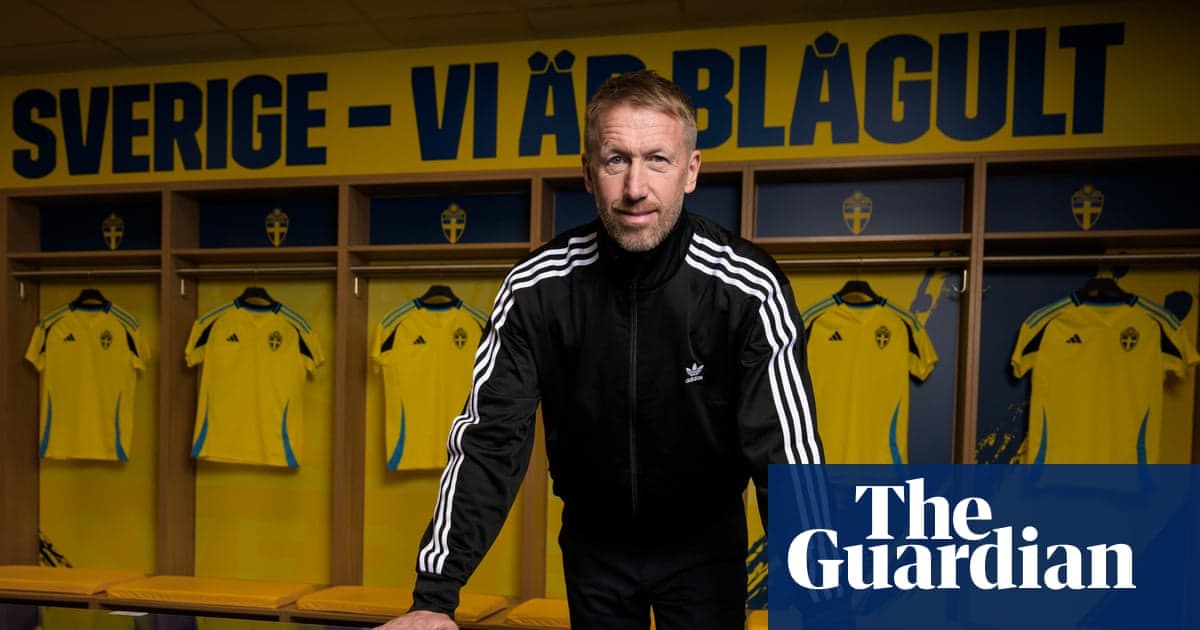
Graham Potter leans back, thinks about Chelsea, thinks about West Ham, and doesn’t flinch.
“You’ve got to face the bad stuff,” he says. At 51, with scars from two of England’s most unforgiving dugouts, he has stopped trying to outrun failure. “The more you face it, the more chance your life is better. Then you get these beautiful moments.”
For Potter, the beautiful moment arrived in yellow and blue.
From London bruises to Swedish rebirth
The past few years have thrown him around. Chelsea first: seven months of chaos after leaving the calm, carefully built world of Brighton in September 2022. He walked into Stamford Bridge, into a club in flux, and never really found the ground beneath his feet.
Then came West Ham. A long break from the game ended when the call came at the start of last year. It felt like the right time to return. It wasn’t the right club.
West Ham were drifting and he drifted with them. Six wins in 25 games, a grim start to his first full season, and the sack last September. His reputation, once rising with Brighton’s clever football, looked as if it might quietly fade.
“What next?” was no longer a theoretical question. It was his life.
“I have had enough life experience to be able to put all these things into perspective,” he says. “I’m grateful for all the experiences I have had, pluses and minuses. In the end, you have to deal with what life throws at you.
“After West Ham, I could have done two things. I could have sat around and done media. Or you can go and work.”
The choice, for him, was simple. Work.
Answering Sweden’s call
Sweden’s call came at a desperate moment. They were in trouble in their World Cup qualifying group, searching for a replacement for Jon Dahl Tomasson and staring at the prospect of missing out entirely.
Before he could help them, Potter had to sort himself out. He spoke to people close to him, picked through the wreckage of West Ham, and tried to leave the anger and regret where they belonged.
“You have to deal with the failure,” he says. “But I think you become a better person for it. And then sometimes in football you just can’t rationalise it. You just go: ‘Maybe it wasn’t meant to be.’ Then you try to move on with your life.
“The learnings you take from these experiences, they’re painful. I won’t share my learnings with you because it’s hurt me to get them. I think it should because that’s how you improve.”
He shut out the noise. “If I worry about what people think about me that’s a miserable life,” he says. He knew, though, what was at stake when he accepted a short‑term deal with Sweden in October. The group was already gone. Their Nations League record had thrown them a lifeline in the form of a playoff spot. Blow that, and another dent would smash into his CV.
The pressure suited him.
Playoff chaos, Gyökeres glory
When Sweden reported in March, something clicked. The team were calm, clear, ruthless when it mattered. Viktor Gyökeres, carrying the form that had made him a central figure at Arsenal, took over the playoffs.
He scored a hat‑trick in a 3-1 semi-final win over Ukraine. Then, in Stockholm, with Poland dragging the final into the kind of anxious, seesaw contest that breaks managers, Gyökeres struck again in the 88th minute to seal a 3-2 victory and a place at the World Cup.
Potter watched the game back later, not the tactical angles, but the sound.
“You go on to YouTube and go into the Swedish commentary of the game; I looked at it a couple of months afterwards and it’s the emotion in the voice,” he says. “Viktor scores and it’s like an out-of-body experience. All our subs are just running on the pitch. There’s 15 players on the pitch and I’m thinking: ‘That’s yellow cards, that’s problems.’ But it’s a World Cup, so all the rules are out the door.”
Sweden had their ticket. Potter had his redemption arc.
His reward was a new contract to 2030 and something deeper: a sense of belonging. This was not a foreigner parachuting into a new culture. This was a return.
A coach who feels “very Swedish”
Potter built his coaching reputation in Sweden, transforming Östersund from fourth-tier obscurity into a Europa League side across seven years. The country shaped him, and he has never really left it behind.
“I feel very Swedish when I’m working,” he says. “I look a bit Swedish. Two of my kids were born in Sweden.”
International football, for him, carries a different weight. “You’re aware with the national team that you’re doing something for more than you. It’s a bigger thing. You can feel the intensity. That’s what’s beautiful about it.”
The challenge is different too. At Brighton he had time, repetition, a daily training ground to embed ideas. With Sweden, he gets windows.
“You haven’t got the time to develop ideas,” he says. “The mistake you could make is that you could form all these ideas from the camp in November ahead of the camp in March, forming tactical plans to beat Ukraine, and the reality is that you have two days to prepare for a game. You don’t want to make it too complex.”
The playoffs were followed by a harsher job: telling players they would not be going to the World Cup. That, he knows, can fracture a squad if handled badly.
“Even if you play 11 v 11 in a training game, four players are standing on the outside,” he says. “That’s not easy. You want the group to be on the same path.”
Harmony, he understands, is as important as any tactical tweak.
USA 94 shadows and the heat of Monterrey
Sweden are in camp in Stockholm before heading to their base in Texas. The ghosts of USA 94 hover over everything. That team, led by Thomas Brolin, Martin Dahlin and Kennet Andersson, finished third. The standard is set.
Potter knows it. He also knows the reality of Group F. Japan, the Netherlands and Tunisia form a tight, awkward mix. There is no free hit, no obvious whipping boy. Reaching the last 32 will demand clarity, discipline and a little nerve.
Their opener against Tunisia in Monterrey on 14 June will be brutal in a different way. The heat will slow the game, drag energy from legs, turn every sprint into a calculation.
Potter is already planning for that. Slower tempo. More structure. Set pieces elevated from useful weapon to central strategy.
“You can see the way the game has gone,” he says of dead balls. “Tournament football, you know the knife is at your throat so it’s less easy to be expansive. Games become tight. It’s a way to create chances so I think teams will focus on it a lot.”
Sweden will be one of them.
Life without Kulusevski, faith in Gyökeres and Isak
They will go to the World Cup without Dejan Kulusevski, whose injury strips them of a creative, line‑breaking presence. Yet there is menace in the front line.
Gyökeres arrives under scrutiny from some at Arsenal after his first season, but Potter’s view is clear.
“It’s a great example of the modern world,” he says. “From our perspective, he got us to the World Cup, so his impact is incredible. From Arsenal’s perspective he’s played his role in the team, scored his goals, the team have won the Premier League and got to the Champions League final. You look at how much work he does. He’s had a brilliant season.”
Alongside him, if fitness allows, will be Alexander Isak. His move from Newcastle to Liverpool last summer has not yet caught fire. A broken leg, a disrupted pre-season, form that never quite settled.
“It hasn’t gone as well as he would have liked,” Potter says. “We sometimes make the assumption that when you sign a player it’s going to improve everything. I’ve lived that – it’s not always the case. Alex playing for Newcastle does this but how does he adapt to what Liverpool want him to do? The player doesn’t change. His quality doesn’t change. He’s still a top player. It’s just how they interact as a team together. It can take a bit of time. He’s a great lad.”
Potter’s history with Isak goes back to a different era. He remembers the day a 16‑year‑old striker walked out for AIK against his Östersund side.
“We were quite happy before the game because the centre‑forward wasn’t playing and some 16‑year‑old kid was playing,” he says. “Then he scored, we got beat 2-0 and I learned my lesson.”
Isak offered another reminder on Monday, with a stunning goal in Sweden’s 3-1 defeat by Norway. The result stung. The finish encouraged.
Potter wants him and Gyökeres together.
“They’re different in their styles, which is good for us. We haven’t played with them together yet so that’s exciting to develop.”
Tournaments, soul and a manager reborn
The anticipation is building. Messages have gone back and forth with Zlatan Ibrahimovic, the great totem of Swedish football, as the country leans into another World Cup adventure.
Potter has thought a lot about the shift from club to country. He has spoken to coaches who have done both. The verdict is consistent.
“People have said the tournaments are the best feeling in football,” he says. “In the national team you feel like you’re doing something with more soul.”
That word matters to him. Soul. After Chelsea. After West Ham. After the sack and the questions about whether he was a one‑club wonder.
West Ham could not save themselves from relegation after dismissing him. Potter, meanwhile, is flying to the World Cup as the manager of a nation he once adopted and which now, in many ways, has adopted him back.
“My first football memories are ’86, 11 years old, watching Diego Maradona rip football up,” he says. “As a kid, that’s where I started. To get the chance to work in that environment, it’s just a dream.”
The boy who watched Maradona now walks into his own World Cup. The failures are behind him, but not forgotten. They travel with him, sharpened into something useful, as Sweden and their very Swedish Englishman step into the heat of another summer.
Related News
UFC 332 Preview: Natalia Silva vs. Wang Cong Fight Card, Odds, Start Time, and Details
Andy Roddick Responds to Andre Agassi’s Comments on Alexander Zverev at the Laver Cup

Knicks Prepare for Flexible Roles in Title Defense

Rui Hachimura Swaps Lakers Fans to Clippers in Surprising Jersey Exchange

Who Will Be the NBA's Next First-Time All-Stars? Top Picks and Long Shots for 2027
How Strong Is Your Team at Home? Check Out the 2026 Brasileirão Home Standings