
Henrik Larsson: Celtic's King of Kings
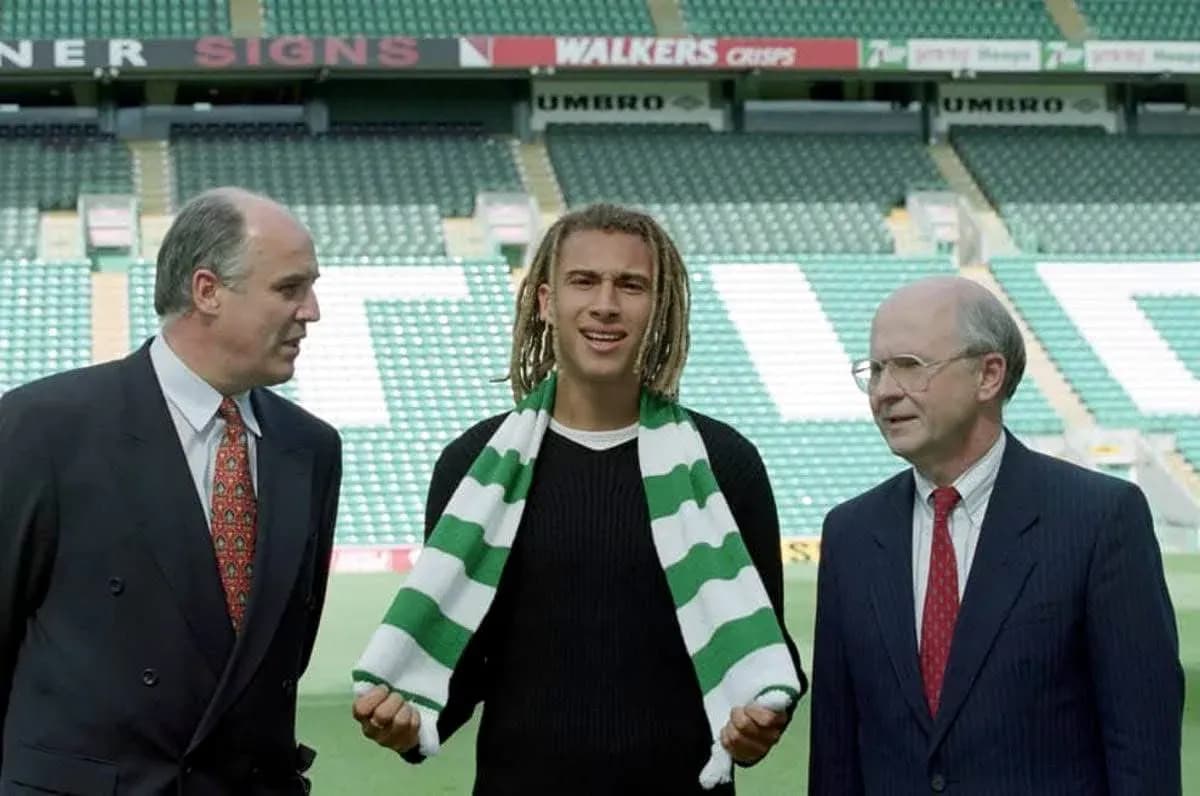
On a warm July day in 1997, a slight, dreadlocked forward in a Hoops shirt and denim jeans stepped out onto the Celtic Park turf. No grand speeches. No fireworks. Just a young Swede, Henrik Larsson, quietly introduced as Celtic’s latest signing.
The fee was modest: £650,000 from Feyenoord. The belief behind it was anything but. Wim Jansen, newly installed in the dugout and armed with inside knowledge from his time in Dutch football, knew exactly what he was taking from Rotterdam. Celtic weren’t just buying a forward. They were buying an era.
From shaky start to instant necessity
It did not all click at once. Larsson’s first competitive outing is etched into memory for the wrong reasons, his error contributing to an opening-day defeat at Hibernian. For some players, that kind of beginning lingers like a stain. For Larsson, it became a footnote.
Game by game, he began to stitch himself into Celtic’s fabric. A clever touch here, a ruthless finish there, a tireless shift for the team. The dreadlocks bounced, the goals followed, and the Celtic support fell hard for their new No.7.
By the end of that debut season, his importance was beyond debate. A League Cup triumph and, more significantly, a first league title in a decade – stopping Rangers’ bid for ten in a row – marked a seismic shift in Scottish football. Larsson was at the heart of it, not just a scorer but the symbol of a team rediscovering its nerve.
Under Dr Jozef Venglos, he went up another level. Thirty-eight goals in his second campaign. The raw forward had become a complete striker: movement, intelligence, finishing with both feet and his head. Celtic had known they were getting a good player. They now had a phenomenon.
The break that didn’t break him
Then came Lyon. A tangle of legs, a sickening snap, and Larsson’s leg shattered. The pictures still jar. For many, such an injury is a line in the career, a before and after that never quite joins back up.
Larsson refused that script. He attacked his rehabilitation with the same relentlessness he showed in the penalty box. When he returned, he was sharper, more ruthless, more driven. The injury, awful as it was, changed more than his own story. Celtic’s form dipped badly in his absence, and the pressure around John Barnes intensified. The Englishman’s reign ended quickly, his time in Glasgow always framed by the void Larsson’s broken leg created.
O’Neill, Sutton and a treble for the ages
If Jansen had brought Larsson to Celtic and Venglos had refined him, Martin O’Neill unleashed him. With Chris Sutton alongside, Celtic had a front line that bullied, out-thought and out-scored almost everyone in front of them.
In O’Neill’s first season, Larsson hit a staggering 53 goals. Fifty-three. The numbers felt like something from another era, but this was modern Celtic, ripping through Scotland and beyond. The domestic treble returned to the east end of Glasgow for the first time in 32 years, and Larsson was its ruthless, relentless spear.
The partnership with Sutton was perfectly balanced: Sutton’s physical presence and link play dovetailing with Larsson’s razor-sharp runs and unerring finishes. Defenders knew what was coming. They still couldn’t stop it.
Europe takes notice
Larsson’s dominance was never confined to the domestic stage. As Celtic pushed deeper into European competition, his goals dragged them with him. The run to the UEFA Cup Final confirmed what those in Scotland had long known: this was a forward of the very highest class.
In Seville, against Porto, Larsson rose to the occasion with two towering, world-class headers in extra time, each one a reminder of his timing, his courage, his refusal to disappear on the biggest nights. Celtic fell short in the final, but their No.7 walked off the pitch with his reputation burnished yet again. Europe had seen the King of Kings at full tilt.
The numbers and the legacy
By the time he left Celtic in 2004, the numbers were almost surreal. Two hundred and forty-two goals in 313 appearances. Third on the club’s all-time scoring list. A strike rate that belongs in the company of the greatest to wear the shirt.
But the statistics only tell part of the story. Larsson was not just prolific; he was decisive. Titles, cups, European nights – when Celtic needed someone to carry the weight, he rarely flinched. He played with a ruthless edge and a humility that endeared him to a support that demands both sweat and skill.
Older generations will always, rightly, invoke Jimmy Johnstone and the Lisbon Lions when they talk about the greatest to grace Celtic Park. Those who lived through the 1970s can put forward Kenny Dalglish, another King who went on to be crowned Liverpool’s greatest ever player.
Yet for a vast swathe of Celtic supporters alive today, the answer to the “best I’ve ever seen” question comes without hesitation. It’s Henrik Larsson. The man who arrived in denim and a Hoops top, who cost a fraction of his true worth, and who left as Celtic’s King of Kings.
Twenty-nine years on from that quiet unveiling, the image of him celebrating in green and white – arms outstretched, dreadlocks flying, net bulging – still defines an era. And it still sets the standard for what a Celtic legend looks like.
Related News
UFC 332 Preview: Natalia Silva vs. Wang Cong Fight Card, Odds, Start Time, and Details
Andy Roddick Responds to Andre Agassi’s Comments on Alexander Zverev at the Laver Cup
Knicks Prepare for Flexible Roles in Title Defense
Rui Hachimura Swaps Lakers Fans to Clippers in Surprising Jersey Exchange
Who Will Be the NBA's Next First-Time All-Stars? Top Picks and Long Shots for 2027
How Strong Is Your Team at Home? Check Out the 2026 Brasileirão Home Standings