
Levante vs Barcelona: Tactical Analysis of La Liga Clash
The afternoon at Estadio Ciudad de Valencia ended with the scoreboard frozen at 2–4, but the story of Levante versus Barcelona was richer than the bare numbers. In a La Liga Regular Season - 5 clash, the league leaders arrived with a perfect record and a terrifying attacking profile; Levante, 13th in the table, brought volatility, courage, and a tactical plan that only held for so long.
Heading into this game, the contrast between the two sides was stark. Levante’s season had been defined by extremes: overall they had scored 7 and conceded 9, a goal difference of -2 across 5 matches, with their home matches turning into wild shootouts. At home they averaged 3.5 goals scored and 3.0 conceded, a chaotic 4-1-4-1 and 4-2-3-1 base morphing here into a 4-4-2 that promised vertical transitions more than control. Barcelona, by contrast, arrived as a machine: 5 wins from 5, 21 goals scored and 4 conceded overall, a goal difference of +17. On their travels alone they had put up 14 goals and conceded just 2, averaging 4.7 scored and 0.7 conceded away from home. This was the league’s most ruthless attack against one of its most open defenses.
I. The Big Picture – Structure and Intent
Levante’s 4-4-2 under Luis Castro was clear in its priorities. M. Ryan in goal sat behind a back four of J. Toljan, Dela, A. Mandi and M. Sanchez. The wide pairing of V. Garcia and R. Brugue, with H. Sotelo and J. A. Olasagasti inside, gave Levante a midfield that could run but not necessarily dictate. Up front, D. Requena and P. Ratkov formed a physical, direct front two designed to pin Barcelona’s centre-backs and attack early balls into the channels.
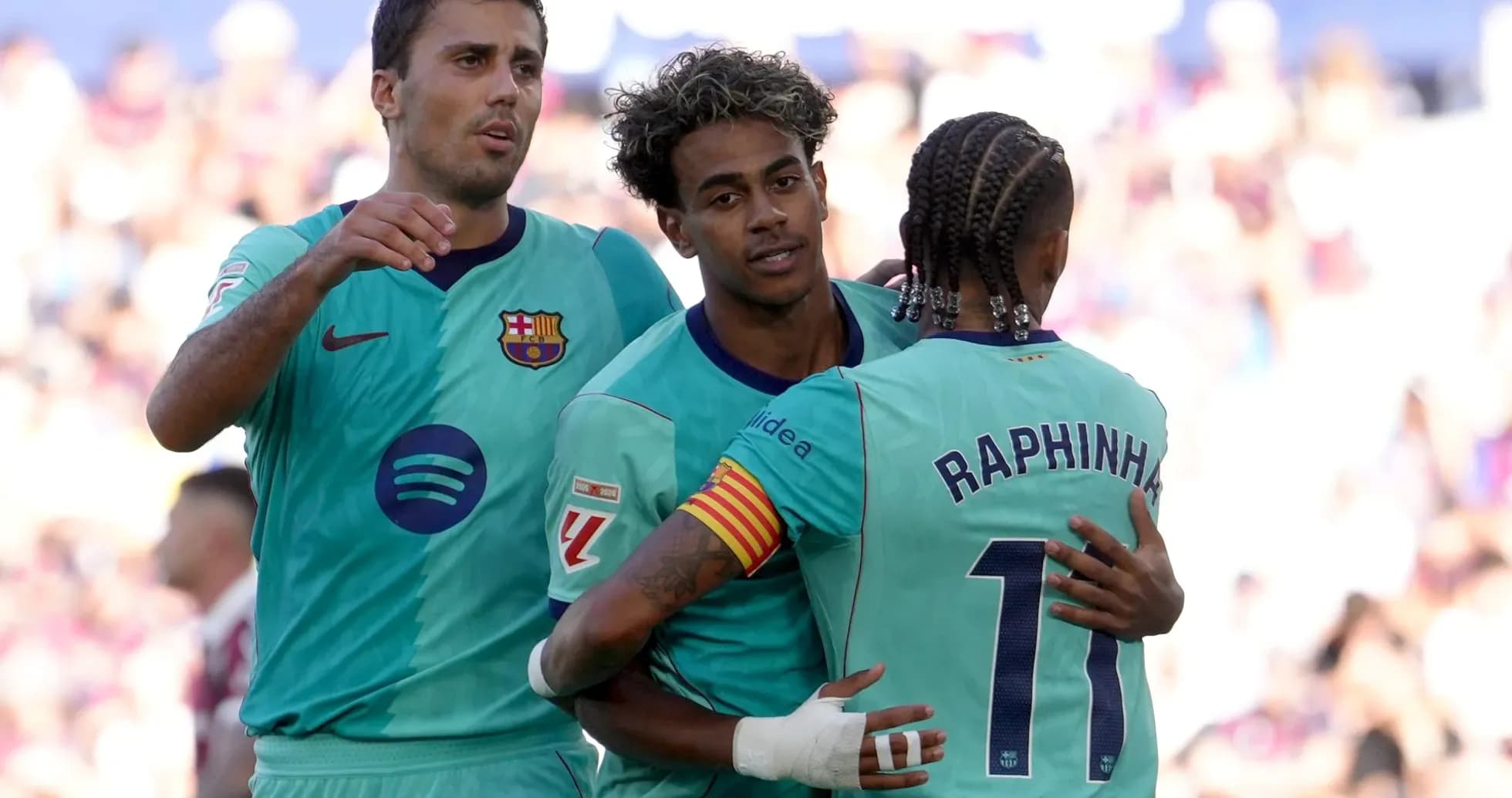
Barcelona’s 4-3-3 under Hansi Flick was far more stable structurally. J. Garcia started in goal behind a back line of E. Garcia, P. Cubarsi, G. Martin and X. Espart. In midfield, the trio of Fermin, Rodri and Pedri offered a blend of verticality, press resistance and tempo control. The front three of Lamine Yamal, Raphinha and A. Gordon was as close to a perfect balance as Flick could hope for: two prolific scorers flanking the league’s top assist provider.
The scoreline mirrored the season’s logic. Barcelona led 2–0 at half-time and finished 4–2, their away attacking power bending the game to their rhythm even when Levante found moments of resistance.
II. Tactical Voids – Absences and Discipline
Both sides entered without key technical pieces. Levante were missing K. Etta Eyong and A. Primo, both ruled out by injury. Their absence thinned Castro’s options in midfield and attack, forcing him to lean heavily on the work rate of Sotelo and Olasagasti and the creativity of Brugue.
Barcelona’s absences were higher profile but better absorbed. F. de Jong and R. Bardghji, both out with knee injuries, removed a deep-lying controller and an additional attacking wildcard from Flick’s arsenal. Yet the depth on the bench—names like Gavi, Dani Olmo, Marc Bernal, Gabriel Jesus and K. Adeyemi—meant the structure and intensity of Barcelona’s plan remained intact.
Disciplinarily, the season’s patterns framed the risk. Levante’s yellow cards were spread evenly, with 20.00% of their cautions in each of the 31–45, 46–60, 61–75, 76–90 and 91–105 minute ranges. It painted a picture of a side that fouls to survive pressure across the full contest, rather than in one specific phase. Barcelona’s yellows were concentrated: 60.00% between 46–60 minutes and 20.00% between 16–30, suggesting a team that ramps up aggression right after half-time as they press to kill games.
III. Key Matchups – Hunter vs Shield, Engine Room
The “Hunter vs Shield” duel was brutally one-sided on paper. Barcelona’s forwards arrived in Valencia in irresistible form. Raphinha had 6 goals and 3 assists in 5 league appearances, with 11 shots and 9 on target, and had already won and converted a penalty this season. Opposite him, Lamine Yamal had matched that 6-goal tally, adding 20 shots and 11 on target, plus 19 key passes. Together they were the sharpest attacking pair in Spain.
Levante’s “shield” was less imposing. Overall they conceded 1.8 goals per game, but at home that figure rose to 3.0. The back four of Toljan, Dela, Mandi and Sanchez had not produced a single clean sheet at home, and the team had yet to prevent a visiting side from scoring in Valencia. Against a Barcelona attack averaging 4.2 goals per game overall, the margin for error was effectively zero.
On the flanks, R. Brugue was Levante’s primary offensive outlet. With 3 goals in 4 appearances, 11 shots and 5 on target, and 40 duels contested, he offered both direct threat and work rate. His battle with X. Espart was one of the game’s true tactical knots. Espart, an 18-year-old defender, had quietly become one of Barcelona’s most reliable performers: 1 goal, 2 assists, 20 tackles, 7 interceptions and 34 duels won from 53. He combined defensive solidity with progressive passing, a full-back capable of both locking down his side and initiating attacks.
In the engine room, Fermin’s duel with Levante’s central pair defined the game’s tempo. Fermin came in with 4 goals, 2 assists and a rating profile that reflected his all-action style: 10 shots (8 on target), 184 passes at 84% accuracy, plus 6 tackles and 1 blocked shot. Against Sotelo and Olasagasti, whose mandate was more about disruption and covering transitions than creative play, Barcelona’s midfielder had the tools to dominate second balls and late runs into the box.
Behind them, Pedri and Rodri provided the glue. Pedri’s ability to receive under pressure and link with Lamine Yamal and A. Gordon gave Barcelona stable access to the half-spaces, while Rodri’s role as a shuttle ensured that Levante’s attempts to overload central zones rarely yielded sustained possession.
Up front, A. Gordon’s presence as the league’s top assist provider (4 assists, 7 key passes, 90% passing accuracy) added a different dimension. While he had yet to score, his movement between the lines and his combination play with Raphinha and Lamine Yamal made Barcelona’s front three fluid rather than fixed. For Levante’s centre-backs, that meant constant decisions: step into midfield and risk space in behind, or hold the line and allow Gordon to turn and feed runners.
IV. Statistical Prognosis – Why 2–4 Felt Inevitable
From a statistical standpoint, Barcelona’s victory aligned almost perfectly with their season profile. On their travels they had scored 14 and conceded 2 across 3 games; adding 4 more goals in Valencia while conceding twice kept them in the same aggressive, high-yield bracket. Their overall defensive record—4 conceded in 5 matches—suggested that even when they dominate, they allow moments, and Levante’s home attacking average of 3.5 goals hinted that they would find a way onto the scoresheet.
Levante’s season arc made a multi-goal defeat plausible. At home they had a 1–1 record with a 7–6 goal tally, their biggest home win a 5–2 and their heaviest home loss now 2–4. The pattern is consistent: when they open up, the game becomes a track meet. Against mid-table opposition, that volatility can be an advantage; against a side with Barcelona’s efficiency, it is a structural flaw.
Barcelona’s penalty record—2 taken, 2 scored, 100.00% conversion with no misses—added another edge to their threat profile: any clumsy challenge in the box was likely to be punished. Levante, by contrast, had not yet earned or taken a penalty this season.
In the end, the 4–2 away win was less an upset of balance and more the natural expression of both teams’ identities. Levante, brave and open, traded punches with a heavyweight. Barcelona, relentless and precise, simply hit harder, more often, and from more angles. The league leaders left Valencia still perfect, their attacking numbers swollen further, while Levante were reminded that in La Liga’s upper reaches, courage without control can be brutally expensive.
Related News

Real Sociedad vs Atletico Madrid: A Clash of Identities

Real Madrid Dominates Rayo Vallecano 4-1 in La Liga Clash

Atletico Madrid vs Real Madrid Stats: Head-to-Head Record Before Match

Levante vs Barcelona: Tactical Analysis of La Liga Clash

Sevilla vs Barcelona Stats: Head-to-head Record and Past Meetings
Barcelona vs Racing Santander Predicted Lineups: Team News and Insights