
Lise Klaveness: The Reluctant Rebel Challenging FIFA
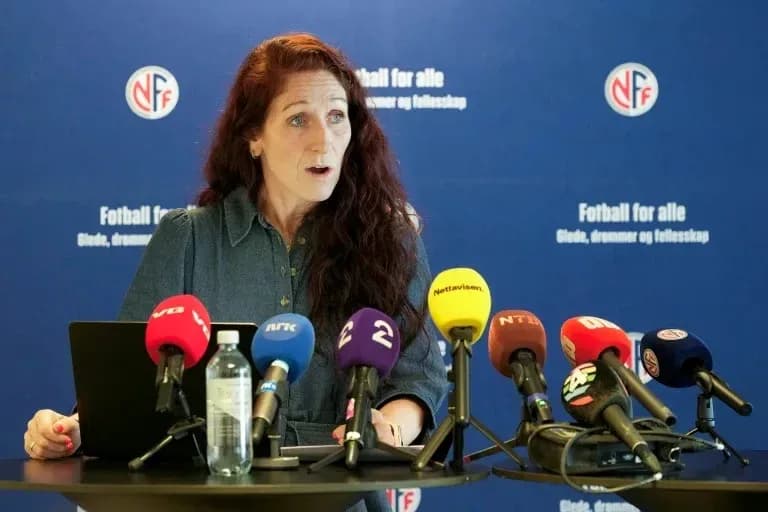
Lise Klaveness has spent years making the most powerful men in football uncomfortable. Now some of them are whispering her name as the next president of FIFA.
The 45-year-old head of the Norwegian Football Federation, a former international with 73 caps and a lawyer by trade, has become the sharpest public critic of Gianni Infantino’s regime. Where others mutter in corridors, she steps to the microphone.
On Friday, she went further than ever. She said Infantino should resign.
When he swept into office in 2016, she reminded AFP, he did so “on a reform programme focused on good governance.” That promise, in her eyes, has collapsed.
“Then things quickly deteriorated,” she said. Distance from political power eroded. Independence weakened. The relationship with heads of state and power brokers — especially in World Cup host countries — grew uncomfortably close. What was sold as a clean break from the past began to look, to critics, like a familiar story.
The latest flashpoint was Infantino’s plan to open FIFA competitions, including the World Cup, to private investors. The idea was shot down last week, a rare and public rebuke. For Klaveness, it was one controversy too many in a growing pile.
She has not been quietly fuming. She has been firing.
A Voice That Refused to Sit Down
Klaveness’s first major clash with FIFA came in 2022, almost as soon as she took charge of the Norwegian federation. In Doha, with the World Cup about to begin, she stood up and said what many only whispered.
“Human rights, equality, democracy, the core interests of football, were not in the starting 11,” she declared, challenging the way Qatar had been awarded the tournament.
It was a direct shot at the heart of FIFA’s decision-making. From that moment, she became a reference point for dissent.
Norway then refused to back Infantino’s re-election in 2023, a symbolic but pointed move. By then, Klaveness had become, as TV2 sports commentator Mina Finstad Berg put it, “the first standard-bearer” for the kind of criticism that has since spread across the game.
“She is very committed to ensuring that rules and decisions are respected,” Berg said. The implication was clear: in her view, FIFA was drifting away from its own rulebook.
Trump, Balogun, Investors: The Breaking Point
The friction has intensified in recent months.
- First, FIFA’s decision to award a “Peace Prize” to US President Donald Trump, a leader with whom Infantino has maintained a conspicuously close relationship.
- Then came the lifting of US forward Folarin Balogun’s suspension for the 2026 World Cup after an intervention by Trump.
- Finally, the now-abandoned plan to open FIFA to private investors.
Norway is not just complaining from the sidelines. The federation has decided to bring all three matters before FIFA’s Ethics Committee.
The timing gives Klaveness extra weight. Norway, long absent from the latter stages of major tournaments, produced a strong run at this year’s World Cup before going out in the quarter-finals to England. On the pitch, the country is relevant again. Off it, its president already is.
International observers have begun to talk about her as more than a protest voice. They see a “strong moral compass” and a potential successor if Infantino were to step aside. For now, he has no intention of doing that. He is standing for a fourth and final term next March and remains the only declared candidate.
Still, the idea of Klaveness at the top of FIFA has moved from fantasy to conversation.
Sepp Blatter, the former FIFA president who left office in disgrace after a corruption scandal, has even joined the chorus from the sidelines. On X, he wrote that she was “the only one who always took a clear stand and did not go along with the mainstream. And at FIFA, the time is right for a woman to take the lead.”
The irony of that endorsement is hard to miss. The significance is not.
Not a Game of Thrones, She Insists
Klaveness herself is trying to keep the spotlight away from personal ambition.
She has pushed back against the idea that this is just a power play at the top of the game. The crisis in world football, she argues, should not be reduced to a “Game of Thrones” storyline.
“For us, it has never been a personal issue against Gianni Infantino,” she told AFP. “The problems go beyond the person of the president.”
Her name may be circulating, and she acknowledges she has “registered” that talk. But when asked directly whether she is a candidate, she brushes it away. “We’re not there yet,” is as far as she will go.
The obstacles are obvious, and she knows them.
“In addition to being seen as extremely radical in many places, especially outside Europe, she is a woman. That is also likely to count against her in many regions of the world,” Berg noted.
The politics of FIFA elections are brutal. Regional alliances matter. Tradition matters. Gender, in many places, still very much matters.
Can She Win the Room, Let Alone the World?
Even in Europe, where one might expect her to find her strongest backing, the path has been bumpy.
Klaveness failed to win election to UEFA’s Executive Committee in 2023. She only made it onto the body in 2025, and then only as the sole candidate for the seat reserved for women. That detail lingers in the minds of sceptics.
If she already has such a hard time getting elected in Europe, how could she convince Africans and South Americans? asked former Norway goalkeeper and now commentator Erik Thorstvedt.
It is a blunt question, and a fair one. The FIFA presidency is not won with applause in Western capitals or praise on social media. It is won in congress halls, with votes from federations across every confederation, many of whom see the world — and football’s power structure — very differently.
Yet the fact remains: in an era when most federation leaders speak in guarded platitudes, Lise Klaveness has chosen confrontation over comfort. She has challenged the sitting president, questioned the system, and forced debates that many in Zurich would rather avoid.
Whether that makes her unelectable or inevitable is the question that now hangs over FIFA’s next chapter.
Related News
Carlos Alcaraz Urges an End to Matches Ending in the Early Hours
Carlos Alcaraz Criticizes Late US Open Finish After 3:30 a.m. Match
Jannik Sinner Set for ATP 500 Return in Beijing with Novak Djokovic Also Competing
Meet Iva Jovic: The American Tennis Prospect Making Waves
Flavio Cobolli Shares Insights on Practice Session with Jannik Sinner Ahead of Comeback
Till vs Romero: Fight Details, Undercard, and Viewing Info for This Weekend