
Manchester City at a Crossroads: Rodri's Future and Enzo Maresca's Vision
Manchester City stand at a crossroads. Not a minor adjustment, not a gentle refresh. A full reset.
A decade of Pep Guardiola has given way to Enzo Maresca, and with it the quiet dismantling of a Treble-winning core. Four pillars from that 2022-23 side – Manuel Akanji, Nathan Ake, Bernardo Silva and John Stones – have gone in a single summer. In their place, City have pushed £116m on Elliot Anderson and pinned part of their future on 17-year-old Jeremy Monga.
This is not evolution. It is surgery.
And the most delicate operation is still to come.
Rodri: The Piece Everyone Wants
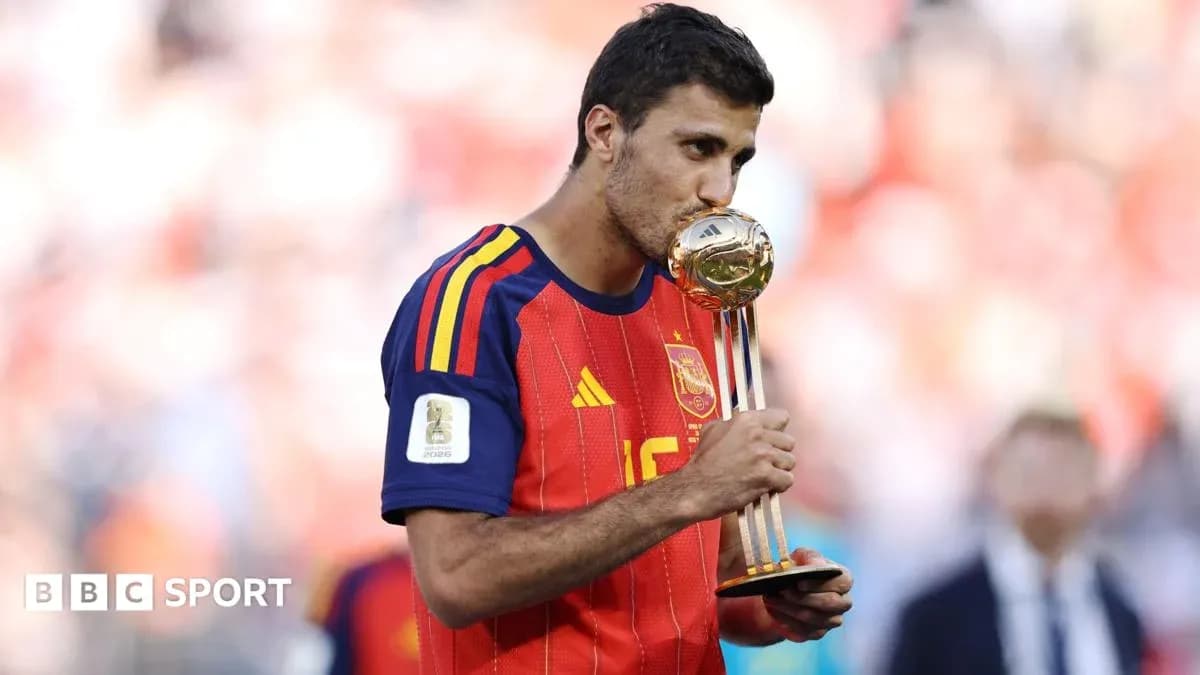
Fresh from lifting the World Cup as Spain’s captain and collecting the Golden Ball as the tournament’s outstanding player, Rodri now heads for a very different theatre on Monday: the operating room. Back surgery, one year left on his contract, and a storm of speculation swirling around him.
Real Madrid are said to be working on the assumption that he will eventually land in white. City, publicly at least, are not entertaining that idea.
Maresca did not flinch when asked about his midfielder.
“I think every manager wants to have Rodri because he is a top player,” he said. Then came the practical checklist: surgery, holiday, rest, recovery, and a return to Manchester. The message was simple. Rodri is part of the plan.
The question is whether the market, and Madrid, allow that plan to hold.
City face a brutal choice once he regains fitness. Cash in on a 30-year-old with a year left on his deal, or double down on the man who has become the metronome of their modern era. Maresca’s stance is clear. The club’s resolve will be tested.
Maresca’s Board, Maresca’s Pieces
To understand why Rodri matters so much to this new City, you have to understand the coach now moving the pieces.
Maresca is a disciple of positional play, a coach who sees football in grids and patterns. He talks about chess, not as a throwaway metaphor, but as a framework.
“There are a lot of similarities,” he has said. “The most important is positional play and strategy. For a coach, it's important to have the mentality of a chess player: develop a plan, study counter-moves, choose the arrangement of the pieces.”
On the ball, his teams settle into a 3-2-2-3. Not rigid, but rehearsed. The innovation comes from how he reaches that shape, not the shape itself.
At City during the Treble season, that meant John Stones stepping out from centre-back to stand alongside Rodri in midfield. Out of possession, a 4-4-2. With the ball, Stones morphed into a pivot, the whole structure tilting around him.
At Chelsea, Maresca’s tweak was even bolder. Moises Caicedo started at right-back, defended as part of a conventional back four, then glided infield to become one of the two holding midfielders when Chelsea built play. The 3-2-2-3 appeared again, conjured from a different starting point.
This is where Rodri becomes priceless.
The Ideal Pivot
Rodri is not just a holding midfielder in this system. He is the hinge.
During the World Cup, he often dropped into the backline when Aymeric Laporte carried the ball forward, then stepped back into midfield when Spain needed control, and surged higher when space opened in front of him. One player, three roles, all within the same phase of play.
In Maresca’s structure, that ability to glide between positions is gold. The 3-2-2-3 demands players who can occupy multiple zones without losing their sense of timing or risk. Rodri has spent years refining that art at City, first under Fernandinho’s shadow, then as the reference point for everyone else.
Maresca knows that Anderson, for all his price tag, will need time to read those patterns. Any future signing, including Lille’s 18-year-old Ayyoub Bouaddi – who caught the eye for Morocco at the World Cup and is firmly on City’s radar – will face the same learning curve. Understanding where to stand, when to step in, when to hold, when to gamble: that is Rodri’s domain.
City are better with him. It is as stark as that.
Life After Rodri?
Yet the club cannot ignore the other side of the board.
If Madrid push and Rodri decides his next move lies in Spain, Maresca will have to do what he has already shown he can: reimagine roles, repurpose players, redraw the map.
His track record is not short of bold repositioning. Stones into midfield. Caicedo into full-back. Marc Cucurella pushed into attacking midfield. Time and again, he has spotted spaces in his system that certain players can fill, even when they have never been asked to do so before.
That eye for reinvention will matter if City lose their anchor.
Anderson offers one option in the double pivot. Bouaddi, should he arrive, another. Monga is one for later. The bigger shift, though, may be structural. Maresca is more open than Guardiola to carrying a larger squad, more pieces for his board, more variations to explore.
Guardiola preferred a smaller, tightly controlled group. Maresca appears willing to embrace depth and competition, to accept that a long season might require several different versions of City, not just one perfected model.
With or without Rodri, that gives him room to experiment, to fail, to adjust, and eventually to land on a formula that works.
The Treble side is already being dismantled. The next iteration of Manchester City will not look or feel the same. The only real unknown is whether the man who has come to define their midfield will still be standing at the centre of it when the new era truly begins.
Related News
UFC 332 Preview: Natalia Silva vs. Wang Cong Fight Card, Odds, Start Time, and Details
Andy Roddick Responds to Andre Agassi’s Comments on Alexander Zverev at the Laver Cup
Knicks Prepare for Flexible Roles in Title Defense
Rui Hachimura Swaps Lakers Fans to Clippers in Surprising Jersey Exchange

Who Will Be the NBA's Next First-Time All-Stars? Top Picks and Long Shots for 2027
How Strong Is Your Team at Home? Check Out the 2026 Brasileirão Home Standings