
Manchester City's Transition: The Future Without Rodri
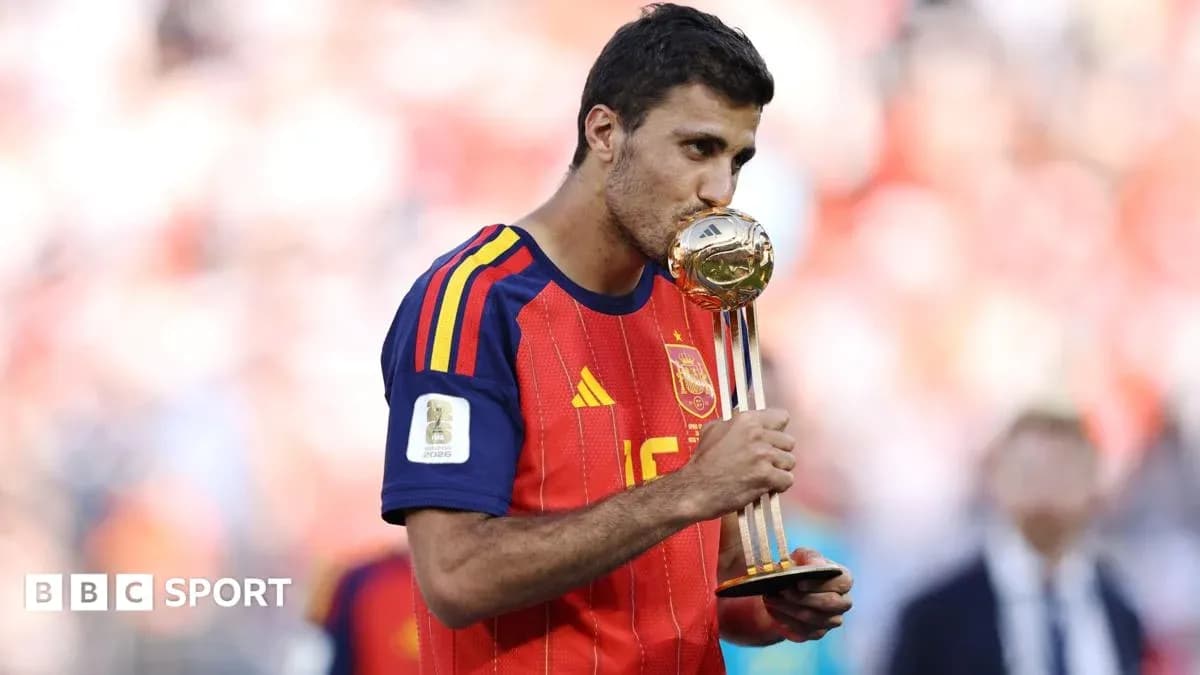
Manchester City stand at a crossroads, and not a quiet one.
A decade of Pep Guardiola has given way to Enzo Maresca. The transition would be seismic in any circumstances. At City, it comes with a squad being pulled apart and rebuilt at the same time.
Four pillars of the Treble-winning side of 2022-23 have already gone: Manuel Akanji, Nathan Ake, Bernardo Silva and John Stones. Players who defined a cycle, who carried City through the most dominant period in the club’s history, are suddenly just names on the departures list.
In their place, the first pieces of a new puzzle: £116m midfielder Elliot Anderson and 17-year-old Jeremy Monga, a teenager tipped for big things but untested at this level. This is not a tweak. It is surgery on a living, breathing champion.
And the most delicate operation is still to come.
The Rodri question
Rodri, fresh from lifting the World Cup as Spain’s captain and taking home the Golden Ball as the tournament’s outstanding player, goes under the knife on Monday for back surgery. He has a year left on his contract. Speculation around his future is no longer background noise; it is the soundtrack to City’s summer.
Real Madrid are reported to be operating on the assumption that Rodri will join them. City, for the first time in years, must seriously confront a question they have always managed to dodge: what do you do when the heartbeat of your side might be about to walk away?
Maresca did not hesitate when asked for his view.
“I think every manager wants to have Rodri because he is a top player,” he said. “But now, surgery on Monday... he needs a holiday... he needs to rest and recover and then he will be back with us.”
The message was clear. Maresca wants him. City’s plan, at least publicly, is to keep one of the best players in world football, not cash in on him.
Yet the reality of modern football demands a contingency. Or several.
Building a new board for the chess player
To understand how City might look with or without Rodri, you have to understand Maresca. He is a disciple of positional play, a coach who openly compares his football to chess.
“There are a lot of similarities,” he has said. “The most important is positional play and strategy. For a coach, it's important to have the mentality of a chess player: develop a plan, study counter-moves, choose the arrangement of the pieces.”
His teams, on the ball, tend to morph into a 3-2-2-3 shape. It is not a formation in the old sense, but a structure, a map of zones and relationships. The trick is not just to reach that shape, but to find new ways of arriving there.
That is where Rodri becomes priceless.
During Spain’s World Cup triumph, he showed exactly why coaches like Maresca treasure him. When Aymeric Laporte stepped forward with the ball, Rodri calmly dropped into the backline. When Spain needed control in midfield, he anchored the game from the holding role. When space opened ahead of him, he drove into it. One player, three positions, all within the same pattern.
City saw the same thing in their Treble season. Defending as a 4-4-2, they would attack as a 3-2-2-3. Stones stepped out from centre-back to form a double pivot with Rodri. It looked simple. It was anything but. The entire system relied on players who could interpret space, risk and tempo in real time. Rodri did that better than anyone.
Life with Rodri – and life without him
Maresca knows that with Rodri, his blueprint becomes far easier to implement. The Spaniard already understands the language of positional play. He has lived it under Guardiola. He knows when to slow a game, when to quicken it, when to hold his ground and when to step into the line-breaking pass.
Anderson, for all his talent and price tag, will need time to reach that level of nuance. So will any other young midfielder City bring in. The club are monitoring 18-year-old Ayyoub Bouaddi of Lille, who impressed for Morocco at the World Cup. The profile makes sense: technically sharp, tactically flexible, young enough to mould.
But Rodri did not become Rodri overnight. It took him seasons to grow into Fernandinho’s role, to learn the demands of a Guardiola midfield. Maresca, inheriting that evolution, would rather not start from scratch.
If City decide they cannot resist Madrid’s pull or a huge transfer fee, the challenge shifts. Then Maresca’s reputation for reimagining players becomes central to the project.
He has done it before. At City, he helped oversee Stones’ move into midfield. At Chelsea, he used Moises Caicedo as a right-back in a system that defended with a back four but attacked in a 3-2-2-3, with Caicedo stepping inside as a holding midfielder. Marc Cucurella, once seen purely as a left-back, was pushed into attacking midfield zones. Each tweak came from the same instinct: find players who can occupy new squares on the board.
That creativity will be essential if the anchor of his ideal system disappears.
A bigger squad, a different philosophy
One of the quiet revolutions under Maresca may come not in shape, but in numbers. Guardiola preferred a lean group, a small core of trusted players who could absorb huge minutes across four competitions. It worked, until it didn’t, and even then, City often found a way.
Maresca appears more open to a broader cast. Anderson is in. Monga is in. Bouaddi could follow. More signings are likely. More pieces on the board mean more combinations, more rotations, more ways to find that 3-2-2-3 that defines his football.
With Rodri, that process accelerates. Without him, it becomes a test of pure coaching.
Either way, City are moving into a new era with a manager who sees the pitch like a grandmaster. The question is whether he gets to keep his queen, or whether he has to win the next title playing a different game entirely.
Related News
UFC 332 Preview: Natalia Silva vs. Wang Cong Fight Card, Odds, Start Time, and Details
Andy Roddick Responds to Andre Agassi’s Comments on Alexander Zverev at the Laver Cup
Knicks Prepare for Flexible Roles in Title Defense
Rui Hachimura Swaps Lakers Fans to Clippers in Surprising Jersey Exchange

Who Will Be the NBA's Next First-Time All-Stars? Top Picks and Long Shots for 2027
How Strong Is Your Team at Home? Check Out the 2026 Brasileirão Home Standings