
Valencia vs Barcelona: A One-Sided La Liga Clash
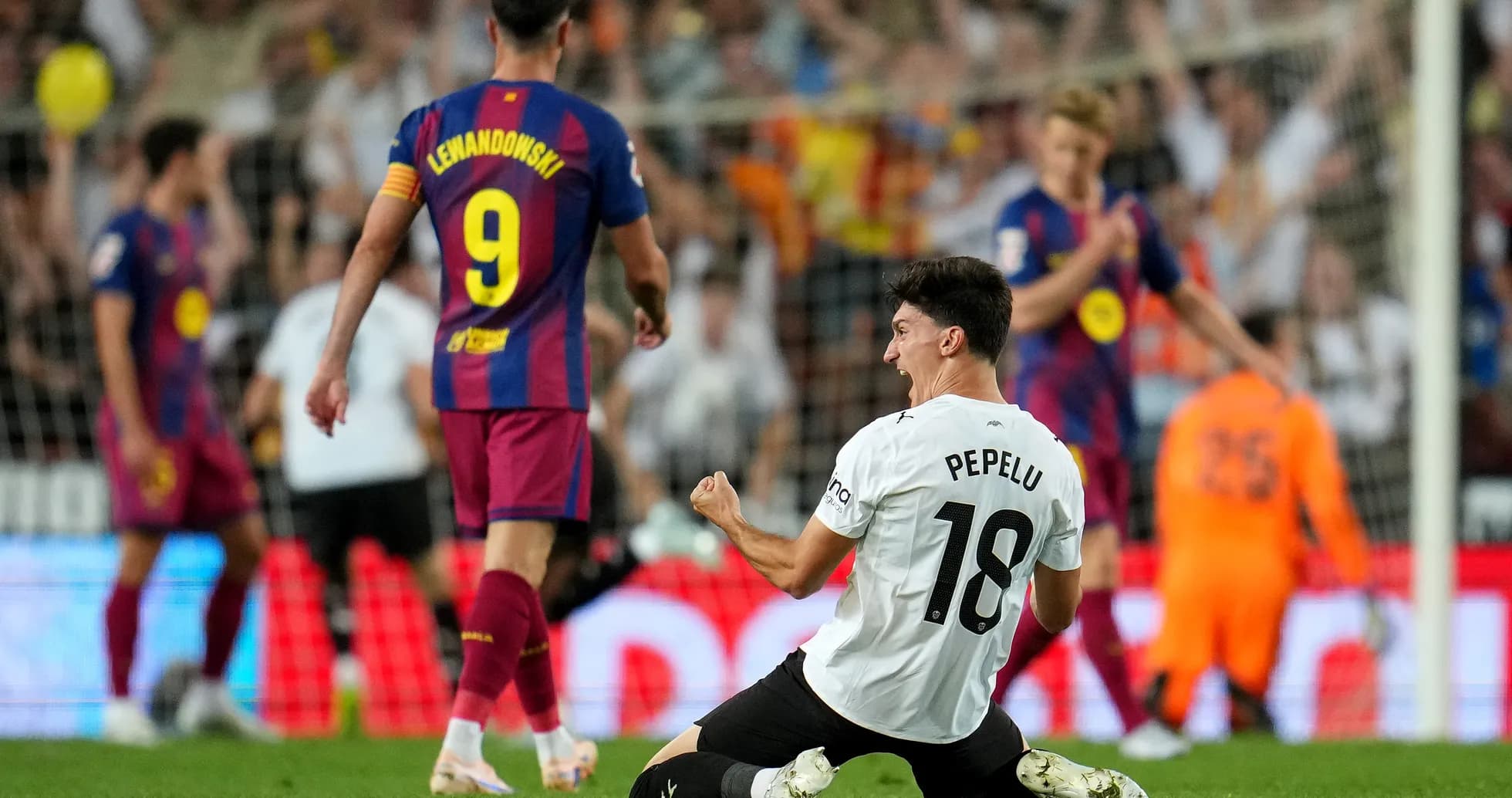
Under the late-summer light of Mestalla, this fixture felt less like Round 4 of La Liga and more like a stress test of two clubs’ identities. Valencia, rooted to 20th with 1 point and a goal difference of -8 (1 scored, 9 conceded in total), were trying to hold their nerve. Barcelona, perfect at the summit with 12 points and a goal difference of +15 (17 scored, 2 conceded in total), arrived as a fully formed machine under Hansi Flick. The 5–0 full-time scoreline did not so much reveal something new as confirm the trajectories already sketched by the season’s opening weeks.
Valencia's Defensive Strategy
Carlos Corberan doubled down on Valencia’s defensive shell: a 5-4-1 that has become their default, used in all 4 league matches. S. Dimitrievski stood behind a back five of P. Maffeo, A. Martinez, M. Diakhaby, Pepelu and J. Vazquez, with a compact midfield band of D. Otorbi, F. Ugrinic, A. Dieng and J. Guerra trying to bridge the chasm to lone forward A. Danjuma. It was a structure born of necessity. At home this season, Valencia have played 3 matches, failed to score in all 3, and conceded 6 goals; overall they have averaged 0.0 goals for at home and 2.0 goals against, while on their travels they have managed 1.0 goal for but shipped 3.0. This is a side whose first instinct is to survive.
Barcelona's Tactical Approach
Barcelona, by contrast, arrived with a swaggering 4-3-3 that already feels codified. J. Garcia in goal, a back four of E. Garcia, P. Cubarsi, G. Martin and X. Espart, a technical midfield of Fermín, Rodri and Pedri, and a front line of Lamine Yamal, Raphinha and A. Gordon. Heading into this game, Barcelona had won all 4 league fixtures, scoring 17 in total at an average of 3.5 at home and 5.0 away, while conceding only 2 overall and none on their travels. Three clean sheets in 4 matches underline the balance between their attacking aggression and defensive control.
Injury Impact on Tactics
The injury lists framed the tactical voids. Valencia were stripped of S. Canos, J. Copete, J. De Haas, D. Foulquier, D. Lopez, L. Rioja, G. Rodriguez and U. Sadiq — a swathe of potential rotation and, crucially, attacking variety. With so many offensive profiles missing, Corberan’s options to switch from a low block to a more vertical, transitional threat were severely limited. Barcelona were without R. Bardghji, J. Bisiwu and F. de Jong, but Flick’s squad depth meant he could replace an elite controller like de Jong with the Pedri–Fermín–Rodri triangle without sacrificing fluency.
Disciplinary Patterns
Discipline was always going to matter for Valencia. Their season card profile shows a pronounced late-game edge: 33.33% of their yellow cards arrive between 31–45 minutes, and another 33.33% between 76–90, with smaller spikes at 16–30 and 61–75 (16.67% each). That pattern hints at a team that struggles to maintain composure just before half-time and as fatigue bites late on. It dovetails uncomfortably with M. Diakhaby’s individual record: 2 yellow cards in 4 appearances, and a defender whose aggression is a double-edged sword. His 2 successful blocks and 6 interceptions show his value as a last-ditch barrier, but in a game where Valencia would be under siege, every mistimed challenge risked tilting the contest further away from them.
Barcelona’s disciplinary curve is calmer and more controlled: 25.00% of their yellow cards between 16–30 minutes, 50.00% between 46–60, and 25.00% between 61–75, with no late spike. That mid-game cluster reflects a side that presses with intensity after half-time but rarely loses their heads in the closing stages. With no red cards for either side this season and no penalties missed by Barcelona (they have scored their only penalty, maintaining a 100.00% conversion rate), the visitors brought a profile of ruthless efficiency.
Statistical Highlights
The “Hunter vs Shield” battle was always likely to be brutally one-sided. Barcelona’s attack is led statistically by Raphinha, whose 6 goals and 1 assist in 4 appearances come from just 9 shots, 8 of them on target. His 10 key passes and perfect 7-from-7 dribbles speak to a winger in total command of his duel. Alongside him, Lamine Yamal has 4 goals from 17 shots and a remarkable 19 key passes, while Fermín adds 4 goals and 2 assists from midfield, marrying vertical runs with work rate (4 tackles, 1 interception). Against that, Valencia’s “shield” at home had already conceded 6 goals in 3 matches, with no attacking output to relieve pressure.
Midfield Dynamics
The Engine Room duel was equally stark. Pedri’s control, Rodri’s rhythm and Fermín’s surging energy faced a Valencia midfield asked to cover huge horizontal distances in a 5-4-1. A. Dieng and J. Guerra were tasked with shuttling out to Barcelona’s full-backs while still screening central zones; F. Ugrinic and D. Otorbi had to choose between tracking midfield runners and stepping out to press. With Barcelona averaging 4.3 goals per match in total and only 0.5 conceded, any hesitation in that chain was likely to be punished.
Conclusion
In narrative terms, the 5–0 final score at Mestalla simply crystallised the statistical prognosis. A Valencia side that had failed to score at home and averaged 0.3 goals in total this campaign ran into a Barcelona team scoring 5.0 away and conceding 0.0 on their travels. The gap in firepower, structure and confidence was too wide. For Corberan, the challenge now is to evolve beyond survival mode, especially once his injured attackers return. For Flick, this was another data point in a title-chasing season: a dominant away performance that aligned perfectly with the numbers, and a reminder that in this La Liga landscape, Barcelona’s ceiling is as high as anyone’s.
Related News

Real Madrid vs Rayo Vallecano Stats: Head-to-Head Record

Real Sociedad vs Atletico Madrid Stats: Head-to-Head Record

Valencia vs Barcelona: A One-Sided La Liga Clash

Athletic Club Dominates Atletico Madrid 3–0: A Tactical Analysis

Real Betis Triumphs Over Real Madrid in Tactical Showdown
Valencia vs Barcelona Predicted Lineups: Team News and Match Insights