
West Ham's Championship Challenge: A Season of Uncertainty
Ten summers in at the London Stadium, and West Ham enter their first season back in the Championship with the mood closer to midwinter. On Saturday, Portsmouth arrive in the Carabao Cup first round, a tie that once would have blended into a busy calendar. Now it feels like a symbol. A reminder of how far, and how fast, the club has fallen since that Europa Conference League triumph in Prague.
Relegation has stripped away the Premier League gloss. The summer has done the rest.
A club using the Championship – or trapped by it?
Some clubs use a year down as a reset. West Ham did it themselves in 2011-12 under Sam Allardyce, powering straight back up. The bookmakers say they can do it again; the Hammers are short-odds favourites for promotion.
The mood around the place says something else.
Behind the scenes, this has been a summer of boardroom turbulence, a power struggle playing out while Nuno Espírito Santo tries to hold together a squad that has lost top-tier status and several key assets. The Championship might offer a chance to regroup. It might also expose every fault line.
Sullivan, protests and a stadium that never feels like home
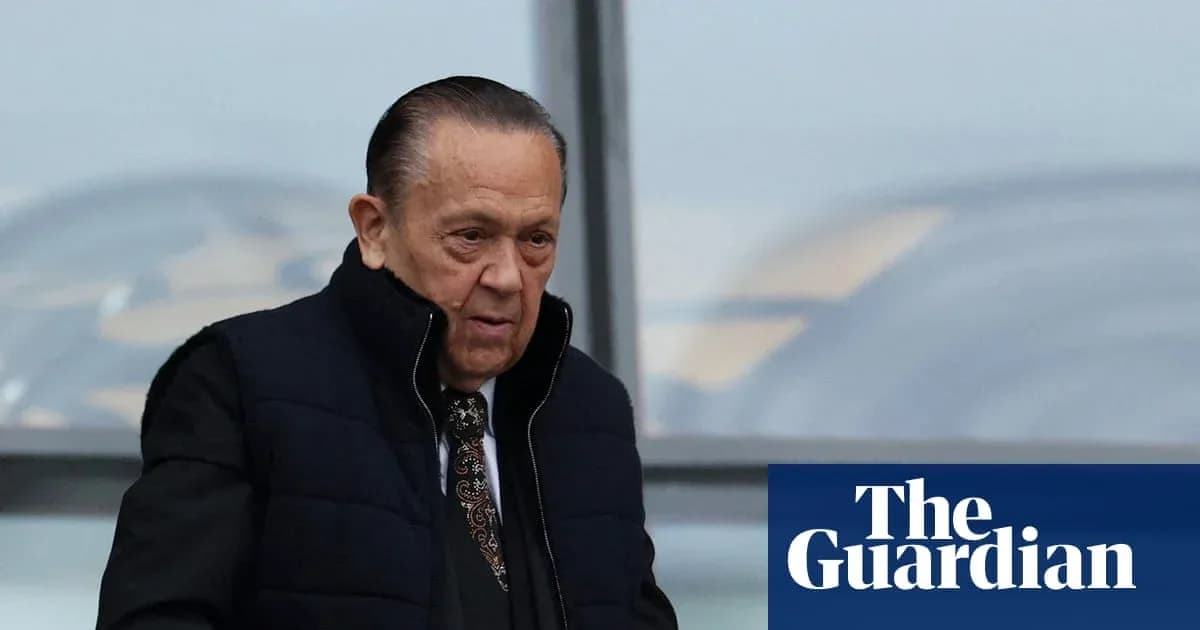
Portsmouth will bring 9,000 supporters to east London. The more intriguing question is whether David Sullivan walks through the same turnstiles.
The operators of the London Stadium have advised the former joint-chair, still a co-owner, to stay away because of the “potential for demonstrations and anti-social behaviour by some spectators”. The club’s fans advisory board has warned that his presence would cause “offence and upset”.
Even so, Sullivan is expected to attend. The suggestion is that he wants to experience the season as a supporter, content to wait before making any decision on selling his 38.8% stake. Given his personal circumstances, it would be a brazenly unpopular decision. On 25 May, as relegation was sealed despite a home win over Leeds, he left early for his own safety.
Sullivan continues to deny allegations of sexually exploitative and predatory behaviour towards women over several decades, made in a BBC Panorama documentary in June. On the eve of the broadcast he stepped down from his role “to avoid disruption to the club while he addresses the matter privately”.
The damage to his standing among supporters had already been done. Even before the allegations, he served as a lightning rod for anger at a club in vertiginous decline since that night in Prague in May 2023. The £100m banked from Declan Rice’s sale was squandered. The squad aged, the direction blurred.
Jarrod Bowen, the captain and hero of that European run, has committed to stay and lead the push for promotion. It is a sizeable burden to place on one man’s shoulders.
Until his abrupt removal, Sullivan operated as a de facto director of football, to the regular irritation of those actually working in the football department. His closest ally, Karren Brady, stepped down in April as the storm gathered, ending a working partnership stretching back to 1990.
New money circling, old power clinging on
On the face of it, the numbers should offer comfort. Around 50,000 season tickets have been sold for the coming campaign. The fanbase is not walking away.
Yet the loudest demand from those supporters remains unchanged: they want Sullivan gone. His announced departure from the frontline had sparked a flicker of optimism, a sense that something different might finally emerge from the boardroom.
The reality is far murkier.
Daniel Kretinsky, the Czech billionaire and Royal Mail owner, has held 27% of West Ham since 2021. Many expected him to make his move once Sullivan stepped back. Instead, this week he trimmed that holding to just under 25%, a shift described as strategic rather than retreat.
Into that vacuum stepped a familiar figure. Amanda Staveley, who left Newcastle in July 2024 after playing a leading role in bringing in the Saudi Arabian Public Investment Fund, has reappeared on the scene. Linked with a Tottenham takeover last September, she is now understood to be pursuing West Ham, again with similar funding sources in mind.
Among Newcastle supporters, her departure has been lamented. Among West Ham fans, some see in her the potential for the same jolt of energy and ambition.
The key to any reshaping of the ownership lies with the 25% stake left by the late David Gold. His daughter, Vanessa Gold, now co-chair, controls that block. Kretinsky holds first refusal and, as Staveley’s interest surfaced, he appeared ready to act.
Had he simply added Gold’s 25% to his own 27%, he would have crossed the 50.1% threshold and triggered a formal takeover offer. Instead, he shifted 2% to Czech ally Jakub Havrlant, keeping himself just under that line. It is a technical move with significant consequences: he can still bid for the Gold stake without being forced into a full takeover.
That manoeuvre cuts straight across Staveley’s ambitions. Sullivan’s 38.8% remains the ultimate balance of power. The next move, from any of the three, will shape the club’s future more decisively than any signing.
Selling to buy, and selling the future
While the boardroom pieces move, Nuno must work with a squad that has been trimmed and traded.
The first arrival of the summer, Joël Veltman, comes as a free agent after spells at Brighton and Ajax. Experience, versatility, a sensible Championship signing.
The exits tell the wider story. Mateus Fernandes has gone to Tottenham and Crysencio Summerville to Al-Hilal, the pair bringing in around £140m between them – roughly the value of a year’s Premier League TV money. The academy has not been spared either: Freddie Potts, a youth product, has joined Club Brugge for £10m, a deal that left many supporters uneasy about what, exactly, is being built.
Needs must. To bring in more players, the club has had to cash in. There is interest in Troy Parrott, Ireland’s World Cup playoff hero now at AZ Alkmaar, as West Ham look for a striker capable of handling the Championship’s grind. Convincing players to drop a division, though, remains a hard sell.
In the dugout, Nuno’s continued presence is one of the few surprises of the summer. His departure had been widely expected. Instead, his calm demeanour remains a buffer against a club that tends to reach for the panic button.
The vacuum created by Sullivan’s situation, relegation and a thin transfer window has only heightened anxiety. The fixture list offers little comfort: by 1 September, West Ham will have faced Burnley, Charlton, Watford and Wolves. No time to ease into the division.
Karim Virani, a former club employee who left in 2020 and has since worked at Rangers, has returned as interim chief executive. His task is as much political as operational: to stitch together something resembling unity.
A stadium still at arm’s length
While the club wrestles with its identity, the London Stadium continues to underline the awkwardness of the move from Upton Park.
This summer, Take That and Metallica have packed the venue. In July, the Diamond League rolled in and Josh Kerr broke the world mile record on the same track that wraps around West Ham’s pitch. On Thursday, a bid was confirmed to host the 2029 World Athletics Championships, following a prolonged impasse between the club and the stadium’s owners.
Each event is a reminder. Ten years after leaving the Boleyn Ground, West Ham still do not truly own their home. The terms agreed by Sullivan, Gold Sr and Brady continue to rankle among supporters who never fully embraced the relocation.
Now, as the Championship looms and protests simmer, that same stadium prepares to welcome back a co-owner who knows he will not be warmly received. The team’s task is clear enough: win games, chase promotion, give those 50,000 season-ticket holders something to cling to.
The question that hangs over the London Stadium is harsher. Can West Ham rebuild their future while still chained to a past – and a power structure – their own fans are desperate to leave behind?
Related News
Carlos Alcaraz Urges an End to Matches Ending in the Early Hours
Carlos Alcaraz Criticizes Late US Open Finish After 3:30 a.m. Match
Jannik Sinner Set for ATP 500 Return in Beijing with Novak Djokovic Also Competing
Meet Iva Jovic: The American Tennis Prospect Making Waves
Flavio Cobolli Shares Insights on Practice Session with Jannik Sinner Ahead of Comeback
Till vs Romero: Fight Details, Undercard, and Viewing Info for This Weekend