
2026 World Cup: A Farewell Tour for Football Legends
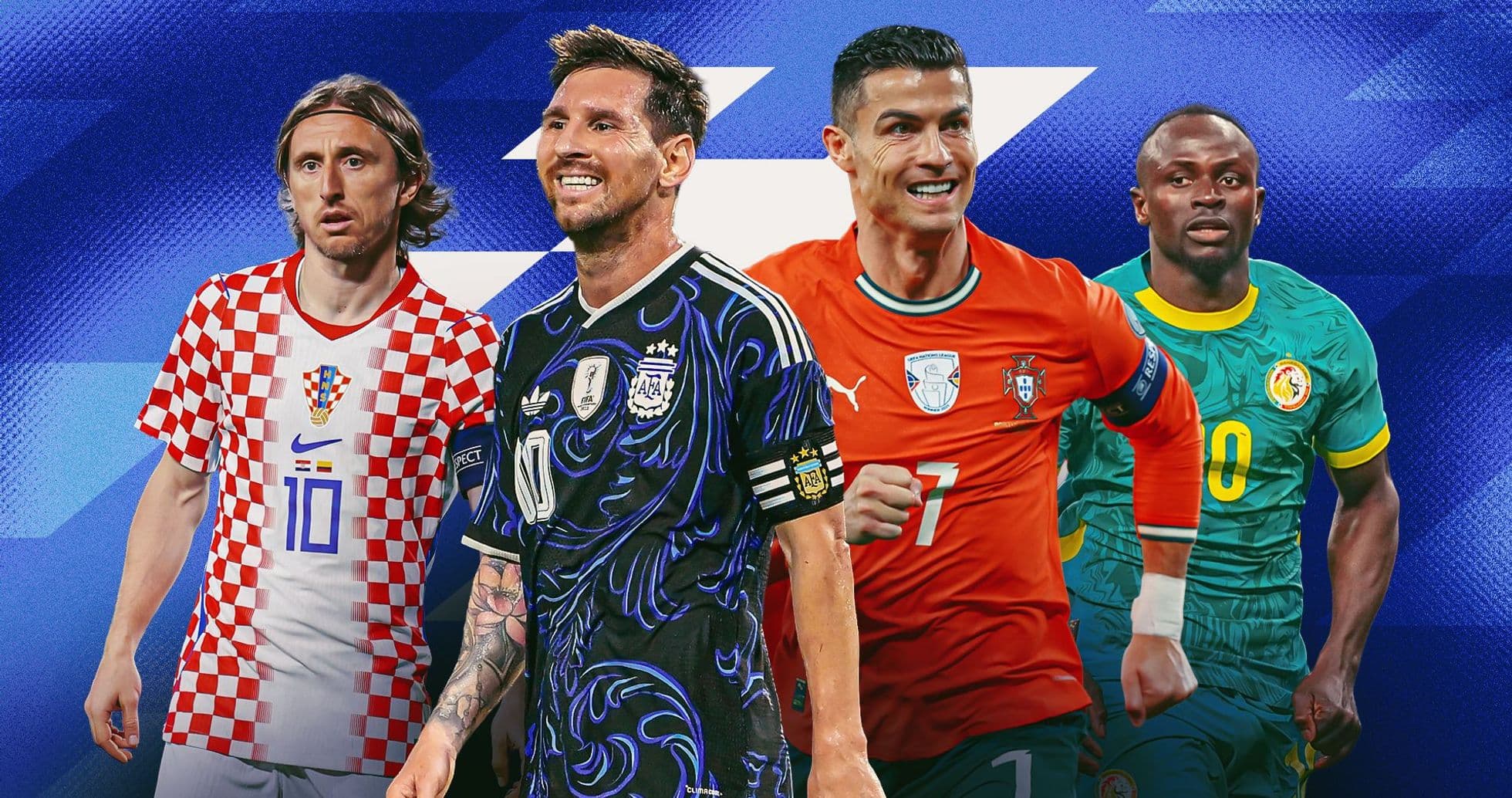
The World Cup has always been football’s grand stage. In 2026, it becomes something else entirely: a farewell tour for a generation that has defined an era.
Some will chase the one prize that has always eluded them. Others will cling to it one last time. All of them know there is no guarantee they will ever be back.
Messi, Ronaldo and Ochoa: The Six-World-Cup Club
Lionel Messi will arrive in North America on the brink of 39, already having completed the circle. He won the trophy that tormented him in 2022, dragging Argentina past France in a final that felt like the closing chapter of a footballing epic.
It wasn’t. Not for him.
Since then he has crossed the Atlantic, swapped the grind of Europe for the glitz and travel of MLS with Inter Miami, and learned to manage a body that has carried him through two decades at the top. The league is less intense, the spotlight is not. He still slips passes through gaps that don’t exist for anyone else, still scores goals no 39-year-old should even see, let alone finish.
Questions will come with the heat and the expanded format: can Messi handle the travel, the climate, the minutes? History suggests doubting him is a fool’s game. If this is the end, it will not be quiet.
Cristiano Ronaldo’s World Cup story is very different. At 41, he will walk into the tournament chasing a ghost that has always stayed just out of reach. No trophy, not even a goal in the knockout rounds. For a five-time Ballon d’Or winner, that gap on the CV glares.
By any normal measure, he should be long gone from this level. Instead, he is still scoring relentlessly for Al-Nassr in Saudi Arabia, still talking about the future, not the past. Portugal do not lack talent – Rafael Leao, Pedro Neto, Goncalo Ramos and others are ready to carry the flag – but Roberto Martinez continues to build around Ronaldo as the reference point, the leader, the finisher.
If Portugal lift the World Cup, Ronaldo becomes the oldest player ever to do it. If they fall short, this sixth finals will almost certainly be his last shot at rewriting his World Cup legacy.
Guillermo Ochoa joins them in the six-tournament club, though his path back was anything but certain. A veteran of more than 150 caps, the Mexican goalkeeper had all but slipped out of the picture, with just one appearance since the CONCACAF Nations League finals in March 2024.
Then Angel Malagon tore his Achilles. The door swung open.
At 40, after a nomadic club career that has taken him through Spain, Italy, France, Portugal, Belgium and most recently Cyprus with AEL Limassol, Ochoa returns as a familiar face for a host nation. He has hinted this will be his last dance. For two decades, World Cups have come with an Ochoa save somewhere in the montage. North America is likely to be his curtain call.
Neuer and Modric: Masters of Control
Germany thought they had said goodbye to Manuel Neuer. After Euro 2024 on home soil, the long-serving captain and a cluster of veterans stepped away from international duty. The story seemed complete.
Julian Nagelsmann tore up the script.
With Marc-Andre ter Stegen battling injuries and doubts swirling around Oliver Baumann, the Germany coach reached back for the old certainty. Neuer, 40, returns for a fifth World Cup after another strong season with Bayern Munich, and Nagelsmann has already confirmed he will be his No.1.
Germany have crashed out in the group stage at the last two tournaments. Neuer’s presence is about more than saves; it is about authority, structure, the feeling that the back line is anchored by someone who has seen everything before. One more World Cup, one more chance to steady a listing giant.
Luka Modric will also turn 40 during the tournament, still gliding through games, still dictating tempo like a conductor who refuses to leave the podium. He has already taken Croatia where they had never been: a World Cup final in 2018, a third-place finish in 2022.
Last summer he left Real Madrid for AC Milan, a move designed to keep his legs ticking over rather than grind them down. North America will be his fifth World Cup, and by then he is expected to become only the fourth player to reach 200 international caps – Messi should get there first, with the Argentine currently on 198 to Modric’s 197.
The numbers are staggering, but the motivation remains simple: one more chapter, one more chance to bend a tournament to his will.
Dzeko’s Return, and the Weight on Asian Shoulders
Few would have blamed Edin Dzeko for assuming his World Cup story ended in 2014. Bosnia and Herzegovina have struggled badly to qualify for major tournaments since their debut that year.
Then came one last surge.
Dzeko, now 40, dragged his country through the UEFA play-offs, knocking out Italy to book a ticket to North America. He is closing in on 150 caps, with more than 70 goals to his name, and still scoring regularly after joining Schalke in January and helping them back to the Bundesliga.
For a striker of his calibre, one World Cup never felt enough. This second shot on the biggest stage offers him the chance to leave international football where it always belonged for him: under the brightest lights.
South Korea face a different kind of goodbye. Son Heung-min turns 34 in July, younger than many on this list, but the burden he carries is immense. Captain, talisman, national obsession – he shoulders a country’s expectations every time he pulls on the shirt.
He has already left European football for LAFC in MLS, a sign that he is beginning to think about the final stretch of his career. By the time 2026 ends, Son may feel he has given all he can to the Korean cause. If this is his last World Cup, it will mark the end of an era in Asian football.
Salah, Mane and Mahrez: African Icons at the Crossroads
Mohamed Salah stands in a similar place for Egypt. A few days older than Son, he has carried his national team almost single-handedly for years. This time, there is at least a semblance of support – Manchester City’s Omar Marmoush leads a more capable supporting cast – but the focus will still fall on Salah.
His Liverpool form has dipped sharply over the past year, and his only previous World Cup, in 2018, was scarred by the shoulder injury he suffered in the Champions League final. For a player of his stature, the absence of a defining World Cup moment lingers.
With a move to Saudi Arabia expected after his departure from Anfield, the winding down of his club career feels close. Imagining him still driving Egypt forward beyond this tournament stretches belief. North America offers him one last shot at a global performance worthy of his legend.
Sadio Mane arrives in a different shade of twilight. Now 34 and playing for Al-Nassr, his visibility in Europe has faded, but his importance to Senegal has not. He scored the penalty that delivered their first Africa Cup of Nations in 2021, then hauled them to consecutive World Cup qualifications, even if injury cruelly ruled him out of the 2022 finals.
He remains captain, still the emotional core of the Lions of Teranga, and now has Ismaila Sarr and Illiman Ndiaye blossoming around him. With that talent emerging, Senegal have the tools to trouble anyone. Mane’s experience and leadership could be the difference between a respectable run and something far deeper in 2026.
Riyad Mahrez completes the African trio. At 35, the Algerian winger still glides past defenders, his first touch as velvet as ever. One of the most gifted players the continent has produced in recent years, he has a World Cup record that feels at odds with his ability: a single appearance, back in 2014.
Algeria have missed every tournament since Brazil. That changes this summer, and with Mahrez now in Saudi Arabia with Al-Ahli, the sense of a last hurrah is hard to ignore. This is his chance to finally leave a mark on the World Cup stage his talent has always deserved.
De Bruyne and Van Dijk: Europe’s Aging Pillars
Kevin De Bruyne’s body has begun to argue with him. His first season at Napoli after leaving Manchester City has been ravaged by injuries, and he turns 35 later this month. The fear, for Belgium and for neutrals, is that we are watching one of the game’s great playmakers fight a battle he cannot win.
When he is fit, nothing has changed. He still sees passes that split entire defensive structures, still strikes the ball from distance with a technique that feels almost unfair. Belgium’s so-called ‘Golden Generation’ has thinned out, and Rudi Garcia’s squad is clearly in transition, but De Bruyne remains the man everything revolves around.
If he can stay on the pitch, Belgium will fancy their chances of upsetting the hierarchy one last time. If he breaks down, the end of an era will come with a whimper, not a roar.
Virgil van Dijk, by contrast, has aged into his role as a defensive colossus. He will turn 35 during the World Cup, still the cornerstone of the Netherlands and still the figure around whom Liverpool’s back line has been built for years.
Yet there are signs of erosion. The last season at Anfield was not his finest. Questions have crept in about his pace, about the sharpness of his defensive instincts. On Merseyside and in the Netherlands, the hope is that a World Cup environment will reignite the old dominance, the aura that once made strikers actively avoid his side of the pitch.
This is likely to be his second and final World Cup. It offers him a chance to remind everyone why he once redefined what a modern centre-back could be.
James, Neymar and the World Cup’s Love Affair with Drama
Some players owe their entire career to a single World Cup. James Rodriguez is one of them.
In 2014 he lit up Brazil, scoring the goals and producing the performances that earned him a move to Real Madrid and a permanent place in tournament folklore. Since then, injuries have stalked him, limiting his club impact and turning his career into a series of short stays – most recently with Minnesota United in MLS – designed to keep him fit enough for Colombia duty.
He turns 35 in July. For Colombia fans, his presence in North America is non-negotiable. James and the World Cup have a special relationship; ending it on the same stage where it truly began feels right.
Neymar’s relationship with the tournament has been far more turbulent. Brazil’s all-time leading scorer has not played for his country since tearing his ACL in October 2023, and Carlo Ancelotti’s arrival as national coach last September seemed to close the door on a comeback.
Then injuries hit Brazil’s forward line. The door creaked open again.
Ancelotti named Neymar in his 26-man squad, a late reprieve that sparked celebrations across Brazil. The 34-year-old, now back at Santos, promptly suffered yet another injury just days after the call-up, throwing his role in North America into immediate doubt.
His body is clearly rebelling. The idea of him making it to 2030 at this level belongs in fantasy. This, almost certainly, is his last chance to chase the sixth star that has haunted Brazil since 2002. Whether he can stay fit long enough to influence the story is another matter entirely.
Kane and England’s Quiet Countdown
Harry Kane sits at a different point on the curve. At 32, he looks like he is in his prime, coming off a staggering first season at Bayern Munich with more than 60 goals and standing alone as England’s all-time leading scorer.
There is a world in which he plays on until 2030. England fans, staring at the drop-off behind him in the pecking order, will cling to that idea. Yet the calendar offers a natural exit: Euro 2028, co-hosted by England, looms as a home-soil farewell that would be hard to resist.
If that becomes the plan, 2026 will be his final World Cup. The same could apply to Jordan Pickford, John Stones and perhaps even Marcus Rashford, who might all eye the chance to end their international careers in front of their own fans two years later.
For now, they focus on North America, where a generation that has come close without crossing the line gets another opportunity.
This World Cup will not just crown a new champion. It will close doors.
Messi, Ronaldo, Modric, Neymar, Salah, Mane, De Bruyne, Van Dijk and so many others will walk into the tournament knowing that, this time, the clock is not just ticking on a match or a campaign, but on their international lives.
Some will leave with medals. Some will leave with regrets. All of them, in their own way, will leave a hole the next World Cup cannot hope to fill.
Related News
UFC 332 Preview: Natalia Silva vs. Wang Cong Fight Card, Odds, Start Time, and Details
Andy Roddick Responds to Andre Agassi’s Comments on Alexander Zverev at the Laver Cup

Knicks Prepare for Flexible Roles in Title Defense
Rui Hachimura Swaps Lakers Fans to Clippers in Surprising Jersey Exchange

Who Will Be the NBA's Next First-Time All-Stars? Top Picks and Long Shots for 2027
How Strong Is Your Team at Home? Check Out the 2026 Brasileirão Home Standings