
AC Milan W Seals Victory Over Parma W in Serie A Showdown
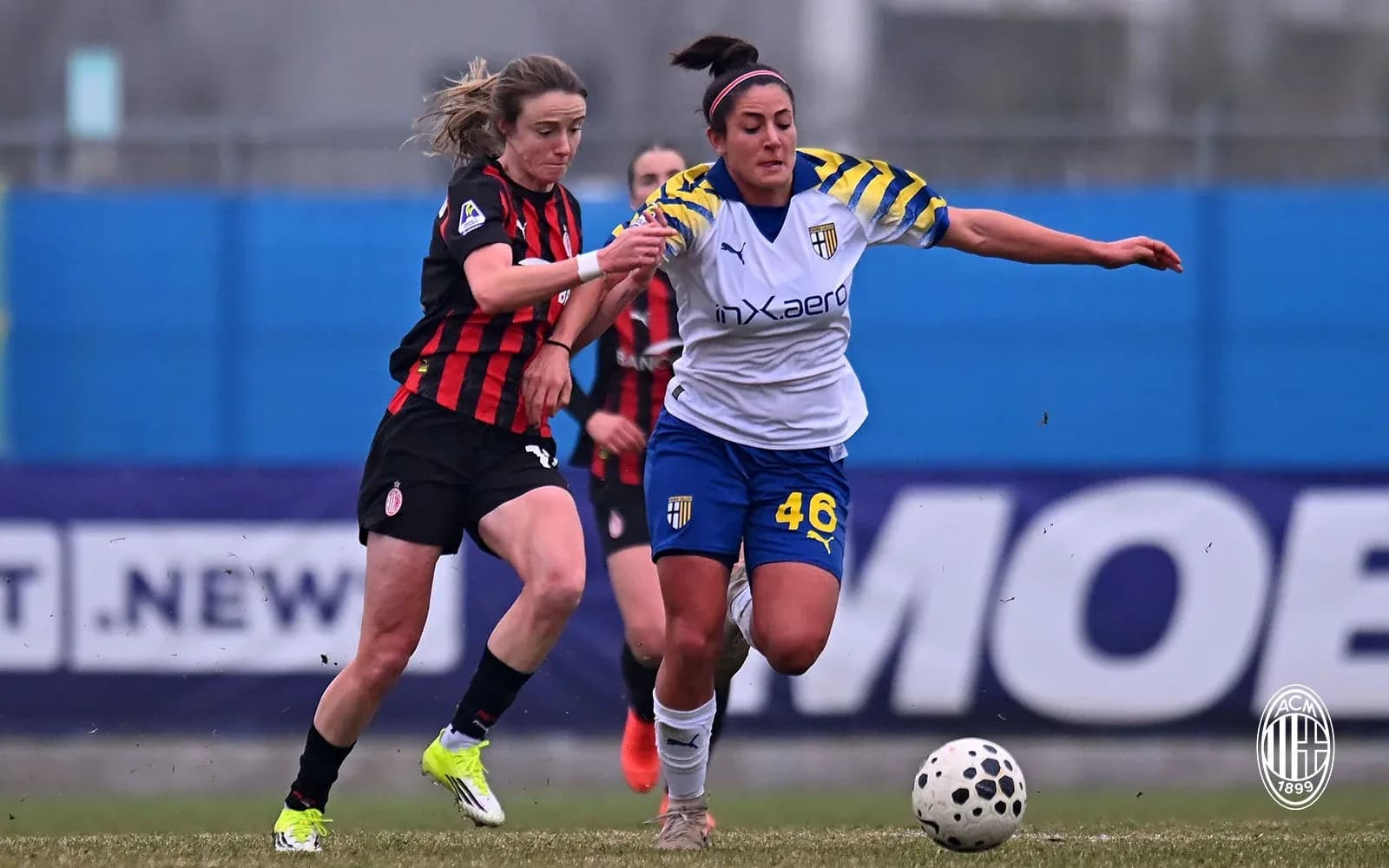
On a bright afternoon at Centro Sportivo Peppino Vismara in Milan, AC Milan W closed out a pivotal chapter of their Serie A Women season with a 3–1 win over Parma W. Heading into this game, the table had already framed the narrative: Milan in 6th on 32 points, Parma in 10th on 16, separated not just by rank but by identity.
Overall this campaign, Milan’s numbers told of a side flirting with the European conversation without ever fully seizing it: 21 matches played, 9 wins, 5 draws, 7 defeats, 31 goals for and 25 against. The goal difference of 6 matched their position as a solid, if inconsistent, mid-table power. At home, they had been more assertive: 5 wins from 11, scoring 18 and conceding 15, averaging 1.6 goals for and 1.4 against at Vismara.
Parma arrived with a very different story. Overall, they had played 21 times, winning just 2, drawing 10 and losing 9. Their 15 goals for and 28 against left them with a goal difference of -13, and the away column was stark: 11 matches on their travels, 0 wins, 5 draws, 6 defeats, only 2 goals scored and 14 conceded. An away average of 0.2 goals for and 1.3 against underlined their fragility once they left home soil.
The match itself followed the statistical script but added its own narrative beats: level at 1–1 by half-time, Milan accelerated after the break, leaning into their home attacking profile to pull away 3–1 by full time.
Tactical voids and disciplinary shadows
With no official absentees listed, both coaches, Suzanne Bakker for Milan and Giovanni Valenti for Parma, could lean on their core structures. Bakker’s starting XI felt like a careful blend of steel and incision: L. Giuliani in goal, a back line anchored by E. Koivisto, K. De Sanders and M. Keijzer, and a midfield triangle in which G. Arrigoni and M. Mascarello offered control while C. Grimshaw provided vertical thrust. Up front, the energy of S. Stokic and T. Kyvag flanked the unpredictable C. Dompig.
Valenti’s Parma leaned into their season-long back-three identity, even if the explicit formation was not listed. The starters – M. Copetti in goal, C. Minuscoli, C. Ambrosi and D. Cox in the defensive unit, with I. Rabot and M. Gueguen supporting a hard-working midfield of M. Uffren, L. Dominguez and C. Prugna behind G. Distefano and A. Kerr – spoke of a side built to suffer, compress space, and hit on transitions.
Discipline has shaped both squads’ seasons. Milan’s yellow-card timing is revealing: 31.58% of their cautions arrive between 76–90 minutes, a clear late-game spike that hints at a team willing to take tactical fouls to protect a result or to break up counters as legs tire. Their red-card profile is even more dramatic: one dismissal in each of the 46–60, 61–75 and 76–90 ranges, each accounting for 33.33% of their reds. Players like C. Dompig, K. van Dooren and M. Keijzer have all seen red this season, and that edge is part of Milan’s competitive DNA.
Parma’s discipline is no less significant. M. Uffren sits at the top of the league’s yellow-card charts with 7 bookings, the embodiment of an enforcer who lives on the line. Parma’s yellow distribution peaks in the 76–90 window too, at 29.17%, while their lone red card this season has also come in that same late phase (100.00% of their reds between 76–90). In a match that was 1–1 at the break, this shared tendency toward late fouls and cards loomed over the second half like a tactical storm cloud.
Crucially, there is penalty vulnerability too. While neither side has taken a spot-kick in total this campaign, Uffren has missed a penalty individually, a detail that underlines Parma’s lack of ruthlessness from the spot.
Key matchups – Hunter vs Shield, and the engine room
The “Hunter vs Shield” narrative for Milan revolves around K. van Dooren, even though she started on the bench here. Overall this campaign, van Dooren has scored 5 goals, from 18 shots with 12 on target, carrying a 6.9 rating and operating as a high-impact midfielder. Her presence in the squad, even as a substitute, stretches Parma’s defensive block psychologically; they know Milan possess a midfield finisher who can arrive late in the box.
That threat ran straight into Parma’s away defensive record: 14 goals conceded in 11 away games, with an average of 1.3 against. On their travels, Parma have often relied on last-ditch defending and deep blocks. Players like M. Gueguen and D. Cox are forced into heavy workloads, and the pressure of containing van Dooren, Dompig and Kyvag over 90 minutes was always likely to tell.
In the “Engine Room” duel, Milan’s C. Grimshaw and M. Mascarello squared off conceptually against Parma’s M. Uffren and C. Prugna. Grimshaw, with 2 assists, 11 key passes and 10 successful dribbles in total this season, is Milan’s line-breaking runner from midfield. Mascarello, meanwhile, brings 368 passes and 15 key passes, but also 4 yellow cards, a rhythm controller unafraid to foul when necessary.
On the other side, Uffren is Parma’s heartbeat and hammer: 512 passes at 82% accuracy, 32 tackles, 34 interceptions and 7 yellow cards. She is both shield and trigger, tasked with breaking up Milan’s central combinations and launching the first pass of Parma’s counters. Around her, G. Distefano operates as the creative outlet: 2 assists, 16 key passes, 24 shots and a remarkable 151 duels contested with 81 won. Distefano’s ability to carry Parma up the pitch, draw 50 fouls and win territory is central to any away resistance.
In this match, the balance tilted toward Milan’s engine. The 1–1 at half-time suggested Parma’s midfield had initially matched the hosts’ intensity, but as the game stretched, Grimshaw’s running and Mascarello’s control, supported by the ball-playing of Keijzer at the back, began to pull Parma’s compact shape apart. With Distefano forced deeper to help in build-up, Parma’s capacity to threaten in behind diminished.
Statistical prognosis and tactical verdict
Following this result, Milan’s season-long profile feels confirmed rather than transformed. Overall, they average 1.5 goals for and 1.2 against; scoring 3 and conceding 1 fits neatly within that offensive tilt at home, where they already averaged 1.6 scored. The 3–1 scoreline is not an outlier but an expression of what they are when their pressing and wide rotations click.
Parma’s numbers on their travels are equally reinforced. On their travels they had scored just 2 goals in 11 matches; adding 1 here is actually a minor uptick, but conceding 3 keeps them aligned with an away average of 1.3 goals against. Their reliance on draws, their inability to turn resistance into wins, and their chronic lack of away goals all reappeared in Milan.
From an xG lens, even without explicit values, the patterns are clear. Milan’s season-long shot and goal output, combined with Parma’s away defensive record and their tendency to concede pressure late, point toward Milan generating the higher volume and quality of chances. Parma’s offensive profile – 0.7 goals per game overall, 0.2 away – suggests that their equaliser before half-time was likely the product of a rare high-quality moment or transitional break rather than sustained pressure.
Tactically, the match becomes a case study in structural gravity. Milan’s established 4-3-3/4-2-3-1 frameworks, reflected in their season lineups, naturally pin back a back-three like Parma’s, especially when supported by aggressive full-backs such as Koivisto and the ball-carrying of Keijzer. Parma’s own preference for back-three systems, seen in their repeated use of 3-4-2-1 and 3-4-3, demands perfect distances and discipline; against a side with Milan’s individual quality and late-game physicality, that margin for error shrinks.
The disciplinary data adds a final layer to the prognosis. Both sides spike in yellow cards between 76–90 minutes, but Milan’s superior bench – with options like van Dooren, V. Cernoia, E. Kamczyk and Park Soo-Jeong available – allows them to rotate intensity without losing structure. Parma, by contrast, lean heavily on Uffren and Distefano to sustain their out-of-possession work, increasing the likelihood of late fouls and fatigue-driven errors.
In the end, the 3–1 at Vismara is less a surprise than a crystallisation. Milan’s home attacking profile, their deep pool of creative and finishing talent, and their willingness to push the tempo late intersected perfectly with Parma’s away frailties, limited offensive output and disciplinary tightrope. As the final whistle sounded under the watch of referee E. Cappai, the table, the stats and the story all aligned: a Milan side asserting their mid-table authority, and a Parma team still searching for a way to turn stubbornness into security.
Related News

Napoli W vs Sassuolo W: Serie A Women Season Finale Analysis
Ternana W Upset AC Milan W in Serie A Women Finale

Parma W vs Juventus W: Serie A Women's Match Analysis

Roma W’s Dominance Secures 2-0 Victory Over Genoa W
Como W Shocks Inter Milano W with 3–0 Victory

Fiorentina W vs Lazio W: Serie A Women Season Finale Insights