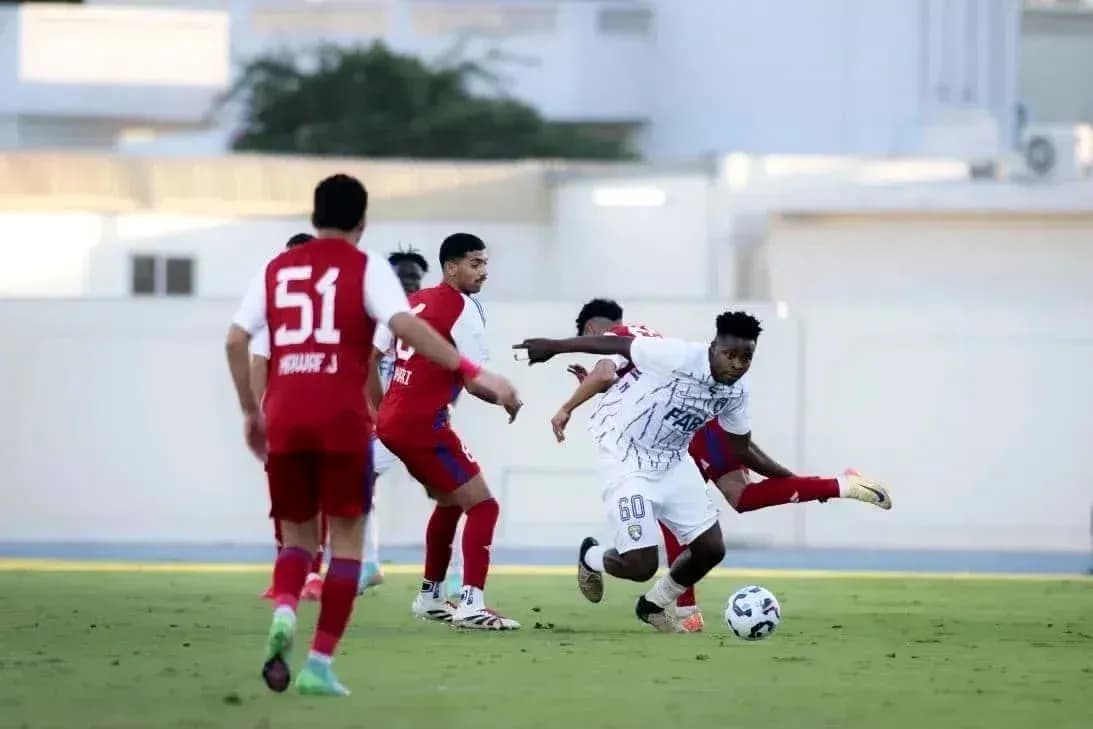
Al Wahda U23 vs Khorfakkan U23: Pro League U23 Match Preview

Al Wahda U23 host Khorfakkan U23 in the Pro League U23 on 12 May 2026, with both sides trying to stabilise difficult seasons in the lower half of the table. There is no cup context here, but league positioning and momentum are very much at stake: Al Wahda U23 start the round in 10th place, while Khorfakkan U23 arrive in 14th and under heavy pressure near the foot of the standings.
Context and stakes
In the league, Al Wahda U23 have collected 28 points from 24 matches, with a goal difference of -5 (27 scored, 32 conceded). They sit 10th in the U23 Pro League table and look relatively safe, but their form line of “DLWDL” underlines a stop‑start campaign. The bigger story is the split between their away and home performances: they have been one of the division’s most awkward travellers but one of its weakest home sides.
Khorfakkan U23, by contrast, are deep in trouble. They are 14th on just 14 points from 24 games and carry the league’s worst goal difference by some distance at -28 (26 for, 54 against). Their recent form of “WLDLD” hints at a slight uptick, but the season-long numbers show a team that has struggled to keep games under control, especially away from home.
With only a handful of rounds left in the 2025 season, Khorfakkan U23 need points simply to keep their heads above water. Al Wahda U23, while not in immediate danger, cannot afford to drift; a poor finish could drag them back towards the bottom pack.
Tactical tendencies and team profiles
Across all phases, Al Wahda U23’s identity is clear: compact and relatively low-scoring, with tight margins in most matches. They average 1.1 goals scored and 1.3 conceded per game. The defensive record is respectable for a mid‑table side, but the attack has been blunt, particularly at home.
At home, the numbers are stark. In 11 league matches, Al Wahda U23 have:
- 1 win, 4 draws, 6 defeats
- Goals for: 7 (0.6 per game)
- Goals against: 15 (1.4 per game)
They have failed to score in 6 of those 11 home fixtures and kept just 1 clean sheet. That suggests a cautious, perhaps reactive game plan that has not translated into home dominance. Their biggest home win in the season is 3-1, but that is an exception in a generally low-output attack. When they do click, they are capable of multi-goal performances, yet the baseline is a side that often struggles to create enough chances in front of their own supporters.
Away from home, however, Al Wahda U23 look almost like a different team: 7 wins from 13, 20 goals scored (1.5 per game) and 17 conceded (1.3 per game). That contrast hints at a tactical pattern: they may be more comfortable ceding some initiative and playing into space, while at home they are forced to break down deeper blocks, something they have not done consistently well.
Khorfakkan U23’s tactical profile is more chaotic. Across all phases they also average 1.1 goals scored per match, but concede a hefty 2.3. The defensive frailty is clear: 54 goals conceded in 24 games is the worst in the league, and they have managed only 2 clean sheets all season (1 at home, 1 away).
On their travels, Khorfakkan U23’s problems are magnified:
- Away record: 1 win, 2 draws, 9 defeats
- Goals for: 10 (0.8 per game)
- Goals against: 30 (2.5 per game)
They have failed to score in 7 of 12 away matches and concede heavily when they are beaten. Their biggest away loss is 5-0, illustrating how quickly games can get away from them if they are forced to chase. Even their best away result, a 1-3 win, shows they can be dangerous when the match opens up, but such performances have been rare.
The clean-sheet and “failed to score” metrics reinforce the likely tactical storyline. Al Wahda U23, despite their home issues, have 4 clean sheets overall and fail to score in 10 of 24 matches; Khorfakkan U23 also fail to score in 10 of 24. This is not a meeting of free-flowing, ruthless attacks, but of two sides that often struggle to impose themselves in the final third.
Neither team has been awarded or scored a penalty in the league this season, according to the data, so there is no clear edge from the spot. Discipline data is not available in detail, but with no red-card distribution recorded, there is no obvious narrative of persistent ill-discipline for either side.
Form and momentum
Al Wahda U23’s longer form string across all phases (“WWDLLLLLWLWLLWWDWLDLDWLL”) shows a season of streaks: runs of defeats punctuated by short bursts of wins. Their biggest winning streak is 2 games, and their longest losing streak is 5, underlining their volatility. Coming into this fixture, the immediate league form (“DLWDL”) is mixed, but not catastrophic.
Khorfakkan U23’s extended form line (“LWLLDLWLLLLDLLLLDLLDLDLW”) is more consistently negative, with a longest losing streak of 4. They have rarely strung results together, and every small positive step has tended to be followed by another dip. The recent “WLDLD” suggests marginal improvement, but the underlying defensive issues remain.
Head-to-head record
The recent competitive head-to-head sample is small but revealing. The only listed meeting in the 2025 Pro League U23 season came on 29 December 2025, when Khorfakkan U23 hosted Al Wahda U23. That match finished Khorfakkan U23 0-2 Al Wahda U23, with Al Wahda U23 winning away in regular time.
So, in the last competitive head-to-head available:
- Khorfakkan U23 wins: 0
- Al Wahda U23 wins: 1
- Draws: 0
Al Wahda U23 therefore come into this fixture with the psychological edge of having already beaten these opponents in the current campaign, and doing so away from home.
Likely tactical battle
Given the data, Al Wahda U23 are likely to approach this as an opportunity to correct their poor home record against one of the league’s weakest travellers. Expect them to try to control territory more than they typically do away from home, but they may still lean on their relative defensive solidity, looking to avoid the kind of open game that has occasionally exposed them.
Khorfakkan U23, with such a fragile away defence, are unlikely to press too high for sustained periods. Their best chance lies in staying compact, limiting space between the lines, and hoping to capitalise on transitions or set pieces. With both teams failing to score in roughly 40% of their matches, the first goal – if it comes – could be decisive.
Al Wahda U23’s biggest home win margin of 3-1 and Khorfakkan U23’s heaviest away defeat of 5-0 both point to the same conclusion: if the hosts can force Khorfakkan U23 to open up, the visitors can unravel quickly. Conversely, if Al Wahda U23’s home attacking issues persist and Khorfakkan U23 keep the game tight, frustration could creep in for the hosts.
The verdict
On balance, the numbers lean towards Al Wahda U23. They are higher in the league, have a far stronger overall record, and have already beaten Khorfakkan U23 0-2 away this season. Khorfakkan U23’s away defensive record – 30 conceded in 12 matches – is a major red flag.
However, Al Wahda U23’s home struggles mean this is unlikely to be a straightforward rout. A controlled, relatively low-scoring home win for Al Wahda U23 fits the statistical profile, with Khorfakkan U23 needing a near-perfect defensive display and greater attacking efficiency than they have shown on the road to take anything from the game.