
Anderlecht Dominates Kairat Almaty 3–0 with Tactical Superiority
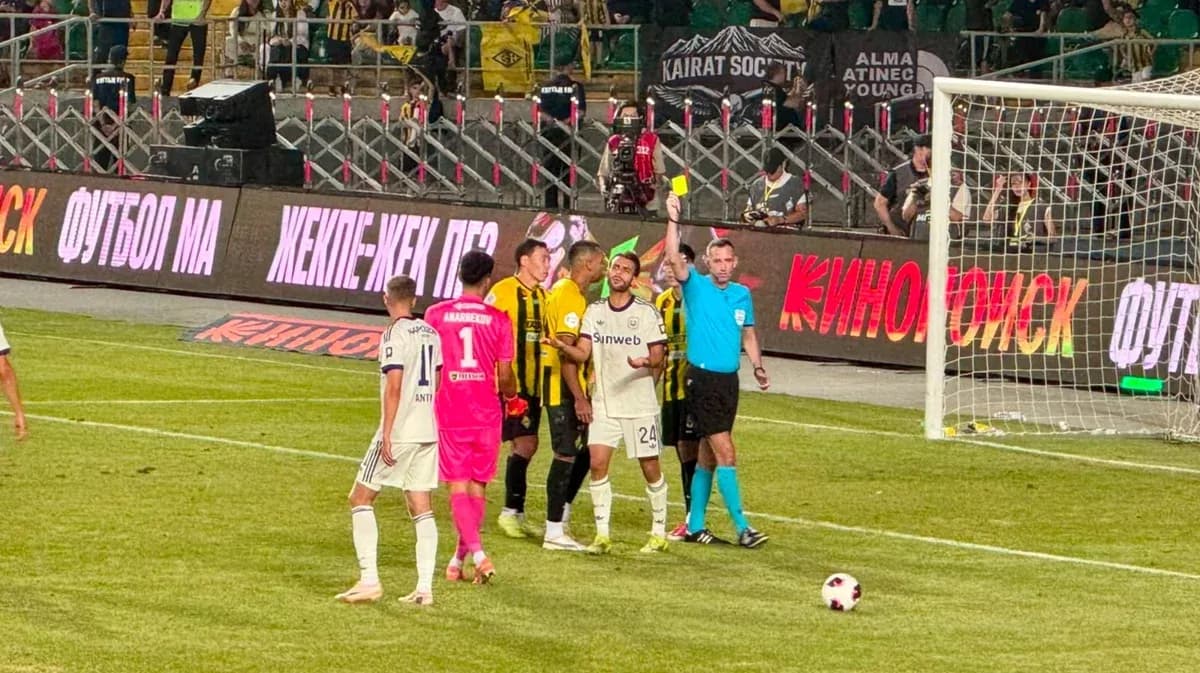
The 3–0 scoreline in Anderlecht’s favour at Central Stadium was the product of clear structural superiority and control of space rather than sheer volume of chances. With 67% possession and an 8–2 advantage in corners, Vitor Bruno’s 4-3-3 imposed its rhythm early and never really relinquished it, while Kairat Almaty’s 4-4-1-1 collapsed into a low block that was repeatedly stretched and eventually broken by a mix of width and central overloads.
Kairat’s Starting Shape
Kairat’s starting shape placed Edmilson as the nominal striker ahead of M. Gual, with wide roles for A. Mrynskiy and O. Jukkola outside the central pair of J. Oksanen and G. Mendonsa. The back four of L. Mata, Lucas Africo, A. Shirobokov and E. Tapalov was tasked with holding a relatively flat line in front of T. Anarbekov. The intention was clear: compactness between the lines, with Gual dropping to screen Anderlecht’s deepest midfielder and deny easy progression through the centre.
Anderlecht’s Tactical Approach
Anderlecht’s 4-3-3, however, was built to unpick that structure. L. Ambros and E. Llansana operated as advanced midfielders ahead of M. Kana, who stepped into the first line of build-up alongside centre-backs L. Petrot and G. Biancone. Full-backs L. Augustinsson and A. Maamar pushed high and wide, allowing the front three of M. Cvetkovic, D. Sikan and J. Nga Kana to attack the half-spaces and central channels. With Kairat’s lone striker unable to press both centre-backs and Kana simultaneously, Anderlecht consistently created 3v1 or 3v2 superiority in the first phase.
The early own goal from Oksanen at 2’ immediately changed the tactical landscape. Kairat, already set up to be reactive, were forced to consider whether to open up. Instead, they remained conservative, which suited Anderlecht’s plan: long possession sequences in the opposition half, patient circulation, and repeated probing down the flanks. The 5–1 disparity in blocked shots underlines how frequently Anderlecht managed to work shooting positions around the box, forcing Kairat’s defenders into last-ditch interventions.
Ambros’ goal at 24’ was emblematic of the structural problems in Kairat’s midfield. With Kana anchoring and drawing Gual’s attention, Ambros could arrive from deep into the right half-space, exploiting the gap between Kairat’s wide midfielder and central midfielder. The 4-4-1-1 struggled to track these third-man runs, especially once Anderlecht’s full-backs pinned Kairat’s wingers deep. As a result, the home side’s second line was perpetually stretched horizontally, opening central corridors for Ambros and Llansana.
Impact of the Red Card
The red card for Shirobokov at 39’ effectively ended any realistic prospect of Kairat mounting a comeback. Reduced to ten men, Kairat’s 4-4-1-1 morphed into a 4-4-1 with even deeper lines, sacrificing any meaningful counter-attacking threat. The numerical inferiority at the back also made it harder to control Sikan’s movements between the centre-backs and full-backs. His goal at 45’, assisted by Ambros, came at a critical psychological moment: just before half-time, confirming Anderlecht’s dominance and exposing Kairat’s inability to defend the box under sustained pressure.
Discipline further shaped the flow. Anderlecht committed 17 fouls to Kairat’s 11, reflecting an aggressive counter-press and a willingness to disrupt transitions high up the pitch. The four yellow cards for Anderlecht – to Mihajlo Cvetković, Ali Maamar, Giulian Biancone and Enric Llansana – point to repeated tactical infringements rather than isolated lapses, a by-product of defending large spaces with a high back line and full-backs advanced. Kairat’s single yellow for Jaakko Oksanen contrasted with Shirobokov’s red, which forced Rafael Urazbakhtin into immediate structural recalibration.
Second Half Adjustments
The second-half substitutions were largely about damage control for Kairat and load management for Anderlecht. At 46’, Kairat introduced O. Baybek for A. Mrynskiy, and Anderlecht brought on T. Degreef for M. Cvetkovic. For the hosts, this was an attempt to refresh the wide positions and add legs in midfield, but with only 33% possession and no clear pressing triggers, the changes did little to alter the territorial imbalance. Subsequent double changes at 60’ (A. Tuyakbaev for M. Gual and I. Bekbolat for Edmilson) further blunted any coherent attacking reference point, leaving Kairat without a consistent outlet to stretch Anderlecht’s defence.
Anderlecht’s later substitutions – O. Antman for J. Nga Kana at 63’, M. Winkler for A. Maamar at 74’, N. Ojea for E. Llansana and A. Bertaccini for D. Sikan at 84’ – allowed them to maintain intensity in wide and central areas while preserving the 4-3-3 structure. Fresh legs in midfield ensured that Kairat’s sporadic attempts to play out were quickly suffocated. The visitors continued to generate corners and shots, even if the scoreboard did not move beyond 3–0.
Statistical Overview
Statistically, the match paints a picture of controlled dominance rather than relentless siege. Anderlecht’s four shots on goal to Kairat’s two, combined with their five blocked efforts, show that they consistently reached shooting zones and forced Kairat into emergency defending. The corner count (8–2) and the overwhelming possession share confirm that the game was played largely in Kairat’s half. Kairat’s inability to translate their limited possession into high-quality opportunities, especially after going down to ten men, meant that the outcome was never seriously in doubt.
Tactical Summary
Tactically, Anderlecht’s superiority stemmed from their use of a flexible 4-3-3, intelligent positioning of their midfield trio, and aggressive full-back play. Kairat’s 4-4-1-1, already under strain after the early setback, could not cope with the overloads and was fatally compromised by the dismissal of Shirobokov. The final 3–0 reflects both the structural mismatch and the way key moments – an early own goal, a red card, and a goal on the stroke of half-time – amplified Anderlecht’s advantages.
Related News
Jagiellonia Dominates FC Iberia 1999 with Tactical Superiority

Mjallby AIF vs Red Bull Salzburg Tactical Analysis
Benfica Dominates Aarhus 3-1 in UEFA Europa League Play-offs
St. Truiden 1-0 Omonia Nicosia: Late Goal Seals First Leg Victory

OFI Secures 3-0 Victory Against CSKA Sofia in Europa League Play-offs

FK Crvena Zvezda Dominates Plzen 3-0 in Europa League Play-offs