
Barcelona Dominates Real Madrid with 2-0 Victory at Camp Nou
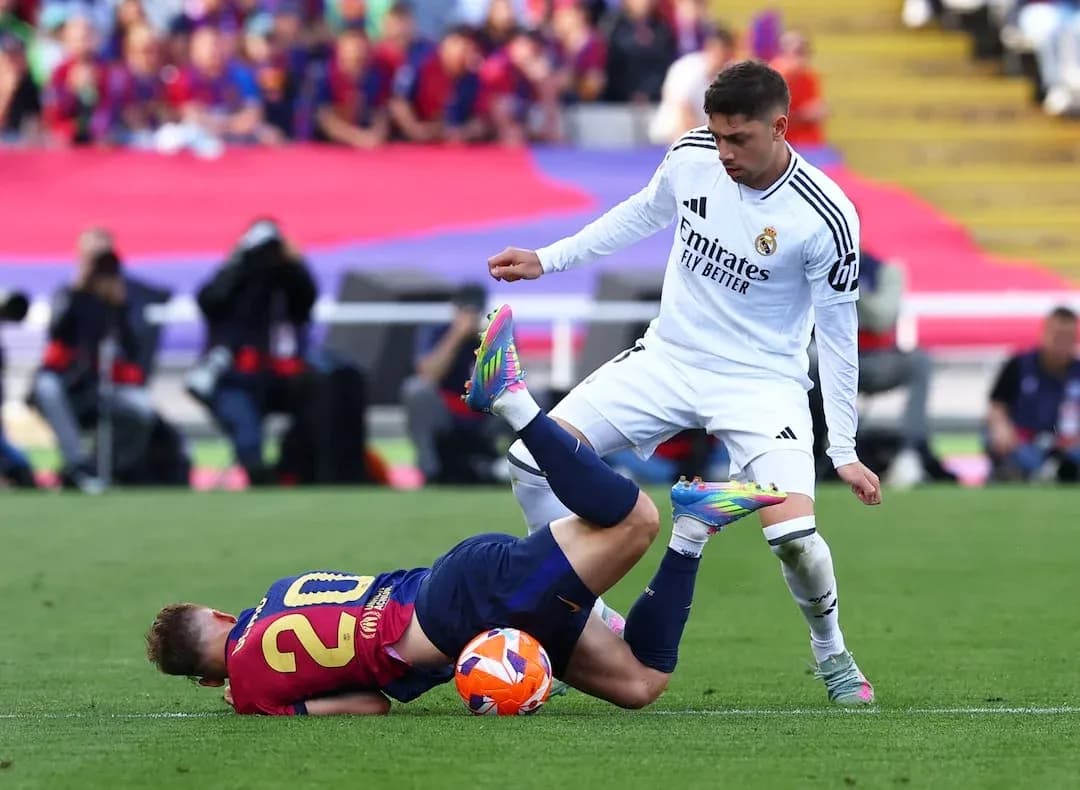
Barcelona’s 2-0 home win over Real Madrid at Camp Nou in La Liga’s Regular Season - 35 was built on early attacking precision and then a controlled defensive posture. Hansi Flick’s side struck twice in the first 18 minutes and then managed the game with structure and discipline, limiting Real Madrid to a single shot on target despite conceding 43% possession and eight corners. Alvaro Arbeloa’s Real Madrid grew territorially as the match went on but struggled to convert wide pressure and set-piece volume into clear central chances, with Barcelona’s compact 4-2-3-1 block protecting the box effectively.
I. Executive Summary of Discipline and Scoring Sequence
Scoring unfolded quickly and decisively. At 9', Marcus Rashford (Barcelona) opened the scoring with a Normal Goal, attacking from his advanced midfield role. At 18', Ferran Torres (Barcelona) doubled the lead with another Normal Goal, this time assisted by Dani Olmo, giving Barcelona a 2-0 advantage that would hold through half-time and full-time.
Card verification from the events array yields: Barcelona: 2 yellow cards, Real Madrid: 4 yellow cards, Total: 6.
Full disciplinary log (chronological, exact reasons):
- 40' Eduardo Camavinga (Real Madrid) — Foul
- 52' Dani Olmo (Barcelona) — Argument
- 52' Raúl Asencio (Real Madrid) — Foul
- 55' Jude Bellingham (Real Madrid) — Unallowed field entering
- 81' Raphinha (Barcelona) — Argument
- 81' Trent Alexander-Arnold (Real Madrid) — Argument
No VAR interventions or goal cancellations are listed; the 2-0 scoreline was established entirely within open play before the 20-minute mark and remained unchanged.
II. Scoring Sequence & Substitution Vector
Barcelona’s 4-2-3-1, with Ferran Torres as the nominal forward and Rashford from the line of three, immediately targeted Real Madrid’s back four. Rashford’s 9' Normal Goal reflected Barcelona’s ability to access the half-spaces behind Eduardo Camavinga and Aurélien Tchouaméni. At 18', a well-timed combination saw Dani Olmo find Ferran Torres, whose Normal Goal made it 2-0, locking in a commanding half-time score of Barcelona 2-0 Real Madrid.
Substitutions followed the flow of game management and Real Madrid’s attempt to change the dynamic:
- 64' Frenkie de Jong (IN) came on for Dani Olmo (OUT) — Barcelona
- 64' Raphinha (IN) came on for Marcus Rashford (OUT) — Barcelona
- 70' Thiago Pitarch (IN) came on for Eduardo Camavinga (OUT) — Real Madrid
- 77' Robert Lewandowski (IN) came on for Ferran Torres (OUT) — Barcelona
- 77' Marc Bernal (IN) came on for Gavi (OUT) — Barcelona
- 79' Franco Mastantuono (IN) came on for Brahim Díaz (OUT) — Real Madrid
- 79' César Palacios (IN) came on for Gonzalo García (OUT) — Real Madrid
- 88' Alejandro Balde (IN) came on for Fermín (OUT) — Barcelona
These changes shifted Barcelona towards a more conservative, possession-secure midfield (Frenkie de Jong, Marc Bernal) and freshened the wide threat (Raphinha), while Real Madrid introduced Thiago Pitarch and César Palacios to inject energy and different profiles between the lines.
III. Tactical Breakdown & Personnel
Barcelona’s 4-2-3-1 was built on Joan García in goal, a back four of Joao Cancelo, Gerard Martín, Pau Cubarsí, and Eric García, a double pivot of Pablo Gavi and Pedri, with Rashford, Dani Olmo, and Fermín López supporting Ferran Torres. The structure aimed to dominate central possession and attack quickly into the channels.
Offensively, Barcelona’s shot profile (10 total shots, 7 on goal, 9 from inside the box) shows how effectively they reached high-value zones. An expected goals value of 0.99 suggests they slightly outperformed their finishing relative to chance quality, but not drastically. Early verticality, especially via Olmo and Rashford, exploited Real Madrid’s midfield spacing before Arbeloa’s side could settle.
Out of possession, Barcelona accepted a degree of territorial concession: 57% possession but only four corners won, compared to Real Madrid’s eight, indicates that while Barcelona controlled the ball phases, Real Madrid’s best pressure came through forcing set pieces rather than sustained box entries. Barcelona’s back line remained compact, with Pau Cubarsí and Gerard Martín protecting the central corridor, funneling Real Madrid’s attacks wide towards Vinicius Júnior and Trent Alexander-Arnold’s side.
Joan García registered 1 goalkeeper save, which, combined with Real Madrid’s 1 shot on goal and xG of 0.79, underlines that most Madrid attempts were either blocked or off target rather than truly testing the keeper. The goals prevented figure of -0.53 for Barcelona indicates that, statistically, Joan García conceded fewer shots on target than expected relative to xG on target, but the volume was low.
Real Madrid mirrored Barcelona’s 4-2-3-1 with Thibaut Courtois behind a back four of Trent Alexander-Arnold, Raúl Asencio, Antonio Rüdiger, and Fran García; Camavinga and Tchouaméni as the double pivot; Brahim Díaz, Jude Bellingham, and Vinicius Júnior behind Gonzalo García. Their attacking structure relied heavily on wide overloads and crosses, reflected in 8 total shots but only 1 on target. The 0.79 xG suggests some moderate-quality looks, likely from cutbacks or second balls, but Barcelona’s central block and last-ditch defending forced inaccuracy.
Courtois’ 5 saves were central to preventing a heavier defeat. With Barcelona generating 7 shots on goal from 0.99 xG, Courtois’ goals prevented value of -0.53 suggests that, relative to shot quality, Barcelona might have been expected to score slightly fewer than they did; his workload was real, but the finishing from Rashford and Ferran Torres was decisive.
IV. The Statistical Verdict
Possession tilted 57% to Barcelona and 43% to Real Madrid, but the real divide lay in chance quality and box access. Barcelona produced 10 shots, 7 on target, and 0.99 xG, converting twice and forcing Courtois into 5 saves. Real Madrid’s 8 shots, 1 on target, and 0.79 xG illustrate a side that reached shooting positions but rarely in clean, central lanes.
Passing further underlines Barcelona’s control. They completed 527 total passes, 484 accurate (92%), reflecting a high Overall Form in ball circulation and tempo management. Real Madrid’s 394 total passes, 342 accurate (87%), show decent but not dominant control, often forced to play riskier vertical balls chasing the game.
Discipline was asymmetric and meaningful: Barcelona 2 yellow cards, Real Madrid 4 yellow cards, Total: 6. Real Madrid’s bookings for Foul (Camavinga, Raúl Asencio), Unallowed field entering (Bellingham), and Argument (Trent Alexander-Arnold) point to both tactical and emotional strain. Barcelona’s two Argument bookings (Dani Olmo, Raphinha) came while protecting the lead, but did not destabilize their structure. Combined, the data and events describe a match where Barcelona’s early precision and stable defensive index overcame Real Madrid’s late territorial push.
Related News
Barcelona Dominates Sevilla in Tactical Showdown
Atletico Madrid vs Real Madrid: A Tactical Derby Analysis
La Liga Officials Admit Refereeing Mistake in Madrid Derby Over Lee Kang-in's Tackle on Federico Valverde

Elche vs Real Madrid: A Clash of Opposites in La Liga

Atletico Madrid Dominates Osasuna 4-0 in La Liga Showdown

Barcelona's Dominance: 7-2 Triumph Over Racing Santander