
Barcelona's Striker Dilemma: Can They Compete Without a Number Nine?
Barcelona arrive at the new season looking heavier with medals, lighter through the middle.
The Spanish champions have spent the summer loading talent into almost every department. Rodri’s arrival from Manchester City brings a Ballon d'Or winner and World Cup‑winning captain into a midfield already overflowing with technicians. Anthony Gordon and Karim Adeyemi add raw speed and width. Belgian winger Jesse Bisiwu, just 18, is one for tomorrow.
Yet one glaring hole remains.
No striker.
With the first La Liga fixture away at Elche on Sunday, 23 August, Hansi Flick is preparing for the possibility of a full campaign without a recognised number nine if Barcelona fail to move before the window closes on 1 September.
Robert Lewandowski has gone, his contract up and his next chapter starting at Chicago Fire in Major League Soccer. At 37, his departure was coming, but it still rips out a reference point in attack. Ferran Torres, so often the man asked to step inside and cover through the middle, has joined Paris St‑Germain in a deal worth about 50m euros (£42.7m) after scoring 21 goals in 49 appearances last season.
Two exits. Two central options gone. No senior specialist striker left in the first‑team squad.
Barcelona’s preferred answer is clear: Julian Alvarez. The Argentina international, 26, made it known during the World Cup that he would be open to a move. Barcelona like the profile, the work rate, the penalty-box instincts. Real Madrid do too.
Atletico Madrid, though, have slammed the door. Chief executive Miguel Angel Gil Marin has already stated the club will not sell Alvarez – not even for 200m euros (£170.8m). It is a message aimed as much at Barcelona as at their city rivals.
Flick knows the situation cannot be ignored.
“We know we have to do something,” he said this month, while also stressing he has internal solutions.
The German has already pointed to Lamine Yamal’s ability to operate as a false nine and highlighted the flexibility of Gordon and Adeyemi across the front line.
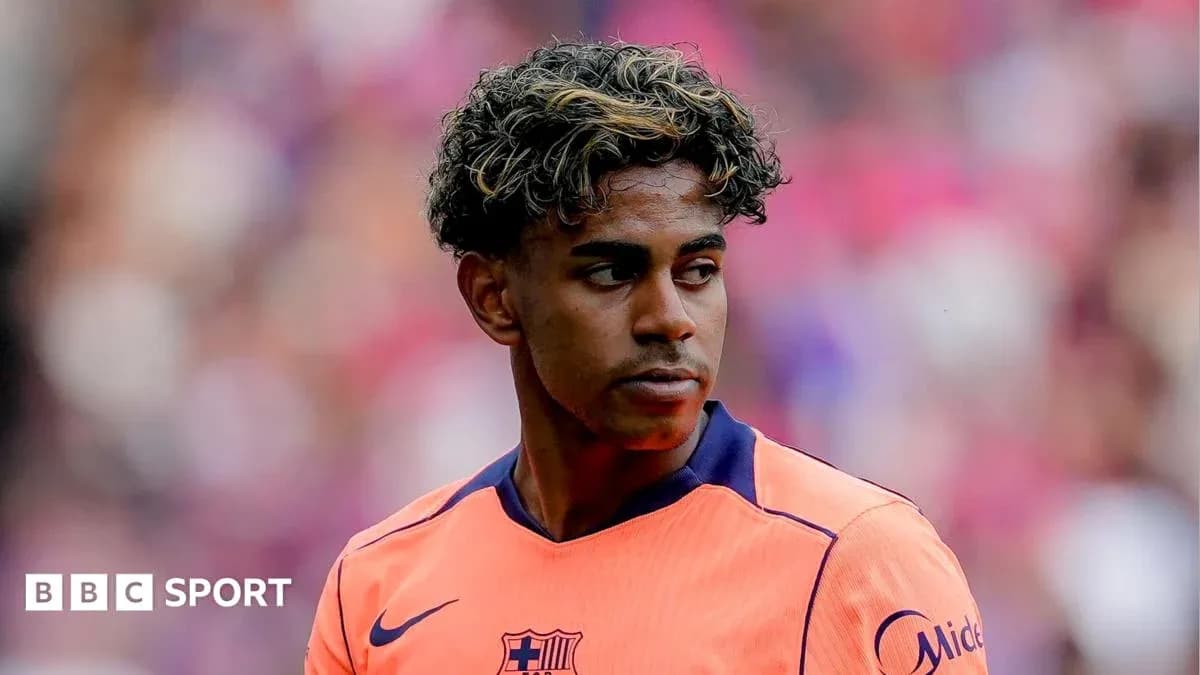
Lamine Yamal, still a teenager, has become the attacking focal point at Barcelona. He is coming off a season in which he scored 24 goals and lifted the World Cup with Spain, numbers that would be extraordinary for a veteran, let alone a player his age. His most devastating weapon, though, remains that familiar pattern: isolate the full-back on the right, shift inside, and conjure something from nowhere.
Flick, by instinct, wants him starting from that right flank, not locked between centre-backs.
There are other internal reshuffles on the table. Dani Olmo can step in as a false nine. Raphinha has already been used centrally under Flick. Fermin Lopez has spoken about his comfort in that role too, another option to drop in as a roaming focal point rather than a classic poacher.
Gordon and Adeyemi will stretch defences, drive into space, and attack the channels, but neither is a conventional penalty-box striker. Their presence nudges Barcelona towards a different idea: a rotating, fluid front three with no fixed spearhead, attackers constantly interchanging positions instead of one player occupying the centre-halves.
On paper, that kind of movement could make them a nightmare to mark.
Yet inside the club, the preference is unchanged. They want a specialist. Someone who lives between the posts, who gives structure to all that talent around him.
The clock is ticking towards 1 September. Barcelona have rebuilt almost everything.
The question is whether they dare chase another title without a true number nine.
Related News
Roy Keane Questions Manchester United's Midfield for Title Challenge

Wolves' Midfield Rebuild: Jordan James Joins Peixoto's Vision

Bernardo Silva and Kylian Mbappe: Reunion at Real Madrid

Manchester United Academy Faces Change as Youngsters Consider Arsenal Move

Prince Al-Waleed Poised for Full Control of Al-Hilal
Barcelona's Striker Dilemma: Can They Compete Without a Number Nine?