
Bayern Munich Wins Supercup: Key Insights and Tactical Shifts
Bayern Munich have the season’s first piece of silverware in their hands and a familiar feeling in their stomachs. A 2-1 win over Borussia Dortmund at a loud, impatient Signal Iduna Park delivered the Franz Beckenbauer Supercup to the German champions – and a handful of early storylines for the months ahead.
Nathaniel Brown and Michael Olise put Bayern 2-0 up by half-time, a margin that reflected their control. Fabio Silva’s reply on 75 minutes gave BVB late hope but not a comeback.
Neuer: still world class, still a live wire
Manuel Neuer has always lived on the edge. It’s what made him a revolutionary goalkeeper. It’s also what now keeps Bayern fans holding their breath a little more often than they’d like.
His feet have been a weapon for over a decade, dragging Bayern up the pitch, breaking pressure, starting attacks. But the balance between genius and danger is shifting. The costly pass to Arda Güler in Madrid last April still lingers in the memory; in Dortmund, the pattern reappeared.
After just 15 minutes, Neuer tried to punch a pass into Min-jae Kim. It went wrong. Badly wrong. Dortmund were almost in, only for Kim to clean up with the sort of recovery that erased the error from the scoreboard but not from the analysis.
Late on, the tension spiked again. A routine back-pass from Kim, a touch from Neuer, then a risky attempt to let Jobe Bellingham run past him into empty space. The feint behind his standing leg misfired, the ball sat up invitingly, and suddenly Bellingham had a clear sight of a dramatic equaliser. Neuer threw himself at the ball and smothered it brilliantly. A world-class save, born from a completely avoidable situation.
This is the paradox of late-career Neuer. On the line, he remains elite. Early in the second half he showed it again, reacting superbly to keep out Konstantinos Karetsas’ awkward close-range effort. His reflexes still win games.
But the mistakes with the ball are coming more often. Bayern know this is probably his final season. They also know Jonas Urbig is already in the dressing room, waiting. The plan is clear: Neuer for the biggest nights, Urbig eased in with more minutes than last year.
The question now nags away: are Neuer’s on-the-ball risks becoming frequent enough that Urbig starts to knock on the door of those “big nights” as well?
Brown the surprise No. 10 – and Bayern’s new trump card
Nathaniel Brown arrived in Munich as a left-back. He walked out in Dortmund as a No. 10 – and walked off with a medal and a goal.
With Jamal Musiala absent as he manages a neurological issue and new signing Ismael Saibari not yet ready to start, many expected Tom Bischof to slot in behind Harry Kane. Vincent Kompany had other ideas.
Brown played centrally, just off Kane, in a role he had only flirted with in pre-season. It was a bold call that said as much about Bayern’s tactical approach as it did about their squad depth.
“For us, the spaces of the full-backs are sometimes similar to those of a No. 10. He is unbelievably good between the spaces,” Kompany told Sky after the game, explaining why Brown had been pushed into the hole.
There were, naturally, a few loose touches and mis-timed runs. Brown has only been at the club a few weeks and this is hardly his comfort zone. But he grew into it, found pockets between the lines, and then made the moment that mattered: a sharp, eye-catching opener in the 28th minute that set Bayern on their way and handed him his first trophy with the club.
His performance underlined something important for the champions. Brown is not just a full-back. He can play as a No. 6, he can step into the No. 10 role, and he gives Kompany another card to play when injuries or form bite.
He is not alone, either. Konrad Laimer can operate on both defensive flanks and through the middle as a 6, 8 or 10. Josip Stanisic is comfortable on either side and can shift into centre-back. Bayern’s full-backs are no longer just full-backs; they are moving parts in a flexible system.
On a night when Serge Gnabry, Lennart Karl and Musiala were all missing, that flexibility won them a cup.
Kovac’s wing-back experiment: promising, but costly
Niko Kovac tried something different. It almost worked. Then it clearly didn’t.
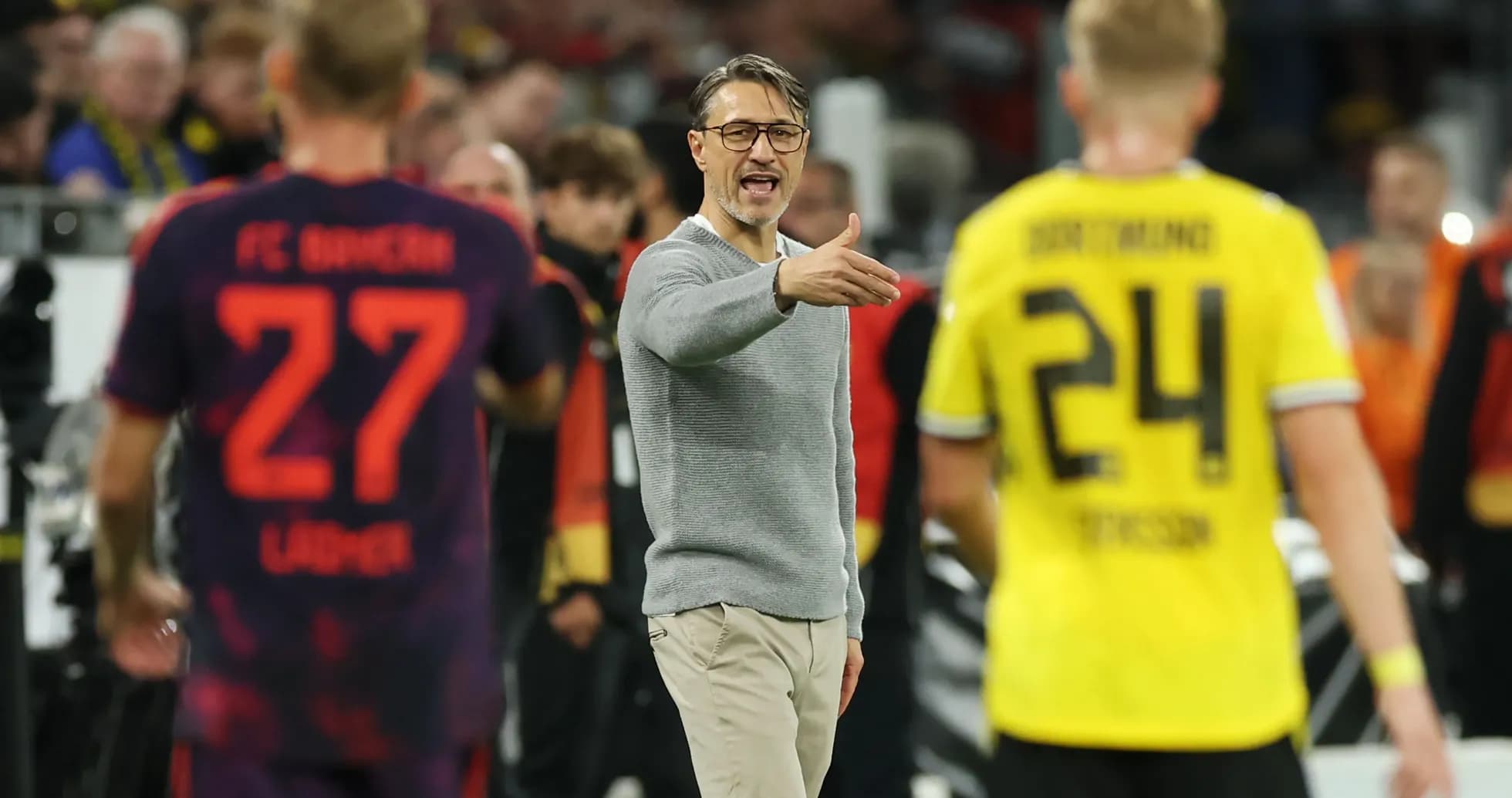
Dortmund started with left-footer Daniel Svensson at right wing-back and right-footer Julian Ryerson on the left. The idea was simple enough: inverted wing-backs, more threat when cutting inside, more options to shoot or slip passes between the lines.
“Every now and then we always need a player out wide who occupies someone,” Kovac said afterwards. With left on the left and right on the right, you go around the outside and cross. With inverted players, you can drive inside, like a classic winger on the wrong foot.
In the first half, the concept showed flashes. Ryerson, cutting in from the left half-space, whipped in a dangerous cross with his stronger right foot. Ramy Bensebaini flicked it in – just offside. Margins.
But the drawbacks were just as obvious. One of the biggest chances before the break came when Bensebaini fired a low ball across from the left. It found Svensson, who had drifted in from the right, near the penalty spot. On his weaker right foot, in an angle and body shape that didn’t suit him, he completely mistimed his swing and hit nothing but air. You could almost see Ryerson, with his right foot, finishing that chance in your mind’s eye.
At half-time, Kovac abandoned the experiment. Ryerson went back to the right, Svensson to the left.
“Because we saw that we had to change something,” he said. “And I think it also did us good.”
He was right. Dortmund were sharper, more direct, more dangerous down the flanks after the switch. They got in behind more often, and the goal that made it 2-1 came straight from that more natural balance: Svensson storming down the left, hitting the byline, and cutting the ball back perfectly for Fabio Silva to finish.
The tweak had shown promise. The reversal brought results. Kovac now has a tactical wrinkle he can revisit, but also a clear reminder: for all the theory about inverted roles, sometimes the simplest solution – left on the left, right on the right – still creates the best chances.
Fabio Silva’s reminder – and a transfer dilemma
While Serhou Guirassy toiled, Fabio Silva made his point.
Guirassy’s night mirrored his tougher spells from last season. He worked, pressed, battled. But he was hardly involved, never truly dangerous. After a little over an hour, Kovac had seen enough and turned to Silva for more spark in the box.
Silva delivered. He dropped into the right pockets, linked play, and then struck. For Dortmund’s goal, he cleverly peeled off, found the right space, and finished ruthlessly from close range. It was the kind of composed, clinical touch that had already appeared in flashes during his first year at BVB.
This time, it arrived on a bigger stage, in a match that mattered, against Bayern.
That changes the conversation.
Several clubs are circling the 24-year-old, with Betis Sevilla recently viewed as particularly keen. Silva himself is reportedly not fixed on staying, and Dortmund’s hierarchy would be open to a sale if the offer is right. A year after his arrival, he could already be on the move.
But his cameo in the Supercup complicates that logic. Late in the transfer window, with limited time to find a suitable replacement, can BVB really afford to let go of a forward who just showed he might be ready to explode in year two?
The Supercup didn’t just hand Bayern a trophy. It handed Dortmund a decision.
Related News

Dominik Szoboszlai's Late Penalty Saves Liverpool Against Newcastle
Tottenham Signs Omar Marmoush as Transfer Strategy Intensifies
Liverpool Stunned by Newcastle in Iraola's Premier League Debut
Alejandro Balde's Uncertain Future at Barcelona
Bayern Munich Wins Supercup: Key Insights and Tactical Shifts
Maresca's Tactical Gamble: Guehi's Surprise Midfield Role