
Beşiktaş Dominates FC Midtjylland in 1-0 Victory
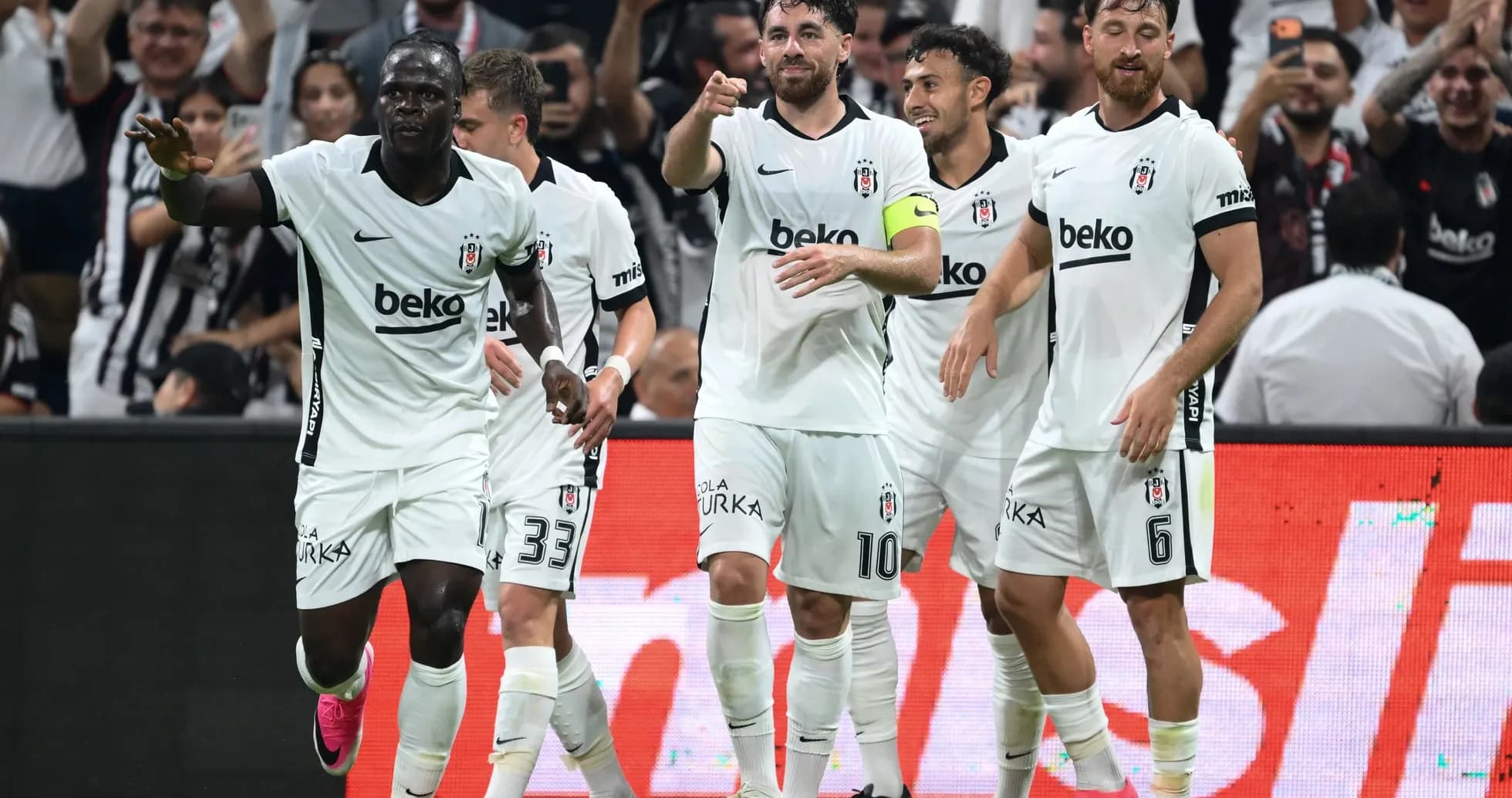
Beşiktaş’s 1-0 win over FC Midtjylland at Tüpraş Stadyumu was a textbook example of territorial dominance meeting numerical superiority. From the 15th minute red card to Friday Etim, the game tilted decisively towards Vincenzo Italiano’s 4-1-4-1, which turned sustained possession into a constant siege, even if the scoreline stayed narrow.
Structurally, Beşiktaş’s 4-1-4-1 operated as a very high, ball-dominant 2-3-5 in possession. Full-backs R. Yilmaz and E. Topcu pushed on to pin Midtjylland’s wide players, while S. Ozcan sat as the single pivot, creating a three-man first line with centre-backs T. Djalo and M. Murillo to recycle possession. Ahead of them, the four-man band of V. Cerny, J. Olaitan, O. Kokcu and I. Fakili constantly rotated between half-spaces and wide zones, with Oh Hyeon-Gyu as the lone reference up front.
The statistical profile underlines how complete that territorial control was: Beşiktaş finished with 75% ball possession, 685 total passes and 606 accurate passes, versus Midtjylland’s 237 total and 146 accurate. That volume of circulation was not sterile; it translated into 28 total shots, with 15 from inside the box and 13 from outside, plus 5 blocked shots. The shot map implied a team able to progress centrally and wide, then vary the final action between cut-backs and edge-of-box efforts.
Decisive Phase
The decisive phase came after the red card. With Etim dismissed on 15 minutes, Mike Tullberg’s 4-3-3 was forced into a reactive low block, often flattening into a 4-4-1. The early substitution on 18 minutes – V. Byskov (OUT) for D. Castillo (IN) – suggested an attempt to stabilise midfield and restore compactness between the lines. However, Beşiktaş’s structure was already pinning them back: the pivot Ozcan was always free to receive, and the interior pair Olaitan–Kokcu repeatedly found pockets between Midtjylland’s midfield and defence.
The 26th-minute goal by O. Kokcu, assisted by V. Cerny, was a logical product of this pattern. With Beşiktaş camped in the final third, Cerny’s positioning on the right half-space drew the defensive line narrow and created a central lane for Kokcu to arrive. Given Beşiktaş’s 7 shots on goal, the finish was one of several clear sights they manufactured, but it was the one that punished Midtjylland’s inability to adjust their block under numerical inferiority.
Defensive Control
Out of possession, Beşiktaş were rarely stretched. Midtjylland managed only 5 total shots (3 inside the box, 2 outside) and just 1 shot on goal. The home side’s rest defence – with Djalo and Murillo holding a high line and Ozcan screening – meant transitions were quickly killed at source. Fouls data reflects controlled aggression rather than chaos: Beşiktaş committed 12 fouls to Midtjylland’s 9, but without any yellow or red cards, indicating tactical, rather than reckless, interventions.
The goalkeepers’ roles were asymmetrical but telling. A. Nubel (Beşiktaş) was largely protected by the dominance in front of him, needing only 1 save across the 90 minutes. His main function was as an auxiliary playmaker, supporting the build-up behind the high line. At the other end, E. Olafsson (FC Midtjylland) had to keep his side alive, making 6 saves. That figure, against Beşiktaş’s 7 shots on goal, underlines how often he was exposed by the volume and quality of chances conceded.
Midtjylland's Response
Midtjylland’s attacking plan never really recovered from the red card. The initial 4-3-3 with Franculino and Etim ahead of a midfield line of Billing, Bravo and Byskov was built for vertical transitions and wide channel attacks. Reduced to ten, they had to sacrifice attacking presence to maintain central compactness. The 46th-minute substitution – Franculino (OUT) for M. Erlic (IN) – further signalled a tilt towards defensive solidity, effectively morphing into a back five in phases or at least a more conservative back four with added aerial presence.
Later, at 62 minutes, D. Osorio (OUT) for Cho Gue-Sung (IN) was an attempt to introduce a more direct outlet up front, but with only 25% possession and limited passing volume, service into the front line was sporadic. Their 2 corner kicks and 0 offsides hint at a lack of sustained field position and few runs in behind; they were defending too deep to threaten consistently.
In-Game Management
Italiano’s in-game management from 63 minutes onward was about energy and maintaining pressure rather than changing structure. At 63', I. Fakili (OUT) for M. Rashica (IN) and Oh Hyeon-Gyu (OUT) for S. Kilicsoy (IN) refreshed the front line and wide lanes, keeping the press and counter-press sharp. At 73', S. Ozcan (OUT) for K. Kayra Yilmaz (IN) and R. Yilmaz (OUT) for K. Ouattara (IN) ensured the pivot role and left flank retained intensity. The 78' change, T. Djalo (OUT) for E. Agbadou (IN), preserved physical presence at centre-back against any late direct balls from Midtjylland. These substitutions maintained the same 4-1-4-1 blueprint while avoiding a physical drop-off that might have invited pressure.
Midtjylland’s final substitution event at 83 minutes – an incoming K. Watjen (IN) with the outgoing player not specified – fits the pattern of trying to add fresh legs in midfield, but by then the tactical script was fixed: deep block, minimal ball, isolated forward.
Statistically, the verdict is clear. Beşiktaş’s 28 total shots to 5, 7 shots on goal to 1, 5-3 edge in blocked shots, and 5-2 advantage in corner kicks all align with the eye-test of near-total control. The absence of yellow cards for either side and a single red card for Midtjylland confirms that discipline was not a major narrative beyond the early dismissal; it was the structural consequence of that red card that defined the contest. In a Europa League 2nd Qualifying Round tie where margins can be thin, Beşiktaş produced a performance where the 1-0 scoreline significantly understates their tactical and statistical superiority.
Related News
AC Milan vs Benfica: A Clash of Two Philosophies in UEFA Europa League
Five Standout Europa League Players to Watch in 2026/27
AC Milan vs Benfica Europa League Clash: Team Updates, Lineups & Broadcast Info
Omonia Nicosia vs Benfica Predicted Lineups: Team News for UEFA Europa League
Red Bull Salzburg vs Ararat-Armenia Predicted Lineups and Team News
Celje vs Red Bull Salzburg Predicted Lineups and Team News