
Bournemouth and Manchester City Share Points in Tactical Stalemate
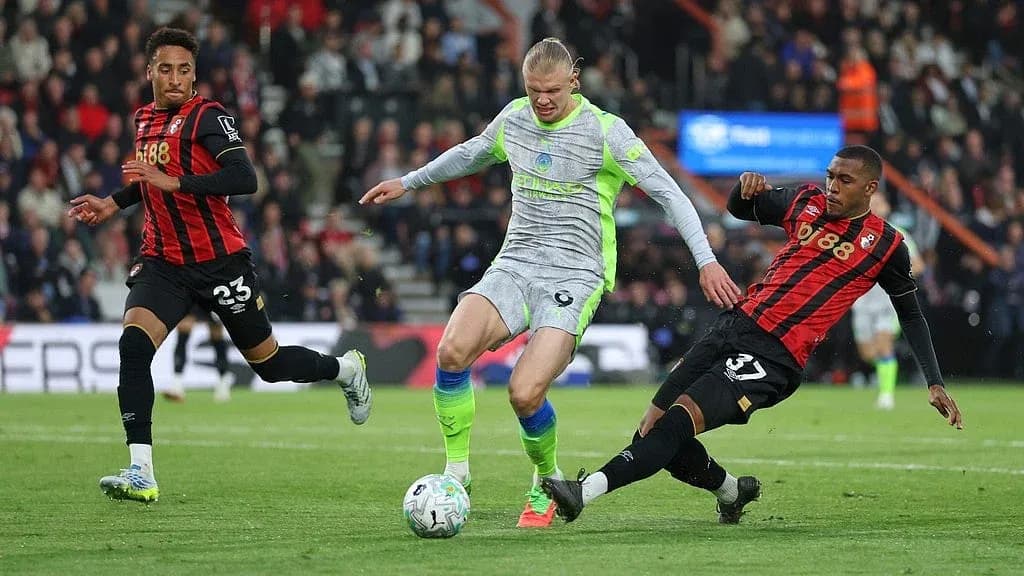
Under the soft spring lights of Vitality Stadium, Bournemouth and Manchester City played out a 1–1 draw that felt less like an upset and more like a statement. Following this result, the league table tells its own story: Bournemouth sit 6th with 56 points and a goal difference of 4 (57 scored, 53 conceded), while Manchester City remain 2nd on 78 points with a goal difference of 43 (76 scored, 33 conceded). Yet for ninety minutes on the south coast, those gaps in resource and reputation were compressed into a razor-thin margin.
I. The Big Picture – Two Identities, One Stalemate
The tactical shapes were revealing from the first whistle. Bournemouth, true to their seasonal identity, went with their trusted 4-2-3-1 – the same formation they have used in 35 of their 37 league matches. It is the framework behind a quietly impressive campaign: heading into this game they had 13 wins and 17 draws in total, losing only 7. At home they have been stubborn and expressive, with 7 wins, 10 draws and only 2 defeats, scoring 29 and conceding 20.
Manchester City answered with a 4-1-4-1, a shape they have used more than any other this season (13 times). It is designed to give Rodri the single-pivot command post, with a line of four technicians ahead and Erling Haaland as the fixed reference up front. On their travels City came into this fixture with 9 away wins, 6 draws and 4 defeats, scoring 32 and conceding 21 – still elite, but less suffocating than at the Etihad.
The first half followed the script of a team unafraid of a giant. Bournemouth’s 1–0 lead at the interval reflected a side that has averaged 1.5 goals at home and is comfortable trading blows with anyone. City, who usually score 2.1 goals per game overall and concede only 0.9, found themselves forced into patience and repetition, probing without prising the home block apart until late.
II. Tactical Voids – Suspensions and Discipline
Bournemouth’s squad sheet carried a quiet asterisk. Ryan Christie and Álex Jiménez were both listed as “Missing Fixture” – Christie through a red card suspension, Jiménez also suspended. Christie’s absence removed a high-energy, risk-taking midfielder who has already seen red this season; Jiménez, a defender with 10 yellow cards in the league, is both an aggressive ball-winner and a disciplinary liability.
In their place, Andoni Iraola leaned on a back four of Adam Smith, J. Hill, Marcos Senesi and Adrien Truffert in front of D. Petrovic. Without Jiménez’s overlapping aggression, Bournemouth’s full-backs had to balance adventure with restraint, particularly against the dribbling threat of Jérémy Doku and the half-space roaming of Bernardo Silva.
Discipline loomed large in the background. Bournemouth are a late-card team: 26.44% of their yellow cards arrive between 76–90 minutes, and another 21.84% between 91–105. City, too, spike late, with 19.70% of their yellows in the 76–90 range. This is a fixture primed for fraying edges in the closing stages, and the second half duly tilted towards City pressure and Bournemouth resistance, though without the meltdown that their card profiles sometimes hint at.
III. Key Matchups – Hunter vs Shield, Engine Room vs Enforcer
The headline duel was always going to be Erling Haaland against Bournemouth’s defensive core. Haaland arrived as the league’s top scorer with 27 goals and 8 assists in 35 appearances, taking 102 shots with 59 on target. He is not just a finisher; he has also missed a penalty this season, a reminder that even the most ruthless hunter has human edges.
Bournemouth’s “shield” was collective rather than individual. Petrovic, protected by Senesi and Hill centrally, had to contend with City’s volume: a side that, heading into this game, averaged 1.7 goals on their travels and had failed to score away only 3 times all season. Bournemouth’s defensive record at home – 20 conceded in 19 matches, an average of 1.1 per game – suggested they could bend without breaking, and for long stretches they did exactly that, especially in the first half when they restricted City to half-chances and sterile possession.
Further forward, Eli Junior Kroupi and Rayan gave Bournemouth a modern, vertical edge. Kroupi, with 13 league goals from 32 appearances, is a top-10 scorer in the division. His 21 key passes and 75% passing accuracy speak to a player who can both finish and link. Operating as one of the three behind Evanilson, he repeatedly looked for the spaces around Rodri, forcing City’s centre-backs to step out and exposing the channels.
For City, the “engine room” battle revolved around Rodri and the interior pair of Bernardo Silva and Mateo Kovacic against Bournemouth’s double pivot of Tyler Adams and Alex Scott. Rodri’s role was to suffocate transitions, but Bournemouth’s structure – with Tavernier and Kroupi tucking in – often created a 4-v-3 in the central band. Adams’ ball-winning and Scott’s composure under pressure were central to Bournemouth’s ability to play through City’s first line and spring Rayan and Kroupi between the lines.
On the flanks, Doku versus Smith and Truffert was a duel of pure acceleration against positional discipline. City’s 4-1-4-1 relies on wide players pinning full-backs, and Doku’s starting position on the left forced Smith to narrow, opening the far-side for late runs from Semenyo, who, intriguingly, was deployed as a midfielder for City in this match despite being one of Bournemouth’s own leading scorers in the league data. His 10 goals, 3 assists and 72 dribble attempts in the season profile underline the kind of direct threat City looked to harness in the half-spaces.
IV. Statistical Prognosis – xG, Margins and Meaning
While raw xG numbers are not provided, the season data frames the logic of this 1–1. Bournemouth’s overall scoring average of 1.5 goals per game and City’s concession rate of 0.9 suggest the hosts landing one goal sits right in the expected window. City, who score 2.1 goals per game overall and 1.7 away, underperformed their typical attacking output, a credit to Bournemouth’s compactness and Petrovic’s command.
Clean sheet trends also support the narrative. Bournemouth have 11 clean sheets in total, but against an attack of City’s calibre – 76 goals in 37 matches – keeping them entirely out was always unlikely. City, with 16 clean sheets overall and only 21 conceded away, are usually able to clamp down after setbacks, and their second-half equaliser felt like statistical gravity reasserting itself.
Following this result, the tactical takeaway is clear. Bournemouth’s 4-2-3-1, powered by Kroupi’s cutting edge and a disciplined back four, is no longer a plucky underdog system; it is a European-level platform capable of taking points off the elite. City’s 4-1-4-1 remains a territorial machine, but when the pivot is crowded and the box is protected, even a striker of Haaland’s volume can be reduced to moments rather than a torrent.
In narrative terms, this was not just a draw. It was a confirmation that Bournemouth’s season-long numbers – strong home record, resilient defence, and a genuine goal threat in Kroupi – translate under the harshest examination. For City, it was a reminder that on their travels, against organised mid-blocks, they must be closer to their 2.1-goal average if they are to turn dominance into titles.
Related News

Premier League Managers Facing Potential Sackings During International Break

Arsenal's Myles Lewis-Skelly Names Unexpected Tottenham Rival as Toughest Premier League Opponent

Three Premier League Players Shining Early This Season

Premier League Early Season Reactions: Man City’s Strength, Arsenal’s Flaws, United’s Struggles

Premier League Returns October 10 After Extended September-October International Break

Fulham and Manchester United Share Points in 1-1 Draw