
Canberra United Secures Future with New Owners and Men's Team Plans
Canberra United finally has what it has been crying out for: security, money on the table, and a roadmap to the A-League Men.
After two years of doubt and dead ends, Australian Sports Group (ASG) has stepped in as the club’s first private owner, buying the licence from Capital Football and immediately underwriting the A-League Women side for multiple years. The deal, believed to be worth around $15 million across both women’s and prospective men’s operations, includes a guarantee to support Canberra United to the tune of up to $3 million.
The takeover lands just in time to confirm United’s place in the 2026-27 A-League Women season. For a club that has lived with the threat of extinction, it is a line in the sand.
McKellar Park at the heart of the plan
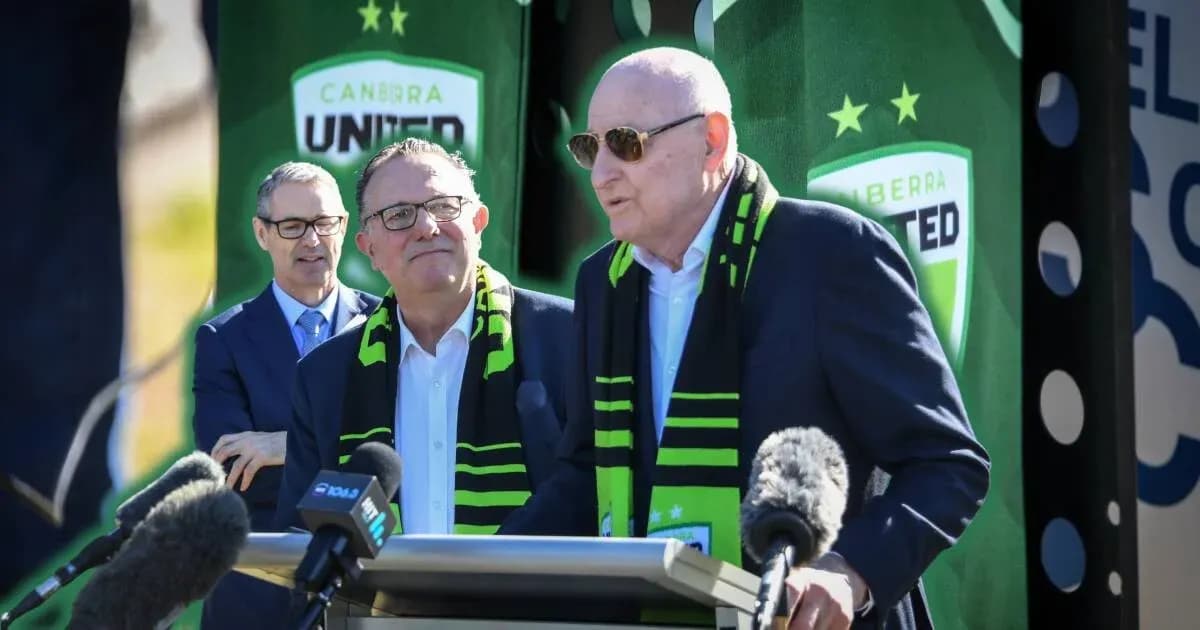
ASG chief executive Theo Fotopoulos and chairman Morris McAlister chose McKellar Park as the backdrop for their announcement, and that was no accident. The club’s “spiritual home” is central to the new era.
Fotopoulos confirmed Canberra United will keep playing at McKellar Park, while the neighbouring Belconnen Soccer Club will become a “strategic partner”. ASG will base its office there, anchoring the operation in the city’s north.
The ambition runs deeper than matchdays. ASG is actively exploring the creation of a dedicated training base at McKellar, turning the six-hectare private ground into a true home of elite football in the capital.
“It’ll come down to what we can get approved in terms of the facility here,” Fotopoulos told The Canberra Times, pointing to early talks that have left him “very positive” about what can be built on site.
Capital Football and the ACT government had previously drawn up plans for a training facility at the Throsby Home of Football, only for the project to collapse when the federation could no longer afford it. ASG is now scouring options across Canberra, but its intent is clear: it wants United’s base to sit where the club’s identity already lives.
“Football needs a home,” Fotopoulos said. “It’d be great to be able to develop that here.”
Coaching, continuity and a fast-approaching season
The clock is already ticking. Pre-season is due to start in six weeks, the A-League Women draw lands next month, and the new campaign kicks off on October 16.
ASG has moved early on the most important football decision: who leads the team. The owners have already held talks with current coach Antoni Jagarinec, who has steered United to the finals in each of the last two seasons, and want the coaching position finalised quickly.
“That is our priority to get that finalised,” Fotopoulos said. “In fact, we had some recent meetings with the coach.”
The Professional Footballers Australia (PFA) is currently working with the playing group, and ASG is pushing to lock in contracts “quicker than later”. Fotopoulos says the response from players has been encouraging and expects deals to be tied up in short order.
On Jagarinec, he was clear: the track record matters.
“It’s never a no-brainer, but yeah, look, I think his results speak for themselves. We’re looking for continuity and consolidation. We’ll have those announcements out pretty soon.”
Men’s team target: 2028-29
For Canberra’s long-running A-League Men dream, the news is both a breakthrough and a test of patience.
ASG holds an option, not yet a full licence, for a men’s team to enter the competition in the 2028-29 season. That’s three seasons away, later than many in the capital had hoped after almost two decades of lobbying, false dawns and stalled bids.
All the pre-announcement noise suggested a men’s side might follow just a year after the women’s future was secured. Instead, the formal timeline stretches further out. Concerns were inevitable.
Fotopoulos, though, was emphatic when asked if a Canberra men’s team will actually arrive.
“Well, we’re here today, so that’s your best guarantee,” he said. “That is part of our twin strategy. When we started speaking to the APL … that was part of our mix. We believe the strength comes from both. It would be almost discriminatory not to work with the men. It’s always been part of our plans.”
APL chair Steve Conroy backed that vision, calling ASG’s arrival “an exciting next step for professional football in the ACT” and highlighting Canberra as a key growth market for the A-Leagues.
For Canberra bid leader Michael Caggiano, who has driven the city’s push for a men’s licence over the past eight years, ASG’s commitment finally offers a defined pathway rather than another round of “wait and see”.
United by name – and still United by nature
One thing will not change: the badge.
Fotopoulos made it clear that the Canberra United name will stay, for both women and any future men’s side. After 18 years in the competition, the brand carries too much weight to discard.
“The name will remain the same, Canberra United,” he said. “You’ve got 18 years of Canberra United. Why would you change it? Unless somebody or the general public have got a negative view towards the team – I don’t think that’s the case.”
What he does want is a nickname, and he wants the city to choose it. Fotopoulos floated the idea of a public campaign, potentially run through The Canberra Times, to settle on a moniker that sticks. The Cosmos, Arrows, Greens, Lakers, Green Machine – the options are open, and ASG is inviting fans to define the next layer of identity.
“If the Canberra community want a nickname for their team, Green Machine, whatever they come up with, we’re happy to look at that,” he said.
Who are Australian Sports Group?
Behind the new era is a pair with deep roots in Australian football’s previous chapters.
ASG chairman Morris McAlister comes from a commerce background. He is governing director of Petron Plus 7 Australia and New Zealand, a company dealing in engine and machine products such as lubricants and grease, and serves as senior consultant at MEC Team Consultants, which connects Australian businesses with markets in China.
Fotopoulos is a marketing executive and chief executive of FOS Group Australia. Both men have long histories in the game. They were involved with the Sydney Cosmos, where Fotopoulos served as chief executive, and with the Newcastle Breakers in the old National Soccer League. Fotopoulos also previously held the chief executive role at Sydney Olympic.
Now they have two years to build out the framework for a men’s team while stabilising and growing one of the A-League Women’s best-supported clubs.
Pathways rebuilt, infrastructure promised
ASG’s arrival is not just about first teams. Fotopoulos has pledged to re-establish academy pathways in Canberra after Capital Football controversially shut down United’s academy three years ago, a move that left a gap in elite development for local boys and girls.
“We’re excited to be part of growing the A-Leagues and building a strong club focused on community engagement, football excellence, commercial growth, new infrastructure and strengthening the football development pathways for boys and girls in the territory and the capital region,” he said.
He also wants ASG to invest in football infrastructure in the city, aligning with the planned training base and broader facility upgrades.
For the A-Leagues, Canberra is no longer a problem to be solved but a market to be unlocked. Conroy thanked the ACT government and local football community for their backing, framing ASG’s investment as proof of the code’s momentum in the capital.
From uncertainty to ambition
Capital Football’s decision to step away from running Canberra United, after bearing the financial load since the club’s 2008 inception, had left a genuine risk that the ALW side would vanish. Last season was the federation’s last in charge, and without a buyer the licence hung in the balance.
Now the picture looks very different.
“Canberra is home to a thriving football community – a huge participant and passionate supporter base who have made Canberra United one of the most strongly supported A-League Women teams for the last 18 years,” Fotopoulos said. “We’re thrilled to be leading the next generation of professional football in Canberra, taking on the ownership of the Canberra United women’s team with a renewed focus on growth and investment, and progressing towards an integrated professional club with the introduction of an A-League Men’s team in season 2028-29.”
On the terraces at McKellar Park, the immediate reaction told its own story. Relief first. Then curiosity. Then, slowly, expectation.
Canberra United has been pulled back from the brink, its women’s future secured and a men’s team finally given a date on the horizon. The question now is not whether professional football survives in the capital – but how far, and how fast, this new project can really go.
Related News

India's Record Chase of 406 Against West Indies Highlighted by Gill's 223 and Rohit's Century

Alex Pereira Hints at Major UFC Bout: 'Big Challenge' Ahead

Three Hall of Famers, Ten Fights, 109 Rounds: The Forgotten Rivalry That Shaped Lightweight Boxing's Golden Era
Khamzat Chimaev and Colby Covington Set for RAF Abu Dhabi Title Clash in November
Thomas Tuchel Confident Harry Kane Will Join 100-Goal Club for England Soon

Cristiano Ronaldo Vows to Reveal Truth After Leaving Portugal Squad Amid Conflict