
Chivas Dominate Pumas 3-0 in Liga MX Clash
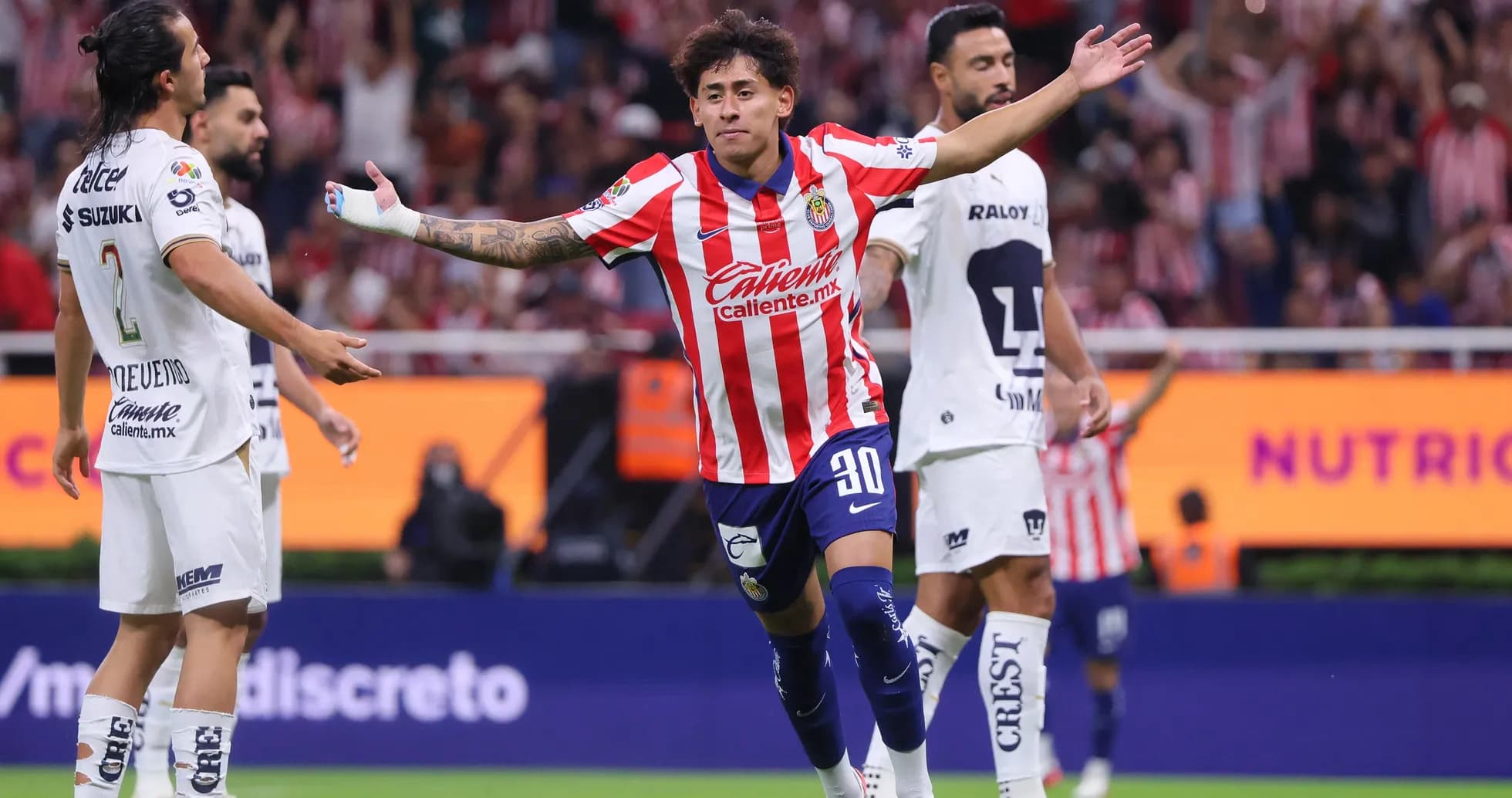
Under the Zapopan night at Estadio Akron, this Apertura Round 8 clash unfolded as a statement of intent. Guadalajara Chivas, already top of Liga MX heading into this game, played like a side fully aware of their status, dismantling U.N.A.M. - Pumas 3–0 in a mirror-image 3-4-2-1 duel that never felt as balanced as the formations suggested.
I. The Big Picture – Two 3-4-2-1s, One Superior Machine
Both coaches lined up in a 3-4-2-1, but the shared shape produced very different personalities.
Gabriel Milito’s Chivas, at home, leaned into the aggressive identity that has carried them to 1st place with 17 points and a goal difference of 9, built on 15 goals for and 6 against in total over 8 matches. The numbers fit the eye test: at home they average 2.3 goals scored and 1.0 conceded, and this performance slotted neatly into that profile. They pressed high, kept the back three compact, and allowed their attacking trident to roam with purpose rather than desperation.
Esteban Solari’s Pumas arrived as the league’s enigma. Their total record of 3 wins, 2 draws, and 3 defeats, with 11 goals scored and 12 conceded, paints a side that oscillates between bold and brittle. On their travels they had been adventurous, averaging 1.8 goals scored and 1.8 conceded away, but here their ambition was smothered early and never truly recovered.
The half-time score of 1–0 hinted at a contest. The full-time reality of 3–0 confirmed a gulf.
II. Tactical Voids – Discipline, Risk and the Edges of Control
In a match without listed absentees, the voids were tactical and psychological rather than personnel-based.
For Chivas, the main risk lay in their own aggression. The season data shows a team that can flirt with disciplinary danger: yellow cards cluster late, with 28.57% of their bookings arriving between 76–90 minutes and another 28.57% between 46–60. They have already seen one red card this campaign, also between 46–60 minutes. Yet on this night, the structure around their front line protected them from being dragged into chaos. The wing-backs and central midfielders compressed space intelligently, so defensive actions felt calculated rather than desperate.
Ángel Sepúlveda embodied that tightrope. In the league he carries both creative weight and a disciplinary shadow, with 2 assists and a red card already this season. Here, starting as the tip of the 3-4-2-1, he provided vertical runs and physical presence without tipping into recklessness. Milito’s management of his aggression has turned a potential liability into a controlled weapon.
Pumas’ void was more systemic. Their disciplinary profile shows a side that tends to lose control late: 27.27% of their yellow cards arrive between 76–90 minutes, and they, too, have seen a red card in the 46–60 window. In a structure that asks wing-backs and midfielders to cover large spaces, fatigue and frustration are constant threats. Pablo Bennevendo, who already has a red card this season, started as the right-sided midfielder in the line of four. His dual role as outlet and auxiliary defender left him exposed whenever Chivas switched play quickly.
III. Key Matchups – Hunter vs Shield, Engine Room vs Enforcer
The “Hunter vs Shield” duel was framed by two of Liga MX’s most influential attackers: Roberto Alvarado for Chivas and Juninho for Pumas.
Alvarado, one of the league’s top scorers with 3 goals and a stellar rating across 8 appearances, slotted into the right half-space of the Chivas box behind the striker. From there, he became the game’s quiet conductor. His season numbers tell the story: 386 passes with 14 key passes and 89% accuracy, plus 26 dribble attempts with 12 successes. Against Pumas’ back three of Rodrigo López, Nathan Silva, and Ricardo Duarte, Alvarado repeatedly found pockets between the lines, forcing them to step out or collapse inward. Either choice created space for Ricardo Marín and Sepúlveda to exploit.
Marín, a top assister in the league with 2 goals and 2 assists in 8 appearances, played as the mobile forward off Sepúlveda. His 84 passes and 4 key passes this season show a forward comfortable linking play, and in this match he acted as the hinge between midfield and the lone striker, dragging markers wide and opening central corridors for late runs.
On the other side, Juninho entered as Pumas’ primary hunter, with 4 goals in total and a sharp 7.03 average rating. His 10 shots and 4 on target this season, plus 11 dribble attempts with 7 successes, mark him as the one player capable of turning half-chances into goals. But the structure around him faltered. With Pumas’ goals against distribution showing vulnerability early (16.67% conceded in both 0–15 and 31–45) and again in the 46–60 and 76–90 windows (25.00% each), Juninho was forced to chase the game rather than shape it.
In the “Engine Room” matchup, the contrast was stark. Chivas’ midfield box of Roberto Alvarado, Osvaldo Govea, Fernando Gonzalez, and Hiram Camberos worked as a coordinated press, pinning back Pumas’ central trio of V. Arteaga, Pedro Vite, and Bennevendo. Vite, one of the league’s most carded players with 3 yellows, is also a key ball-winner with 11 tackles, 4 blocks, and 9 interceptions this season. Yet Chivas’ rotations forced him into constant lateral movement, reducing his ability to step in front and break lines. When your main enforcer is chasing shadows, your back three becomes exposed.
Out wide, Uriel Antuna was meant to stretch Chivas, but the home side’s back three of D. Aguirre, D. Campillo Del Campo, and Luis Romo held their line bravely, trusting the midfield to screen. That faith allowed them to stay compact against Juninho while still shuffling out to meet Antuna and Robert Morales, who himself has 3 assists and 15 shots this season. Morales found occasional pockets, but with Chivas defending in numbers and R. Rangel protected, his usual delivery into the box lacked targets and time.
IV. Statistical Prognosis – Why 3–0 Felt Inevitable
Following this result, the numbers and the narrative align neatly. Chivas’ total average of 1.9 goals scored and 0.8 conceded was always likely to collide with a Pumas side that averages 1.4 scored and 1.5 conceded overall, and 1.8 both scored and conceded away. A high-scoring, open game was on the cards, but Chivas’ defensive structure tilted the balance.
Pumas’ goal timing profile shows a late surge, with 27.27% of their goals arriving between 76–90 minutes. Yet their defensive timing is almost a mirror image of fragility, with 25.00% of their goals conceded in both 46–60 and 76–90. Against a Chivas side that often grows into games and has already kept 4 clean sheets in total, that intersection was always going to be decisive. Once Chivas took control, Pumas’ traditional late push became a risk rather than a weapon.
In a league where small margins and chaotic endings are the norm, this match felt unusually clear-cut. Chivas’ superior structure, their layered attacking threats through Alvarado, Marín, and Sepúlveda, and their disciplined control of the game’s tempo turned a tactical mirror into a one-sided reflection. The 3–0 scoreline was not just a result; it was the logical endpoint of two teams on very different tactical trajectories.
Related News
FC Juarez vs Tigres UANL Prediction: Betting Tips and Team News
Monterrey vs Tigres UANL: Clásico Regio Preview
Club America vs Guadalajara Chivas: Head-to-head Stats and Insights
Cruz Azul vs Club America: A 4-3 Thriller at Estadio Banorte

Monterrey vs Cruz Azul Stats: Head-to-Head Record Analysis
FC Juarez vs Tigres UANL Stats: Head-to-Head Record