
Craiova vs Ararat-Armenia: Tactical Analysis of 1-1 Draw
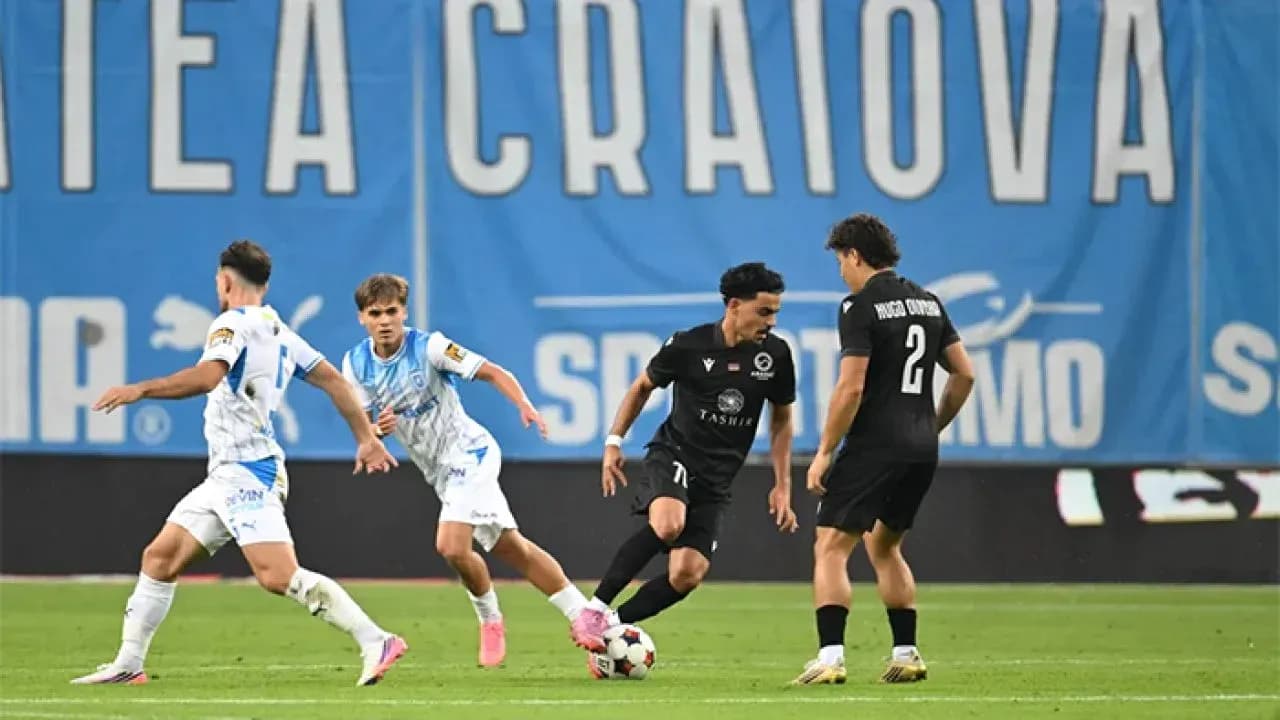
Universitatea Craiova’s 1-1 draw with Ararat-Armenia at Stadionul Ion Oblemenco was tactically defined by structure and territory rather than control of the ball, with both teams officially recorded at 0% possession but showing very different attacking profiles and risk management.
Craiova lined up in a 3-4-3 under Filipe Coelho, with L. Popescu behind a back three of O. Romanchuk, Adrian Rus and V. Screciu. The wide band of C. Mora and N. Bancu, flanking A. Mekvabishvili and A. Cicaldau, was clearly designed to stretch Ararat-Armenia’s 4-3-3 and pin their full-backs. Up front, the trio of D. Matei, A. Al Hamlawi and S. Baiaram provided vertical threats between the lines and in the half-spaces.
Ararat-Armenia’s 4-3-3, coached by Tulipa, was more orthodox: Joao Bravim in goal, a back four of Junior Julio, B. R. Wilson Valdez, A. Malis and E. Grigoryan, with H. Oliveira stepping into midfield alongside Benny and K. Muradyan. Ahead of them, A. Serobyan and Z. Banjaqui supported central forward Sandro Lima. The structure was built to be compact horizontally, with the three midfielders screening central zones and the wingers tracking Craiova’s wing-backs.
The early pattern reflected this: Ararat-Armenia were more direct and opportunistic, Craiova more patient and wing-oriented. The visitors’ 2 shots on goal from only 6 total attempts (2 on, 4 off) underline a selective shot profile, often waiting for clearer looks rather than volume. One of those early forays produced the opener at 20', when A. Malis scored for Ararat-Armenia, assisted by H. Oliveira. The centre-back’s goal, coming from a defender’s run and delivery, encapsulated Tulipa’s plan: exploit set phases and secondary balls with defenders stepping into advanced positions.
Craiova’s response was structurally coherent. With three centre-backs and a four-man midfield, they were able to push Bancu and Mora high to pin Ararat-Armenia’s full-backs, while Mekvabishvili and Cicaldau controlled second balls. The hosts generated 7 shots on goal and 7 off goal, plus 1 blocked shot, illustrating a high-volume, pressure-based attacking approach. The equaliser at 33' reflected that dynamic: N. Bancu scored for Universitatea Craiova, assisted by A. Cicaldau, a classic pattern of a central midfielder finding the advanced wide man breaking into the box.
From that point, the game became a contrast between Craiova’s territorial dominance and Ararat-Armenia’s compact resilience. Craiova’s 8 corner kicks to Ararat-Armenia’s 4 show how often Coelho’s side forced the visitors back onto their own goal-line. The 3-4-3 allowed them to overload wide channels, with Bancu and Mora repeatedly combining with the front three and forcing clearances. However, the lack of recorded data for total passes and passing accuracy prevents a deeper passing-network analysis; what is clear is that Craiova turned pressure into shots and corners rather than into clear scoreboard superiority.
Defensively, Craiova’s aggression is visible in the foul count: 15 fouls to Ararat-Armenia’s 5. The hosts accepted defensive risk to keep the game in the visitors’ half, stepping out aggressively with their back three and midfielders. This approach translated into disciplinary pressure: Universitatea Craiova collected 4 yellow cards, all on their side, while Ararat-Armenia finished without a booking. The cards to David Matei (39'), Oleksandr Romanchuk (47'), Adrian Rus (69') and Monday Etim (78') underline how often Craiova’s defenders and forwards had to halt transitions or contest duels at full stretch.
Tulipa’s side, by contrast, defended with control rather than desperation. Only 5 fouls and 0 yellow cards suggest that Ararat-Armenia maintained their shape, relied on positional discipline and avoided reckless challenges. Their 2 blocked shots, compared to Craiova’s 1, reinforce the picture of a low-block team that protected the central corridor and forced the hosts to shoot through crowds.
The substitution pattern from Coelho further clarifies his tactical intent. On 62', S. Nsimba (IN) came on for A. Al Hamlawi (OUT), and M. Etim (IN) came on for D. Matei (OUT, listed as D. Matei in the event log but David Matei in the card event), injecting fresh pace and direct running into the front line. Later, at 69', Teles (IN) replaced A. Cicaldau (OUT), adding new energy and perhaps more vertical passing from midfield. The double change at 85', with T. Baluta (IN) for A. Mekvabishvili (OUT) and L. Basceanu (IN) for S. Baiaram (OUT), was a final attempt to tilt the balance with fresh legs in both midfield and attack, without altering the underlying 3-4-3 structure.
Ararat-Armenia’s substitutions were more about preserving balance and legs than changing the model. Franca Carlos (IN) for Benny (OUT) at 69' refreshed the midfield screen. On 75', J. A. Balanta (IN) replaced H. Oliveira (OUT), swapping one box-to-box profile for another. The triple change at 80' — Z. Shaghoyan (IN) for Z. Banjaqui (OUT), M. Carlier (IN) for K. Muradyan (OUT), and A. Tera (IN) for A. Serobyan (OUT) — essentially rebuilt the midfield and wide lines to maintain intensity in the closing stages, but kept the 4-3-3 shape intact.
In statistical terms, the match reads as a classic “home pressure vs away efficiency” scenario. Universitatea Craiova led the attacking metrics: 7 shots on goal versus 2, 7 shots off goal versus 4, and more corners (8 to 4). Their higher foul and card counts reflect an aggressive, front-foot defensive strategy designed to sustain pressure and prevent transitions. Ararat-Armenia, with fewer shots and corners, nonetheless extracted maximum value from their limited attempts, scoring once and otherwise staying compact enough to restrict Craiova to just the single goal.
With goalkeeper saves and xG data absent, we cannot quantify shot quality or shot-stopping, but the raw shot and corner numbers suggest that Craiova created volume without finding a decisive second breakthrough. Ararat-Armenia’s ability to withstand sustained pressure, avoid bookings and remain dangerous enough to score first speaks to a disciplined, well-drilled 4-3-3 that travelled to Craiova to manage the tie rather than dominate it.
Tactically, the 1-1 draw leaves the impression of a home side structurally geared to attack and a visiting side structurally geared to survive and counter. Craiova’s 3-4-3 successfully generated width and chances; Ararat-Armenia’s 4-3-3 successfully compressed central spaces and limited damage. Over a two-leg context, this balance of risk and control from both coaches could prove decisive.
Related News
Beşiktaş Dominates Kauno Žalgiris in 3-0 Victory
Trabzonspor vs Ferencvarosi TC: Tactical Analysis of 0-1 Defeat
Egnatia Rrogozhinë vs Lillestrom: Tactical Analysis of a 0-0 Draw
Craiova vs Ararat-Armenia: Tactical Analysis of 1-1 Draw
Lech Poznan's Tactical Masterclass Against FC Thun
Jagiellonia Dominates FC Iberia 1999 with Tactical Superiority