
Cruz Azul vs Club America: A 4-3 Thriller at Estadio Banorte
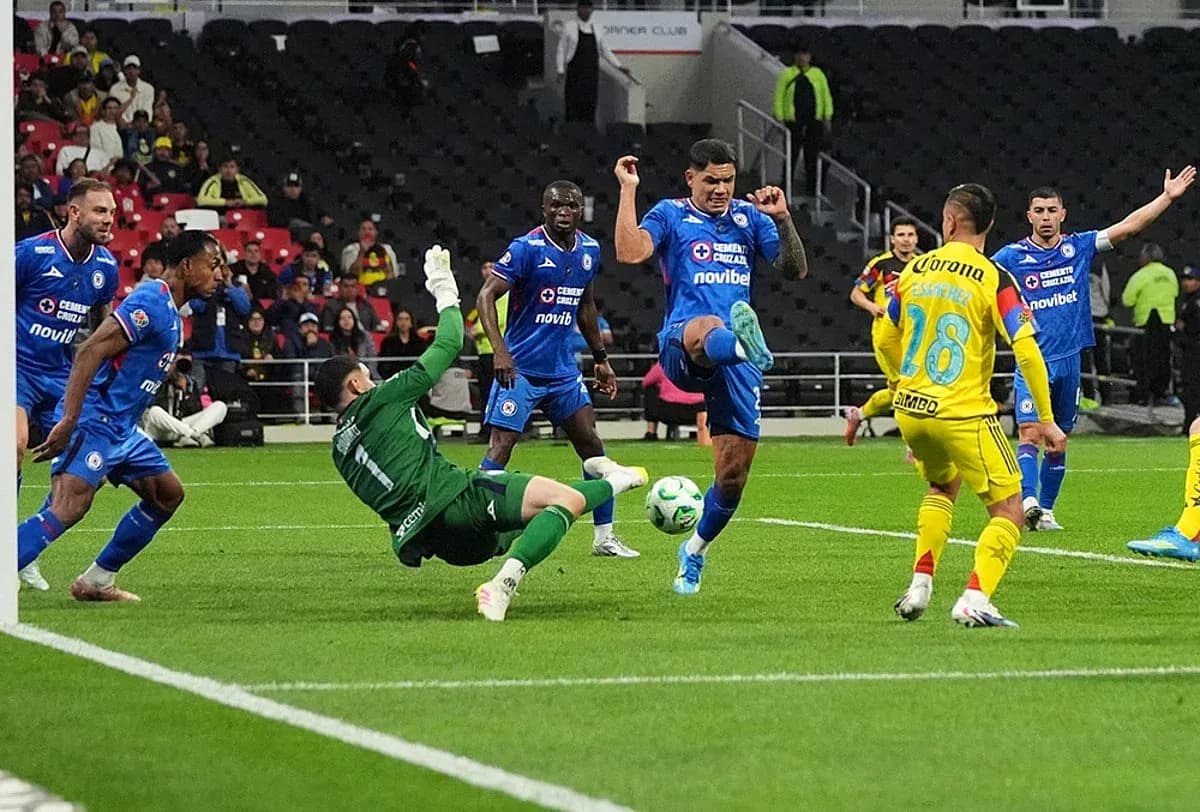
The night at Estadio Banorte felt like a distillation of everything this Apertura has made of Cruz Azul and Club America: two sides built to attack, each carrying their own structural flaws, colliding in a seven-goal storm that finished 4–3 to the hosts after 90 breathless minutes.
Heading into this game, the table already framed it as a heavyweight clash. Cruz Azul sat 4th with 15 points from 8 matches, their overall goal difference a fragile +2 (16 scored, 14 conceded). Club America arrived in 3rd on 16 points from 7 games, with a far more imposing overall goal difference of +9 (15 for, 6 against). On paper, America were the more balanced machine; on the pitch, Cruz Azul were the more chaotic, high-variance side. The 4–3 scoreline simply confirmed the scouting report.
I. The Big Picture – Structure and Intent
Cruz Azul’s 5-4-1 under Joel Huiqui was never a purely defensive shape. With Kevin Mier in goal and a back five of Érik Lira, Willer Ditta, Ángel García, Juan Orozco and O. Campos, the hosts built a broad, flexible platform. The wing-backs were tasked with stretching America’s 4-2-3-1, while the central trio of José Paradela, Agustín Palavecino and Jeremy Márquez supported Carlos Rodríguez between the lines. Nicolás Ibáñez, alone up front on the teamsheet, was actually the tip of a fluid, rotating attacking unit.
This structure mirrored Cruz Azul’s seasonal DNA. Overall they had scored 16 goals in 8 league matches, an average of 2.0 per game, with 9 of those at home (1.8 per home match). But they had also conceded 14 overall, 9 of them at home at the same rate of 1.8. Their biggest home win and their biggest defensive scare were, tellingly, the same scoreline: 4–3. This is a side that lives on the edge.
Club America, by contrast, came in with a more orthodox 4-2-3-1 that has become their signature: six league matches in that shape already this season. Rodolfo Cota started in goal behind a back four of D. Espinoza, Igor Reyes, Rodrigo Juárez and Kevin Álvarez. The double pivot of Érick Sánchez and Alan Cervantes underpinned a high-technical band of three – I. Violante, Raphael Veiga and Brian Rodríguez – feeding Henry Martín as the lone striker.
America’s numbers suggested control and late-game ruthlessness. Overall they had scored 15 goals in 7 matches (2.1 per game), with 8 at home at a ferocious 2.7 per home match and 7 on their travels at 1.8 per away match. Defensively they had allowed just 6 overall (0.9 per game), with a perfect defensive record at home (0 conceded) and 6 away (1.5 per away match). The 4–3 defeat here became their heaviest away concession of the season, matching the 4 goals they had already once allowed on their travels.
II. Tactical Voids – Discipline and Margins
Neither side had a formal list of absentees in the data, so the tactical voids were less about missing names and more about structural risk.
For Cruz Azul, the glaring vulnerability has been the third quarter of games. Heading into this fixture, 35.71% of their goals conceded came between minutes 46–60, and another 21.43% arrived from 76–90. It is a team that can lose its grip after half-time and again in the closing stretch. The defensive average of 1.8 goals conceded overall – identical at home – underlines how often their matches open up.
Discipline adds another layer. Their yellow cards are heavily clustered between 46–75 minutes, with 43.75% shown from 46–60 and 31.25% from 61–75. That means their most fragile defensive period overlaps with their most card-prone window, a dangerous mix when protecting a lead. The absence of red cards this season suggests control at the very edge, but it is still a tightrope.
America’s disciplinary profile is different. Their yellows are more evenly spread, but the 61–75 window again stands out (25.00% of their yellows). The red card pattern is stark: 100.00% of their reds this season have arrived between 76–90 minutes. In other words, when America chase or defend late, they flirt with meltdown. In a match that finished 4–3, that late-game volatility felt baked into the narrative even without a dismissal here.
Penalties have also shaped both squads’ psychology. Cruz Azul had taken 3 penalties this season, scoring only 1 and missing 2; they simply cannot claim to be reliable from the spot. America had 2 penalties overall, scoring 1 and missing 1. Even their star forward Henry Martín carries that duality, with one penalty scored and one missed this campaign.
III. Key Matchups – Hunter vs Shield, Engine Room vs Enforcer
The most fascinating duel on paper was the “Hunter vs Shield” dynamic between Cruz Azul’s attacking core and America’s away defence.
Cruz Azul’s overall scoring distribution showed a clear attacking surge before half-time: 25.00% of their goals arrived between 31–45 minutes, and 18.75% from 46–60. Their late-game threat was also real, with 18.75% of goals between 76–90 and another 12.50% in the 91–105 window. Those peaks intersected brutally with America’s defensive soft spots. Fully 50.00% of America’s goals conceded came between 31–45 minutes, and 33.33% between 61–75. It was almost scripted: Cruz Azul’s most productive windows aligned with America’s most fragile.
Within that framework, the individuals mattered. Jeremy Márquez, listed as a defender but functionally a hybrid in Huiqui’s 5-4-1, came into this match as one of the league’s top scorers with 3 goals and 1 assist. His 21 tackles and 12 interceptions, plus 1 blocked shot, made him a two-way pillar. When Márquez stepped into midfield, Cruz Azul effectively morphed into a back four in possession, overloading America’s double pivot.
Ahead of him, Ibáñez carried his own threat: 3 league goals from 21 shots, 14 on target, plus 7 key passes. He had also blocked 3 shots, pressing from the front. His role against Reyes and Juárez was to pin the centre-backs and force them into uncomfortable decisions about when to step out.
On America’s side, the attacking “Hunter” was actually a trio. Brian Rodríguez, with 3 goals and a 7.48 average rating, arrived as one of the league’s form attackers. His 12 shots (8 on target) and 15 key passes marked him as both finisher and creator. Henry Martín matched him for goals (3) and added 1 assist, winning 32 of 68 duels and drawing 6 fouls – the classic reference nine who can both finish and batter a back line. Behind them, Raphael Veiga was the conductor: 1 goal, 2 assists, 20 key passes and 15 shots (8 on target) made him the creative axis between lines.
The “Engine Room vs Enforcer” battle revolved around Cruz Azul’s ball-players against America’s double pivot. Carlos Rodríguez came in as the league’s leading assister with 5 assists and 36 key passes, at an 82% pass accuracy. Alongside him, Paradela added 4 assists and 20 key passes, plus 10 tackles and 3 blocked shots. This pair were tasked with playing through Alan Cervantes and Érick Sánchez.
Cervantes, however, is no passive shield. He had 8 tackles, 5 interceptions, 1 blocked shot and an excellent 92% pass completion, but also carried a disciplinary edge: 2 yellow cards and 1 second yellow already this season. His mandate was to disrupt Rodríguez and Paradela without crossing the line. Once he stepped out of position, Veiga and Brian Rodríguez had to help collapse the central lanes, or Cruz Azul’s midfield would simply pass through the first line and attack the space in front of Reyes and Juárez.
IV. Statistical Prognosis – Chaos as a Feature
From a probabilistic lens, this fixture always pointed towards a high-event contest rather than a cagey chess match. Cruz Azul’s under/over profile showed that overall, 5 of their 8 matches had gone over 1.5 goals, but only 3 had gone over 2.5 and just 1 over 3.5. America, meanwhile, had gone over 1.5 in 5 of 7 and over 2.5 in 3 of 7. The defensive numbers – 1.8 goals conceded overall for Cruz Azul, 0.9 for America – suggested that if anyone dragged the match into chaos, it would be the hosts.
That is precisely what unfolded. Cruz Azul’s season-long habit of striking before half-time (25.00% of goals from 31–45) met America’s worst defensive window (50.00% conceded in that same period), and the 3–0 half-time scoreline reflected that mismatch. Then, true to type, Cruz Azul’s vulnerability after the break (35.71% of goals conceded from 46–60 and 21.43% from 76–90) allowed America back into the contest, turning a rout into a thriller.
Following this result, the broader tactical lesson is clear. Cruz Azul are not accidentally chaotic; their squad is built for volatility. With Márquez stepping into midfield, Rodríguez and Paradela threading passes, and Ibáñez constantly threatening the last line, they are structurally designed to create chances – but the same aggression leaves their back five exposed in transition.
America, on the other hand, remain a high-level side whose away defensive numbers took a hit here but whose core principles hold: a disciplined double pivot, a creative 10 in Veiga, and a front line of Martín and Brian Rodríguez that will continue to generate xG in volume. Their late-game scoring surge – 33.33% of their goals arriving between 76–90 minutes – nearly rescued a point, and that pattern will persist.
In the end, this 4–3 was less an anomaly than a crystallisation of who these teams are. Cruz Azul embrace risk and live with the consequences. Club America trust their structure and their talent to carry them through storms. On this night at Estadio Banorte, the storm simply hit too early and too hard.
Related News

Monterrey vs Cruz Azul Stats: Head-to-Head Record Analysis

FC Juarez vs Tigres UANL Stats: Head-to-Head Record

Monterrey vs Tigres UANL preview: key match details and predictions

Guadalajara Chivas vs U.N.A.M. - Pumas match preview: date, venue & prediction
Monterrey vs Tigres UANL Predicted Lineups: Liga MX Clash

Guadalajara Chivas vs U.N.A.M. - Pumas Predicted Lineups