
Declan Rice's Boot Switch: From adidas to Nike and Beyond
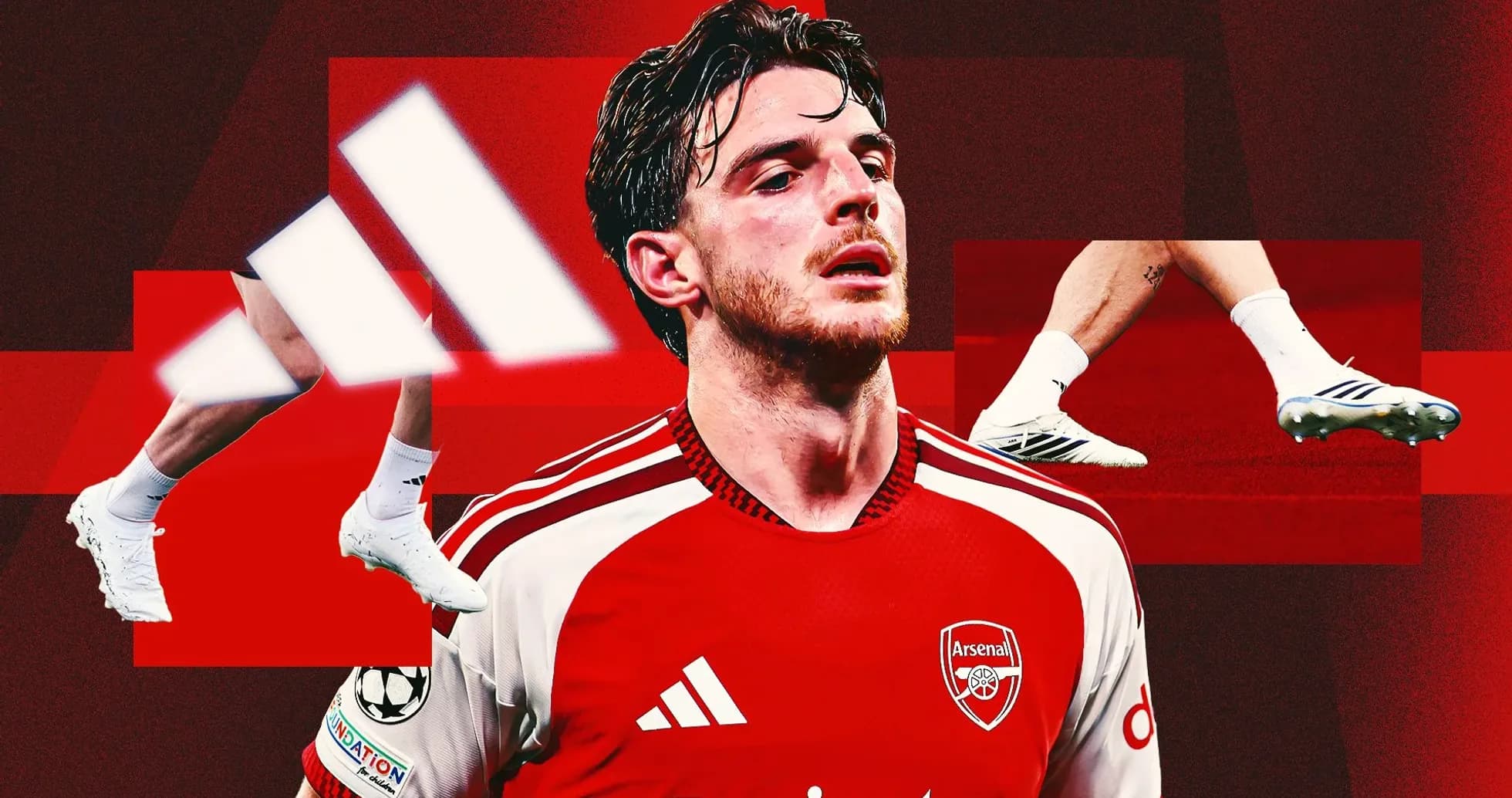
Declan Rice has always made the game look simple. His boots, too. For years it was the same silhouette, the same understated look: adidas COPA Pure, no fuss, no drama.
Then late August arrived – and the pattern snapped.
A quiet switch that said a lot
At Arsenal’s training ground, Rice suddenly appeared in a pair of Nike’s new white, red and gold Tiempo Maestri. For boot obsessives, this wasn’t a minor detail. It was a flare shot into the sky.
Seven years with adidas, gone in a flash of Swoosh? That was the immediate reading from industry insiders. The move would actually be a homecoming of sorts. Rice began his professional journey as a Nike athlete, wearing Tiempos through his breakthrough at West Ham before signing with adidas in 2019.
The Tiempo is familiar territory for him – Nike’s answer to the heritage comfort-and-control template that COPA has long owned. If you’re leaving adidas and still want that traditional feel, it’s the obvious landing spot.
But this is not a straightforward trade of Three Stripes for Swoosh.
Testing the market – on his feet
The Nike cameo in August training didn’t last. Rice slipped back into his COPAs, then, earlier in September at London Colney, turned up in something different again: a plain, unbranded whiteout pair.
No logos, no colours, no giveaways. The classic tell that a player is in testing mode.
He’s still wearing adidas in matches, almost certainly down to existing contractual obligations. Training, though, is where the truth leaks out. Boot specialists quickly pored over the mystery shape and stitching. The verdict was not Nike at all, but something far more left-field: Under Armour’s new Magneto 6, launched at the end of August.
Whiteouts and blackouts almost always mean the same thing. A deal is expiring. A separation has been agreed. Or a player is driving a hard bargain by trying on the competition. In Rice’s case, all signs point towards an exit from adidas and a deliberate exploration of the market before he commits to a new, and likely very lucrative, agreement.
Why walk away from the Three Stripes?
The exact trigger remains unclear. Seven years is a long time with any brand; sometimes players just want a fresh start. Equally, the shift could be rooted in money, status, or both.
Rice has been one of the faces of adidas’ COPA line, a boot family that leans on tradition rather than hype. He has featured in campaigns and built a solid relationship with the brand. But he has never been pushed as one of their global headliners.
On the men’s side, that space is tightly guarded. Lionel Messi. Lamine Yamal. Jude Bellingham. They front the biggest campaigns, dominate the storytelling, and soak up the spotlight.
The contrast was stark around major tournaments. Rice was nowhere to be seen in adidas’ glossy five-minute World Cup short film, “Backyard Legends”, which paired Hollywood star Timothee Chalamet with their chosen football figureheads, from Messi and Bellingham to Ousmane Dembele, Pedri, Raphinha and Florian Wirtz. Before Euro 2024, Bellingham again stood at the centre of adidas’ pre-tournament push. Rice, his England midfield partner, stayed on the periphery.
Domestically, he’s a huge character – a leader at Arsenal, a fan favourite, a big presence in the Premier League. Globally, though, his profile has not been amplified to match his status as one of the world’s elite midfielders. It’s easy to see why he might feel another brand could change that.
A different role with a different badge
Look at the depth chart. adidas are stacked with A-listers. At Nike or Under Armour, Rice’s name would immediately leap closer to the top of the roster.
That matters. Top players don’t just want a cheque; they want to be a priority. They want their own campaigns, their own storylines, their own sense of importance within a brand’s ecosystem.
There’s also the possibility that the decision hasn’t come from Rice at all. Suppliers sometimes choose to walk away. If adidas feel they are not getting sufficient commercial return, they may simply opt not to renew on previous terms. According to reporting from The Athletic, players are usually informed in the final year of their deals if no extension is coming, and brands often start scaling back spend and promotion on those athletes as the end approaches.
Rice’s recent absence from high-profile adidas campaigns fits that pattern neatly.
A changing boot world
The boot market itself has shifted since the pandemic. After Covid-19, Nike cut ties with a number of elite footballers, choosing to double down on their biggest commercial magnets: Cristiano Ronaldo, Kylian Mbappe, Marcus Rashford and a handful of others.
At the same time, some players have started to push back. Sources told The Athletic that certain stars “require more attention and promotion than they have sometimes received from the largest brands”. In Rice’s case, that line lands with particular force. If he feels under-served by adidas, he won’t be the first to look elsewhere.
Money inevitably plays its part. At the top end, boot deals can be worth around 10–15% of a player’s club earnings. For someone in Rice’s bracket, that’s serious business. If another brand offers better terms, more prominence, and a stronger commitment to building his image, it’s hardly surprising he would listen.
Power, profile and the new age of autonomy
There is also a wider trend at work: footballers seeking more control over their image and commercial destiny.
Vinicius Junior famously blacked out his Nike boots in 2022 in protest at what he viewed as unsatisfactory new terms after his contract expired. The message was clear – invest properly in his brand, or he walks. Nike eventually relented.
Mbappe, the new face of Nike Football as Ronaldo edges towards the end of his career, has been linked with a dramatic break of his own. Reports suggest he could walk away from the Swoosh after two decades to join an “unknown” disruptor, widely rumoured to be Swiss running specialists ON. The proposed package goes far beyond a standard endorsement: a stake in the company, a say in product strategy, and the freedom to co-design a signature boot line.
Not every player moves at that scale, but the principle trickles down. Second-tier suppliers like PUMA, Under Armour, New Balance and Mizuno are building powerful portfolios, luring names away from the traditional giants with the promise of star billing and heavy investment. Neymar, Kai Havertz, Bukayo Saka, Eberechi Eze and Ibrahima Konate have all left either Nike or adidas in recent years to become central figures elsewhere.
Others reject the whole system. Bayern Munich and France star Michael Olise famously has no boot deal at all. Hector Bellerin once simply bought his own online.
Rice doesn’t appear to be heading for that kind of independence, but the principle is the same: players want leverage, visibility and control.
adidas exit… or last-minute twist?
For all the clues – the whiteouts, the Magneto 6 sightings, the rotating brands in training – an adidas renewal cannot be completely dismissed.
We’ve seen this dance before. Erling Haaland tried different options and blacked out his boots before eventually signing on with Nike again. Vinicius, for all his public posturing, stayed put. Testing other models, hiding logos, flirting with rivals – it can all be part of the negotiation theatre before a fresh deal is inked with the original supplier.
Right now, though, Rice is the one keeping everyone guessing. One day it’s Nike’s Tiempo Maestri, the next it’s a suspected Under Armour prototype, all while adidas COPAs remain on his feet when it actually counts.
For a midfielder who controls games with calm authority, his boot choices have suddenly become the most unpredictable thing about him. The next contract he signs won’t just decide what he wears. It will say plenty about where he sees his place in football’s global hierarchy – and which brand is willing to match that ambition.
Related News
Southend United Signs Ryan Battrum on Loan
Seko Fofana Retires from International Duty with Ivory Coast
Ballon d'Or Battle Ignites: Candidates and Controversies
Philippe Coutinho's Return to Vasco da Gama: A Story of Love and Sacrifice
Jorge Mendes Declares Lamine Yamal Deserves Ballon d’Or
Philippe Coutinho Reunites with Neymar at Santos FC