
Dinamo Zagreb vs Viking: Tactical Analysis of the 2-2 Draw
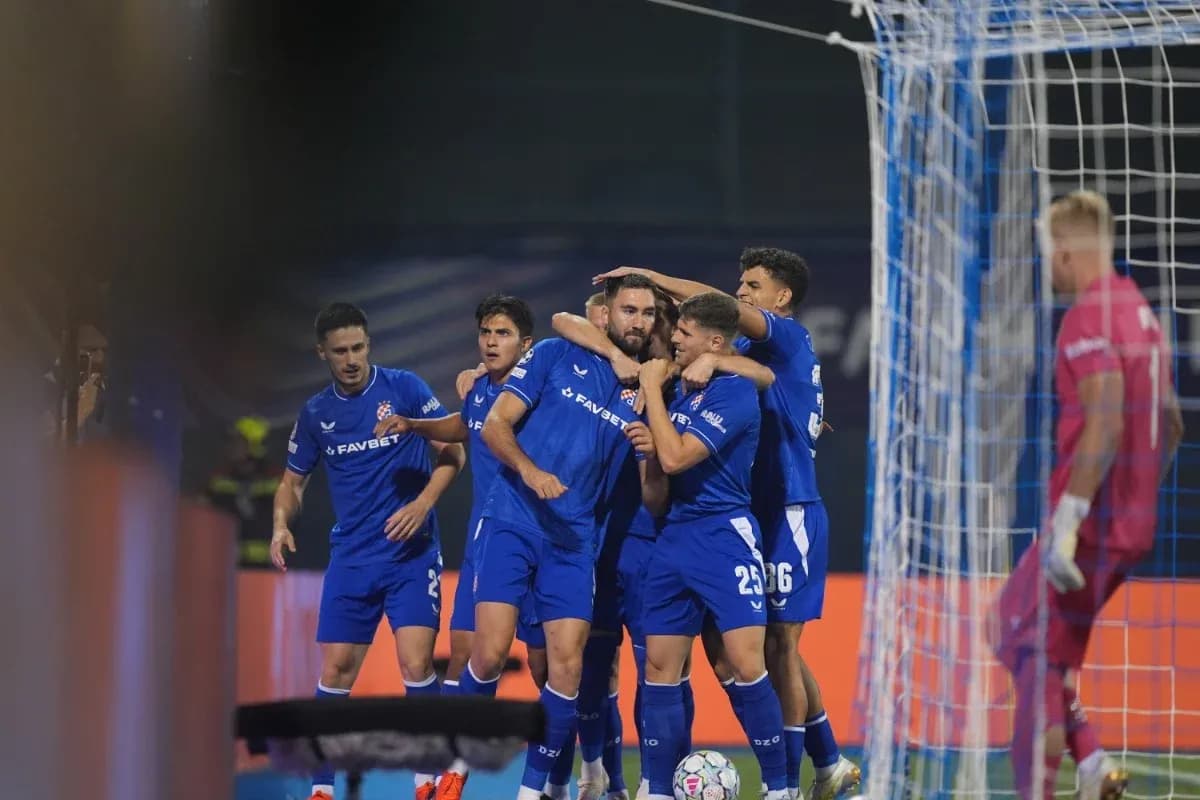
Dinamo Zagreb and Viking produced a tactically rich 2-2 draw at Stadion Maksimir in this UEFA Champions League Play-offs tie, a match defined by Dinamo’s territorial dominance and Viking’s ruthless efficiency in transition. Dinamo built a 2-0 lead inside ten minutes, only to be pegged back before half-time, and despite sustained second-half pressure, they could not turn control into a decisive third goal.
Dinamo Zagreb's Formation
Dinamo lined up in a 4-1-4-1 under Mario Kovacevic, with J. Misic anchoring in front of the back four and a fluid band of four behind lone striker D. Beljo. The structure was clearly designed for ball dominance, and the numbers confirm it: 60% possession, 544 passes with 438 accurate (81%), and 23 total shots. The shape allowed both wide midfielders, M. Orsic on the left and M. Lisica from the right half-space, to attack high while Misic stayed as the positional reference, recycling possession and protecting against counters.
First Half Goals
The early goals illustrated how well this structure worked in settled play. Dinamo consistently created overloads between the lines, with M. Zajc and L. Stojkovic stepping into pockets, while full-backs M. Perez Vinlof and M. Valincic provided width. The first goal at 6' came from Beljo attacking the box with Perez Vinlof supporting from deep, and the second at 10' showed the striker dropping to combine, with Lisica arriving as the spare runner. Those patterns reflected a clear plan: use Beljo as a reference point, then attack the box with second-line runners.
Viking's Response
Viking, in Bjarte Aarsheim’s 4-3-3, accepted a more reactive role. With only 40% possession and 371 passes (272 accurate, 73%), they focused on compactness in midfield and quick vertical attacks once they recovered the ball. The front three of Z. Tripic, P. Christiansen, and E. Austbo were tasked with exploiting the space behind Dinamo’s advanced full-backs. The comeback from 0-2 to 2-2 was built almost entirely on transition moments, with T. Moi and the midfield three playing forward quickly after regains.
Shot Profile
The shot profile underlines the contrasting approaches. Dinamo’s 23 shots included 17 from inside the box, but only 4 on goal, with 7 blocked. That combination suggests Viking’s back line defended their own area aggressively, closing down shooting lanes even when they were pinned deep. Viking, by contrast, took just 6 shots in total, 5 from inside the box and 3 on goal, but converted two of those into goals. Their efficiency in high-value moments compensated for their lack of sustained pressure.
Goalkeeper Usage
Goalkeeper usage and defensive structures further frame the tactical story. I. Nevistic (Dinamo Zagreb) was largely a spectator in phases of Dinamo dominance, officially making 1 save. This reflects how Viking created few but very clear chances rather than a steady stream of shots. A. Ostbo (Viking), with 2 saves, was protected by a low block that forced Dinamo into crowded central channels, meaning many of Dinamo’s attempts were blocked before they reached him. The discrepancy between Dinamo’s shot volume and Ostbo’s save count is explained by Viking’s defenders doing much of the last-ditch work inside the box.
Full-Back Impact
The full-backs were crucial on both sides. For Dinamo, Perez Vinlof and Valincic pushed high and wide to stretch Viking’s 4-3-3 into a 4-5-1 without the ball, forcing Viking’s wingers to track back and creating room inside for Zajc and Stojkovic. However, this aggression left space in the channels, which Viking exploited on the counter, particularly through Tripic drifting into the left half-space and Christiansen attacking the right channel. Viking’s initial back four, with H. Heggheim and K. Haugen at full-back, tried to hold a relatively narrow line, prioritizing central compactness over wide pressure, which explains Dinamo’s ability to circulate and cross but not always to get clean shots away.
Substitutions
The substitutions in the second half underline each coach’s reading of the game. Aarsheim’s first change at 58' brought S. Kvia-Egeskog (IN) on for T. Moi (OUT), trading some of Moi’s creative passing for fresher legs and more defensive work on the flank as Viking sought to protect the 2-2. Later, at 72', S. Bjorshol (IN) for H. Heggheim (OUT) and H. J. Haugen (IN) for K. Haugen (OUT) refreshed both full-back positions, reinforcing the defensive shell against Dinamo’s growing pressure.
Kovacevic, seeing control but lacking penetration, turned to his bench at 60', introducing L. Kacavenda (IN) for M. Zajc (OUT) to add more directness between the lines. At 68', he doubled down on central energy and attacking thrust with R. Mudrazija (IN) for L. Stojkovic (OUT) and A. Hoxha (IN) for M. Lisica (OUT), pushing the team towards a more aggressive, almost 4-1-3-2 look in possession, with multiple players attacking the box around Beljo. The later entries of N. Galesic (IN) for M. Valincic (OUT) and S. Prevljak (IN) for M. Orsic (OUT) at 84' showed a clear intent to maintain attacking presence while adding fresh legs in the back line and a more penalty-box-oriented forward profile.
Discipline
Discipline also had a tactical impact. Joe Bell’s yellow card at 65' for “Foul” limited his ability to break up play aggressively in Viking’s midfield, potentially contributing to Dinamo’s growing territorial dominance in the final 25 minutes. Moris Valinčić’s booking at 83', also for “Foul”, came as Dinamo were committing numbers forward and occasionally exposed to counters, forcing their right-back to make a riskier intervention.
Statistical Overview
Statistically, Dinamo’s 9 corner kicks to Viking’s 3 highlight sustained pressure, especially after the interval. Yet the combination of Viking’s compact block, effective shot blocking, and their clinical finishing meant that the game state never forced Viking to abandon their plan. Dinamo’s high pass completion and box entries show a coherent positional attack, but the lack of clear, unpressured shots on goal prevented that structure from translating into a decisive advantage.
In sum, this was a tactical contest where Dinamo Zagreb’s structured, possession-heavy 4-1-4-1 produced control and volume, while Viking’s disciplined 4-3-3, geared towards transitions and penalty-box efficiency, extracted maximum value from limited attacking phases. The 2-2 scoreline reflects that balance: Dinamo dictated where the game was played, but Viking dictated how dangerous it was when they did attack.
Related News

Fenerbahçe vs Lyon: Tactical Analysis of UEFA Champions League Draw
Dinamo Zagreb vs Viking: Tactical Analysis of the 2-2 Draw
Dinamo Zagreb and Viking Draw 2-2 in UEFA Champions League Play-offs
Fenerbahçe 1-1 Lyon: UEFA Champions League Play-offs Review
Levski Sofia vs AEK Athens FC: UEFA Champions League Play-offs Match Report
Slovan Bratislava vs Celje: Champions League Play-Off Insights