
Fenerbahçe vs Lyon: Tactical Analysis of UEFA Champions League Draw

Fenerbahçe and Lyon produced a tactically tight 1-1 draw at Chobani Stadium in this UEFA Champions League Play-offs first leg, a match defined more by structural discipline than chaos. Both sides mirrored each other in a 4-2-3-1, and the statistics underline just how finely balanced it was: 12 shots apiece, 5 shots on goal each, and an almost even share of the ball (52%–48% in Fenerbahçe’s favour). The hosts edged territory and passing volume, but Lyon’s compactness, shot blocking, and transitional threat ensured the tie remains perfectly poised heading into the return leg.
First Half
Lyon struck first, and their opener encapsulated Paulo Fonseca’s plan. With a double pivot of T. Tessmann and T. Morton screening the back four, Lyon were content to defend in a mid-block, then break quickly through the line of E. Nuamah, C. Tolisso, M. Fofana and L. Openda. The 40th-minute goal from Openda, assisted by Tolisso, was the reward for those vertical transitions: the visitors accepted that Fenerbahçe would have more of the ball, but ensured that when they did attack, they progressed with purpose and numbers.
Ismail Kartal’s Fenerbahçe, also in a 4-2-3-1, tried to control the game through their double pivot. N. Kanté and M. Guendouzi were central to the hosts’ 453 total passes, of which 389 were accurate at an 86% success rate. Fenerbahçe’s 7 shots inside the box versus Lyon’s 5 show that their positional play did manage to penetrate, particularly via the attacking midfield trio of M. Greenwood, Talisca and K. Akturkoglu working between the lines and pulling Lyon’s full-backs into difficult decisions.
Second Half
The equaliser early in the second half was a direct product of that structure. In the 47th minute, Greenwood finished a move assisted by Akturkoglu, a pattern that reflected Fenerbahçe’s desire to overload wide zones then attack the half-spaces. With A. Brown and N. Semedo providing width from full-back, Akturkoglu and Greenwood could drift inside, creating interior passing lanes for Talisca and allowing V. Muriqi, initially, to occupy Lyon’s centre-backs. That the goal came so soon after the restart suggests a successful half-time adjustment: Fenerbahçe pushed their line higher and committed more aggressively to second balls around the Lyon box.
Defensively, both back fours were broadly solid but in different ways. Fenerbahçe’s line of Brown, N. Ake, Milan Škriniar and Semedo allowed 12 shots but only 5 on goal, while Lyon’s back line of Abner Vinicius, M. Niakhate, R. Kluivert and A. Maitland-Niles were more focused on last-ditch interventions, registering 5 blocked shots to Fenerbahçe’s 2. That block count is a key indicator of Lyon’s low-to-mid block approach: they often defended deep enough that shots came through crowds, forcing attackers to shoot through legs rather than into open lanes.
In goal, Ederson (Fenerbahçe) and D. Greif (Lyon) mirrored each other statistically, each making 4 saves. Those numbers, combined with the 5 shots on target per team, underline how both keepers were consistently involved but not overwhelmed. Ederson (Fenerbahçe) had to stay alert to Lyon’s quick counters and Openda’s direct running, while D. Greif (Lyon) dealt more with structured, multi-pass attacks culminating in efforts from Greenwood, Talisca and later substitutes.
Substitutions
The substitution patterns from both coaches were clear tactical levers rather than mere fitness management. At 73 minutes, Kartal made a double attacking change: D. Nene (IN) came on for K. Akturkoglu (OUT), and M. Asensio (IN) came on for Talisca (OUT). This shifted Fenerbahçe’s attacking profile from ball-carrying and combination play towards more direct dribbling (Nene) and long-range threat plus creative passing (Asensio). The intent was to increase unpredictability in the final third against a Lyon block that had grown more compact as the game wore on.
Lyon’s response at 75 minutes was to refresh their defensive line and right flank: C. Mata (IN) came on for R. Kluivert (OUT), and K. Boudache (IN) came on for E. Nuamah (OUT). Mata offered more conservative full-back play, reinforcing the defensive shell, while Boudache gave fresh legs to chase counters and press Fenerbahçe’s build-up on that side. Later, at 86 minutes, M. Bidstrup (IN) replaced T. Morton (OUT), injecting energy into midfield pressing, and at 90+1 minutes M. Ouedraogo (IN) came on for M. Fofana (OUT), a move clearly aimed at shoring up defensive wide coverage for the closing stages.
Kartal’s final major attacking gamble came in the 82nd minute: R. Lukaku (IN) came on for V. Muriqi (OUT). Rather than changing the reference point profile dramatically, this swap was about fresh physical presence and penalty-box occupation. With Lyon increasingly defending deep, Lukaku’s ability to pin centre-backs and attack crosses was a logical final-phase adjustment, especially with Asensio now able to deliver from the half-spaces and Brown/Semedo pushing high.
Discipline
Discipline subtly shaped the defensive tone. Lyon’s single yellow card went to Abner Vinicius at 37' — “Foul” — a reminder of how often he was exposed by Fenerbahçe’s right-sided combinations. Fenerbahçe, by contrast, collected two bookings: N’Golo Kanté at 81' — “Foul” — and Milan Škriniar at 84' — “Foul”. Both cautions reflected the hosts’ increasing risk-taking in rest defence as they chased territory and tried to keep Lyon’s counters in check higher up the pitch.
Statistics
Statistically, the match reads like a near-perfect equilibrium. Fenerbahçe had 52% possession to Lyon’s 48%, 453 passes to 433, and completed 389 passes (86%) to Lyon’s 375 (87%). The shot profile was identical in volume (12 each, 5 on goal each), with Fenerbahçe slightly more box-focused (7 shots inside the box to Lyon’s 5), while Lyon compensated with more efforts from range (7 outside the box to Fenerbahçe’s 5) and a higher number of blocks (5 to 2). Both sides committed 13 fouls, underscoring a match that was competitive but controlled.
Taken together, the tactical and statistical picture is of two well-drilled 4-2-3-1 systems neutralising each other over 90 minutes. Fenerbahçe’s marginal edge in territory and box entries was offset by Lyon’s compactness, blocking, and counter-attacking efficiency. The 1-1 scoreline, matching the underlying balance of chances and control, sets up a second leg where micro-adjustments — rather than wholesale changes — are likely to decide who progresses.
Related News
Dinamo Zagreb vs Viking: Tactical Analysis of the 2-2 Draw
Levski Sofia vs AEK Athens: Tactical Analysis of Goalless First Leg
Dinamo Zagreb and Viking Draw 2-2 in UEFA Champions League Play-offs
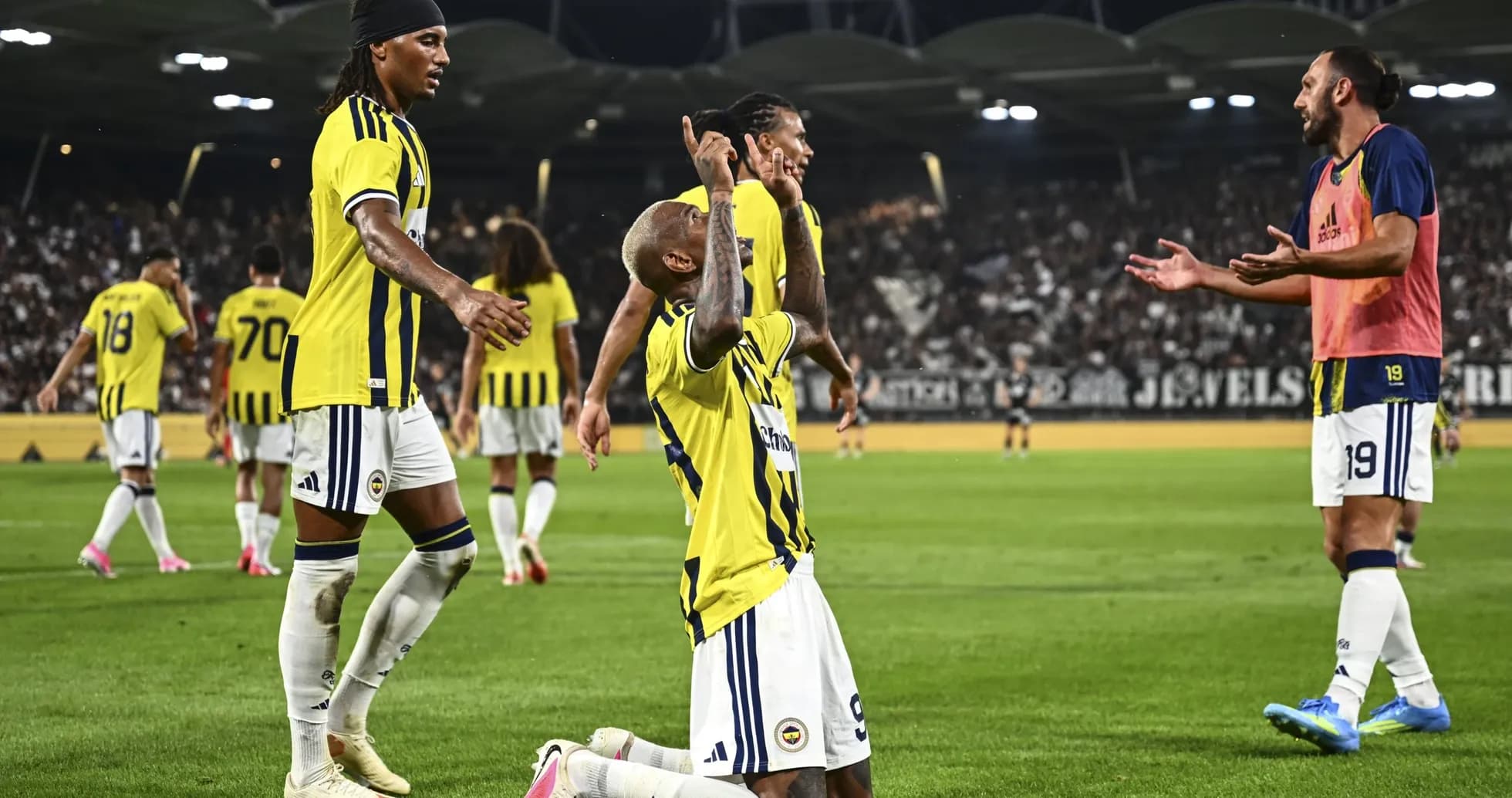
Fenerbahçe 1-1 Lyon: UEFA Champions League Play-offs Review
Levski Sofia vs AEK Athens FC: UEFA Champions League Play-offs Match Report
Slovan Bratislava vs Celje: Champions League Play-Off Insights