
FK Crvena Zvezda Dominates Plzen with Tactical Mastery
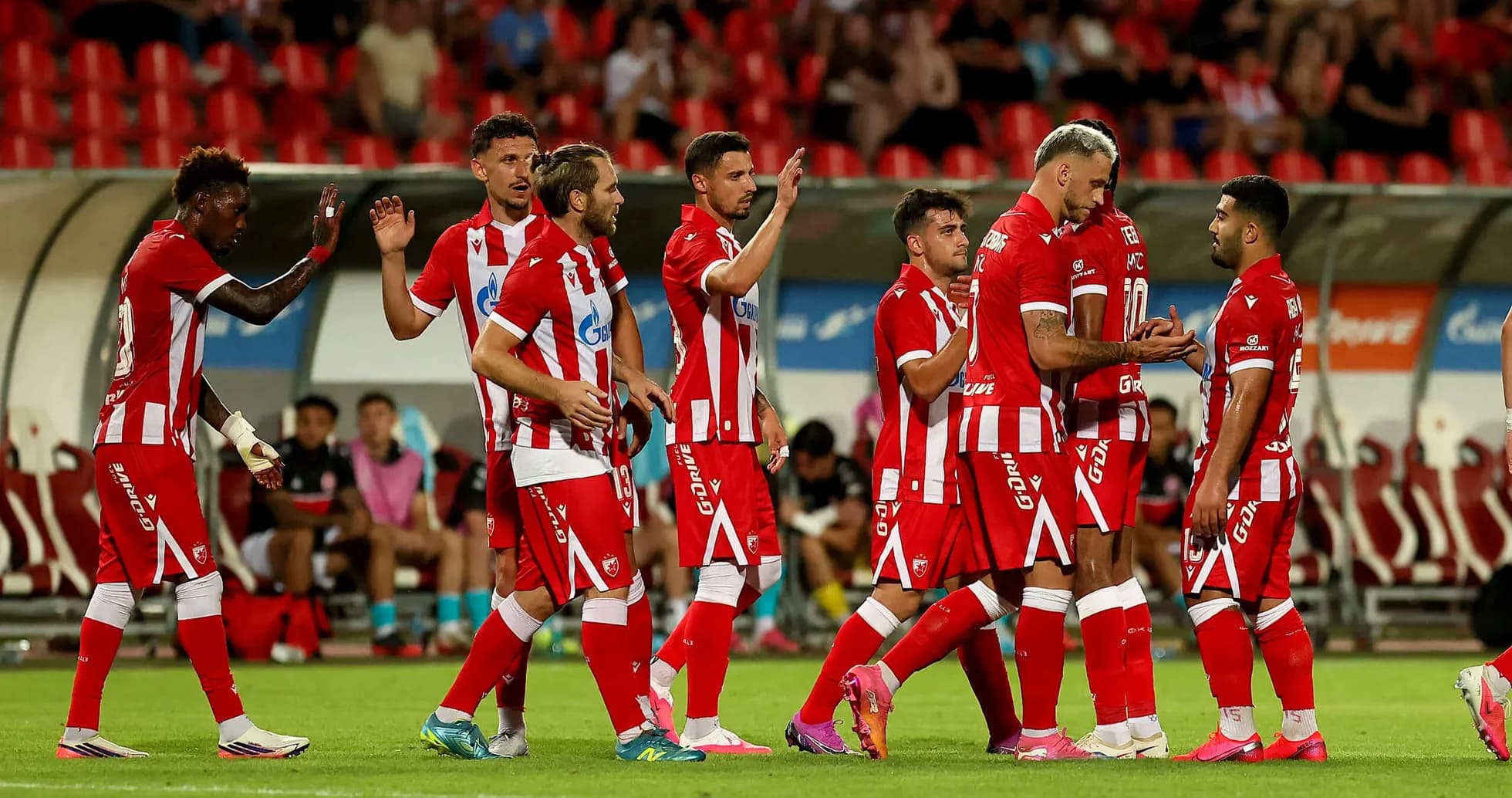
FK Crvena Zvezda’s 3-0 win over Plzen at Stadium Rajko Mitić was a controlled, structurally coherent performance built on a clear 4-3-3 framework and superior use of key spaces, rather than overwhelming volume. With both sides finishing on 50% possession, the decisive edge came from how Albert Riera’s team converted territory and positional play into clean chances, while Plzen’s 4-4-1-1 never fully connected its lines.
Crvena Zvezda's Formation
Crvena Zvezda’s 4-3-3 was asymmetric in its attacking behaviour. The back four of Seol Young-Woo, D. Luckassen, M. Veljkovic and T. Elsnik provided a stable platform, with Elsnik operating as a hybrid left-back/auxiliary midfielder. Ahead of them, the midfield trio of M. Ivanic, R. Krunic and V. Kostov gave Riera three distinct profiles: Ivanic as the advanced conductor, Krunic as the central organiser, and Kostov as the more industrious shuttler. This interior triangle was the engine of the match, repeatedly finding pockets between Plzen’s double pivot and back line.
In the front line, O. Bukari and M. Cham flanked M. Arnautovic in what functioned less like a classic three and more like a fluid front unit. Bukari and Cham frequently inverted into the half-spaces, allowing full-backs to advance and stretching Plzen’s wide midfielders. That movement created the lanes Ivanic exploited for his two goals, both coming from combinations with Elsnik. The repeated Ivanic–Elsnik connection underlined how Zvezda targeted Plzen’s right side, dragging the 4-4-1-1 block narrow before exploiting the seam just inside the full-back.
Plzen's Formation
Plzen’s 4-4-1-1, with P. Adu ahead of a band of four including T. Ladra, L. Cerv, F. Prebsl and C. Souare, was designed to be compact and counter-oriented. The back four of M. Doski, D. Krcik, S. Dweh and A. Memic sat relatively deep, inviting Zvezda forward and looking to spring Adu and Ladra into space. The problem was the disconnect between Adu and the midfield line: with Zvezda’s three central midfielders outnumbering Plzen’s central pair in many phases, Cerv and Hrošovský were repeatedly forced to protect the centre rather than step out to press. That ceded initiative to Krunic, who could dictate tempo and switch play, even if the passing stats are not numerically specified.
Match Statistics
Despite Plzen registering 5 shots on goal to Zvezda’s 7, the qualitative balance favoured the hosts. Zvezda’s single blocked shot versus Plzen’s 2 suggests Riera’s side created clearer shooting windows, often arriving in the box with separation after third-man runs. Ivanic’s brace encapsulated this: late surges from midfield into spaces vacated by a back line preoccupied with Arnautovic’s presence. The late penalty from A. Katai, confirmed by VAR after the 89th-minute award and 90th-minute check, was the logical endpoint of sustained territorial pressure rather than an isolated moment.
Defensive Strategies
Out of possession, Zvezda’s 4-3-3 dropped into a compact 4-1-4-1, with Krunic screening in front of the centre-backs and Kostov and Ivanic stepping out to press Plzen’s first pass into midfield. The low foul count (5) indicates a controlled defensive performance, with the structure doing most of the work rather than emergency interventions. The two yellow cards – to Young-woo Seol and Vasilije Kostov – did not destabilise the block, and the team maintained discipline in transitions.
Plzen, by contrast, were forced into more reactive defending, as evidenced by 6 fouls and 4 yellow cards. The bookings for Cheick Souaré, Patrik Hrošovský, Sampson Dweh and Karel Spáčil reflect a side often arriving late into duels, especially once chasing the game after the second goal. Their 2 corner kicks to Zvezda’s 1 show they did reach the final third, but the lack of sustained pressure and the absence of statistical dominance in any key attacking metric underlined their difficulty in turning those moments into high-quality chances.
Game Management
In terms of game management, Riera’s substitutions were tactically coherent. With the game at 2-0, the 72nd-minute double change – J. Enem (IN) for M. Arnautovic (OUT) and A. Katai (IN) for M. Ivanic (OUT) – refreshed the front line without altering the underlying shape. Katai’s introduction added composure between the lines and he ultimately converted the late penalty to seal the tie. Later changes, such as M. Bajo (IN) for V. Kostov (OUT) and F. Tebo Uchenna (IN) for D. Luckassen (OUT), helped lock down the result and manage energy in the final minutes.
Martin Hysky’s response from the Plzen bench – introducing C. Kabongo for C. Souare at 46', S. Pirgic for T. Ladra at 61', and later D. Visinsky for F. Prebsl, M. Vydra for P. Adu, and K. Spacil for D. Krcik – gradually shifted the attacking personnel but did not significantly change the structural issues. The 4-4-1-1 remained stretched vertically, and the lack of a true extra midfielder continued to leave Cerv and Hrošovský exposed against Zvezda’s three.
Conclusion
Statistically, the match was more balanced on the surface than the 3-0 scoreline might suggest. Possession was perfectly split at 50%-50%, and Plzen’s 5 shots on goal indicate they did test Zvezda’s defensive organisation. However, Zvezda’s 7 shots on goal, combined with their more efficient use of central zones and better spacing between lines, translated into three goals and a clean sheet. With no explicit data on xG, passes or goalkeeper saves, the clearest measurable edges lie in shot quality (reflected in goals scored) and disciplinary control.
In the context of UEFA Europa League Play-offs, this performance paints Zvezda as a side comfortable controlling games without monopolising the ball, relying on a well-drilled 4-3-3, intelligent midfield timing and flexible wide play. Plzen, meanwhile, showed that their 4-4-1-1 can generate moments but needs a tighter connection between lines and more midfield support if it is to withstand high-level continental opposition over 90 minutes.
Related News

Beşiktaş Dominates Kauno Žalgiris in 3-0 Victory
Trabzonspor vs Ferencvarosi TC: Tactical Analysis of 0-1 Defeat
Egnatia Rrogozhinë vs Lillestrom: Tactical Analysis of a 0-0 Draw
Craiova vs Ararat-Armenia: Tactical Analysis of 1-1 Draw
Lech Poznan's Tactical Masterclass Against FC Thun
Jagiellonia Dominates FC Iberia 1999 with Tactical Superiority