
Forge Dominates Atlético Ottawa in 3-0 Victory
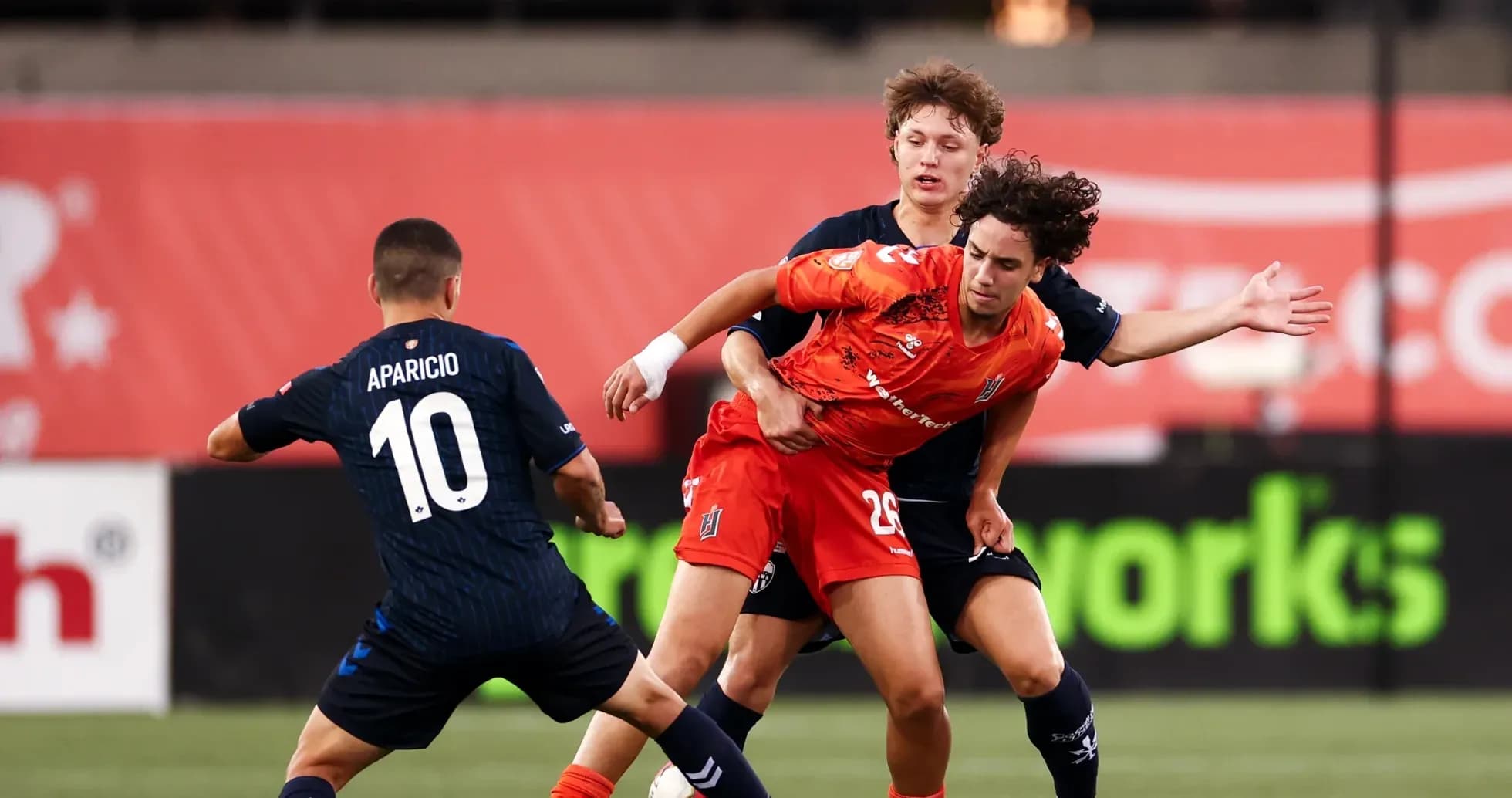
Under the lights at Tim Hortons Field, Forge’s 3–0 dismantling of Atlético Ottawa felt less like a one-off result and more like a crystallisation of two very different seasonal identities. One side, Forge, is behaving like a ruthless machine in the Canadian Premier League’s Group Stage; the other, Atlético Ottawa, remains a talented but volatile project, especially on its travels.
I. The Big Picture – Forge’s structure vs Ottawa’s volatility
Heading into this game, Forge sat 2nd with 45 points from 21 matches, built on a formidable overall goal difference of +18 (33 scored, 15 conceded). At home they had been even more imposing: 8 wins from 11, with 17 goals for and just 6 against, an average of 1.5 goals scored and 0.5 conceded at Tim Hortons Field. This is a side that knows exactly what it is: compact, controlled, and punishing in the final third.
Atlético Ottawa arrived in Hamilton in 3rd place with 34 points from 22 matches, but their overall goal difference of -3 (34 scored, 37 conceded) and especially their away profile told a more fragile story. On their travels they had won only 3 of 11, losing 7, with 13 goals for and 24 against. An away average of 1.2 goals scored but 2.2 conceded underlined the risk in Gustavo Leal’s approach once his side leaves home comforts behind.
Forge’s 4-3-3 under Bobby Smyrniotis was a statement of continuity. D. Bertaud anchored the side in goal, shielded by a back four of R. Rama, D. Nimick, A. Batisse and M. Jevremović. In front of them, the midfield trio of A. Sadek, A. Aromatario and captain K. Bekker offered a blend of energy, bite and orchestration. Up front, the fluid front three of M. Bourgeois, B. Wright and H. Massunda stretched Ottawa both wide and in behind.
Ottawa’s 4-4-2, by contrast, was a nod to verticality and transition. C. Kalongo started in goal behind a young but intriguing back line of Rony Mbomio, Loïc Cloutier, Sergei Kozlovskiy and Joaquim Coulanges. The midfield four – J. Castro, M. Aparicio, D. Gutiérrez and G. Antinoro – had the task of linking to the dangerous front duo of N. Fleuriau Chateau and Ballou Tabla, one of the league’s standout attackers with 5 goals and 1 assist in total this season.
II. Tactical Voids – Discipline, risk, and the cost of chaos
Neither side came into this fixture with a published list of absentees, so the tactical voids were less about missing bodies and more about inherent tendencies.
For Forge, the main risk sits in the back line’s aggression. R. Rama and M. Jevremović are both among the league’s more combative defenders. Rama, with 5 yellow cards and 1 straight red in 17 appearances, has a disciplinary record that forces Smyrniotis to walk a tightrope: his 20 tackles and 81 duels speak to his front-foot defending, but every high press from the right-back carries the memory of previous dismissals. Jevremović, meanwhile, has also seen red this season, even as he contributes 23 tackles, 3 blocks and 8 interceptions. The flip side is that Forge’s structure and pressing help them keep the ball away from danger zones, reflected in those 10 clean sheets overall and a home average of only 0.5 goals conceded.
Ottawa’s void is more systemic. Their yellow-card profile is heavily back-loaded: 34.69% of their cautions arrive between 76–90 minutes, a late-game surge that hints at fatigue, chasing games, or emotional loss of control. G. Antinoro, who started on the left of midfield, carries a red card on his seasonal record despite his otherwise positive contribution as a dribbler and chance creator. M. Aparicio, with 6 yellows in 22 appearances, is the heartbeat of the midfield but also a foul magnet and foul machine, committing 20 fouls overall. In a fixture against a possession-dominant Forge, that tendency to lunge late and often is a dangerous flaw.
Then there is the penalty story. Forge have been clinical from the spot this season: 3 penalties taken in total, 3 scored, none missed. Ottawa, in stark contrast, have split their 4 penalties down the middle – 2 scored, 2 missed. In a tight match-up, that 50.00% success rate is not just a statistic; it is a psychological crack.
III. Key Matchups – Hunter vs Shield, and the engine rooms
The Hunter vs Shield narrative begins with Ottawa’s attack against Forge’s defensive spine. Ballou Tabla is one of the league’s premier hunters: 5 goals, 1 assist, 19 shots with 13 on target, plus 26 dribble attempts with 12 successful. He thrives on isolations and quick changes of direction. Alongside him, N. Fleuriau Chateau brings 3 goals and 2 assists in only 9 appearances, with 14 shots and 3 key passes; he is a secondary scorer who can arrive late or run beyond.
But they are running into perhaps the most complete defensive shield in the league. D. Nimick, a top-rated defender with 3 goals and 2 penalties scored, has been immaculate in possession (510 passes at 90% accuracy) and rugged without it (11 tackles, 4 blocked shots, 10 interceptions). He is flanked by Jevremović’s aerial presence and Rama’s overlapping energy. Together, they underpin a unit that concedes only 0.7 goals per game overall and has allowed just 6 goals at home in 11 league fixtures.
In midfield, the “engine room” duel is equally decisive. For Forge, A. Aromatario is a quiet enforcer with 29 tackles, 23 interceptions and 8 yellow cards. His job is to break Ottawa’s rhythm, especially the passing lanes into Tabla’s feet and Fleuriau Chateau’s runs. Beside him, Bekker remains the metronome, and Sadek adds legs and coverage.
Ottawa’s response is built around Aparicio and Antinoro. Aparicio’s 670 passes at 83% accuracy and 11 key passes show his importance in progression; his 25 tackles and 19 interceptions underline his two-way role. Antinoro, with 46 dribble attempts and 14 key passes, is the chaos agent who can unbalance Forge’s block if he finds pockets between the lines. But both must navigate Aromatario’s physical presence and Forge’s structured 4-3-3 press.
Out wide and off the bench, there are further subplots. For Forge, T. Borges offers 3 assists and 18 key passes in limited minutes, a creative weapon who can be introduced to tilt the game further. I. Oketokoun adds vertical running and end product, with 2 goals and 2 assists despite starting only 6 times. Ottawa’s bench counters with K. Habibullah – 3 assists in just 255 minutes – and E. García, a two-way forward with 3 goals, 18 tackles and 6 interceptions, ideal for late-game pressing and transitional punches.
IV. Statistical Prognosis – Control vs chaos
Following this 3–0 result, the numbers and the narrative align around a clear pattern. Forge’s season-long profile – 1.6 goals scored per game overall, 0.7 conceded, 10 clean sheets – is that of a side that strangles games into its preferred rhythm. Their penalty perfection, defensive organisation and midfield balance give them multiple stable platforms to win.
Atlético Ottawa, by contrast, live on a knife-edge. They score 1.5 goals per game overall, but concede 1.7, and on their travels that balloons to 2.2 goals conceded per match. Their late-game yellow-card spike and 50.00% penalty conversion rate speak to a team that can thrill but not always close.
In tactical terms, this fixture underlined a simple truth: when Forge’s structure meets Ottawa’s volatility, the team with the clearer identity and sturdier shield usually prevails. At Tim Hortons Field, the scoreline merely confirmed what the season’s data had been whispering all along.
Related News

Cavalry FC vs Forge: Head-to-Head Stats and Historical Context

Pacific FC vs Cavalry FC Predicted Lineups and Team News

York United vs Vancouver FC Predicted Lineups and Team News

Pacific FC vs Cavalry FC: Clash of Survival and Title Ambitions

York United vs Vancouver FC: Match Preview and Predictions

Forge vs Atlético Ottawa Predicted Lineups and Team News