
France's World Cup Exit: The End of Deschamps' Era
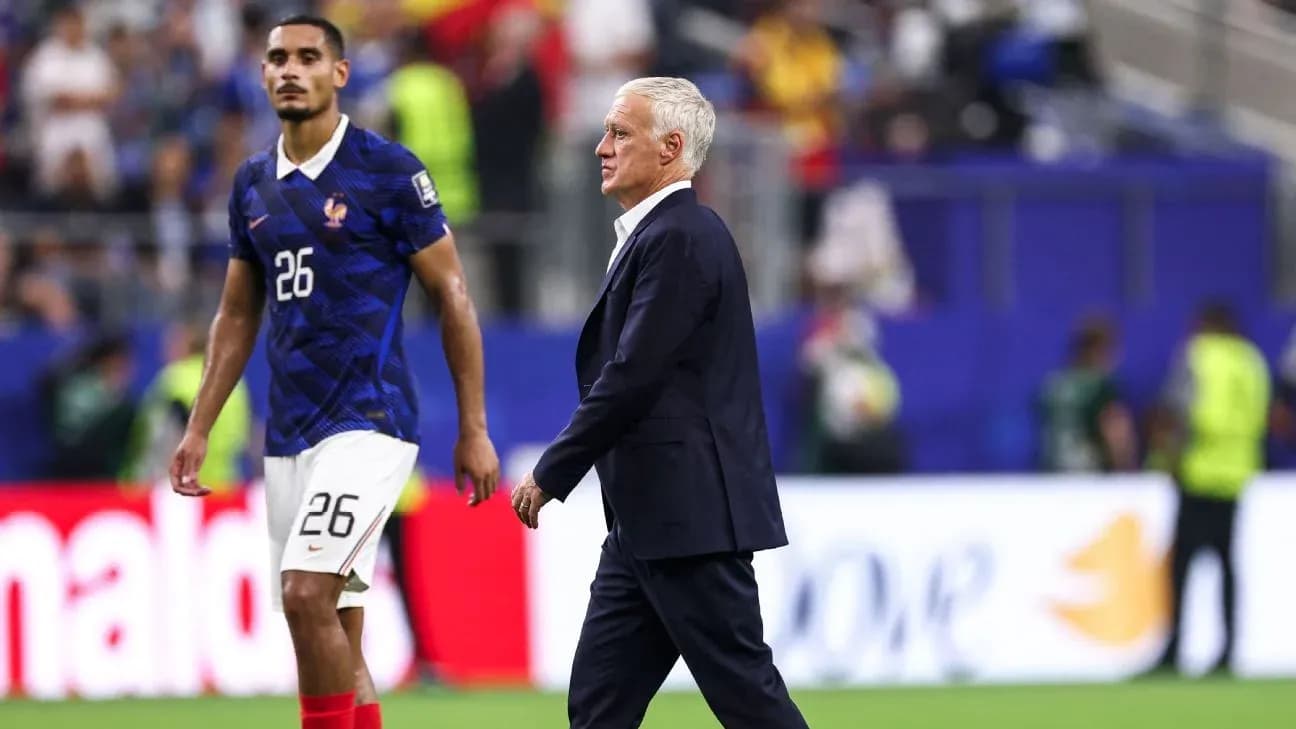
ARLINGTON, Texas — The end came quietly for France, which is precisely what will sting the most.
A team that arrived at this World Cup as the field’s undisputed benchmark, that carried the weight of expectation with apparent ease, finally buckled under the lights of Jerry Jones’ vast Texas monument. Spain struck first, France never struck back, and a 2-0 semifinal defeat felt, by the final whistle, like a fair reflection of a one-sided evening.
It was not just the end of a campaign. It was the end of an era.
Didier Deschamps walks away after 14 years, 184 games and a body of work that would normally be untouchable: two World Cup finals, one European Championship final, a World Cup trophy and the UEFA Nations League. He was a penalty shootout and a Randal Kolo Muani chance away from becoming only the second man to win two World Cups as a coach, to go with the one he lifted as a player.
Yet he leaves on the back of a performance that had France fans counting down the minutes to the Zinedine Zidane era.
Outplayed, outthought, out of answers
Losing to Spain is no disgrace. This Spain, built by Luis de la Fuente, is slick, confident and almost as deep in talent as France. The issue was not the opponent. It was the manner of France’s surrender.
For 64 minutes, Les Bleus’ glittering front four produced 0.04 xG. That is not a misprint. For all the names on the teamsheet, for all the attacking firepower, they offered almost nothing. Spain controlled the ball, controlled the tempo and, crucially, controlled the space. France never looked like wrestling any of it back.
It was the third time in three years that De la Fuente had outcoached Deschamps: the Euro 2024 semifinal, the wild 2025 Nations League clash that Spain once led 5-1 before edging it 5-4, and now this World Cup semifinal. Same coaches, same matchup, same outcome. If you were searching for a learning curve from the France bench, you needed a microscope.
Everyone knew how this game was likely to unfold. Spain would monopolize possession, move the ball, probe, recycle, probe again. The question was France’s response. Would Deschamps adjust, press higher, add an extra midfielder to avoid the two-vs-three mismatch Kylian Mbappé himself had highlighted? Or would he trust his stars, stick to his usual blueprint and dare Spain to cope?
He chose the latter. Spain barely broke stride.
The limits of a trusted formula
Deschamps’ philosophy has always been rooted in a kind of pragmatic orthodoxy. Keep the dressing room happy. Keep the structure simple. Let superior talent decide the rest. It worked for him as a player alongside Zinedine Zidane, Patrick Vieira and Thierry Henry in 1998. It worked again in 2018 and almost again in 2022.
In a low-scoring sport, there is logic to that. Overcomplicate the system and you risk paralyzing your best players. Deschamps has never been a chalkboard revolutionary; he has been a manager of men, not a theorist.
But that approach has a clear weakness. It relies on your stars having either the ball or the space to damage the opponent. Spain allowed them neither. They dominated possession and squeezed the pitch. Without room to run and without touches in dangerous areas, even elite attackers become anonymous. Michael Olise, so often decisive, looked no more threatening than a training cone. Or, as the article’s original line put it, only marginally more effective than Michael Scott.
That is the moment when a coach must intervene, bend his own rules, tilt the game. Deschamps never truly did. His substitutions — Manu Koné for Adrien Rabiot, Désiré Doué for Bradley Barcola — felt like the tactical equivalent of predictive text. Logical, familiar, utterly unsurprising.
On a good day, that conservatism keeps France solid and composed. On a night like this, it simply stretched out the suffering.
His loyalty to certain players, Rabiot above all, is part of the same story. It built trust and continuity over a decade. It also left him slow to react when those same players struggled, as they did here. The strengths that carried him to unprecedented success as an international manager became the very things that dragged him down when he finally had his most gifted squad.
Enter Zidane, with questions attached
So what now? The answer, almost certainly, is Zidane.
On paper, his résumé is formidable: three UEFA Champions League titles, two LaLiga crowns, all with Real Madrid. He managed egos, navigated the game’s most intense spotlight and kept a dressing room of superstars aligned and hungry. Few men on the planet command instant respect in a France camp the way he will.
But the picture is not that simple. Zidane has not worked in five years. His last title dates back to 2020. And he has only ever coached at one club, a club that bears little resemblance to an international job. At Real Madrid, he saw his players every day, could drill ideas constantly, and if a relationship broke down, the solution was simple: ask for another Galáctico.
None of those luxuries exist at Clairefontaine.
Zidane’s Madrid sides were not built on elaborate tactical schemes. He, too, preferred clarity and man-management over complexity. Given his long history with Deschamps for France and Juventus, it is tempting to assume he will be a smoother, more glamorous continuation of the same model.
That might not be a bad thing. Deschamps’ tenure, despite its bitter end, was a golden age. Replicating it would already count as a triumph. But Zidane has a chance to nudge the formula forward.
He has seen, in this World Cup, the cost of assuming that better players automatically win if you simply wind them up and let them go. He has lived, as a player, the importance of balance. He lifted the World Cup with Stéphane Guivarc’h leading the line, a reminder that a functioning collective can elevate even modest individual pieces. Deschamps was there too. Both men know the lesson. The question is who applies it faster.
For Zidane, the key takeaway from this semifinal — assuming he watched every minute — is stark: when the gap in technical quality is narrow, structure and cohesion can overpower star power. Spain proved it. France felt it.
He will inherit one of the deepest attacking pools in world football, a generation overflowing with pace, skill and versatility. He will also inherit the expectations Deschamps helped create: France do not just compete now; they are supposed to dominate.
Match those achievements and he will be hailed as a worthy successor. Go one step further, add a layer of tactical edge to all that talent, and the story of France after Deschamps might read very differently from the way it ended in Arlington.
Related News
India's Record Chase of 406 Against West Indies Highlighted by Gill's 223 and Rohit's Century
Alex Pereira Hints at Major UFC Bout: 'Big Challenge' Ahead
Three Hall of Famers, Ten Fights, 109 Rounds: The Forgotten Rivalry That Shaped Lightweight Boxing's Golden Era
Khamzat Chimaev and Colby Covington Set for RAF Abu Dhabi Title Clash in November
Thomas Tuchel Confident Harry Kane Will Join 100-Goal Club for England Soon
Cristiano Ronaldo Vows to Reveal Truth After Leaving Portugal Squad Amid Conflict