
Hapoel Beer Sheva Dominates FK Crvena Zvezda in UEFA Qualifiers
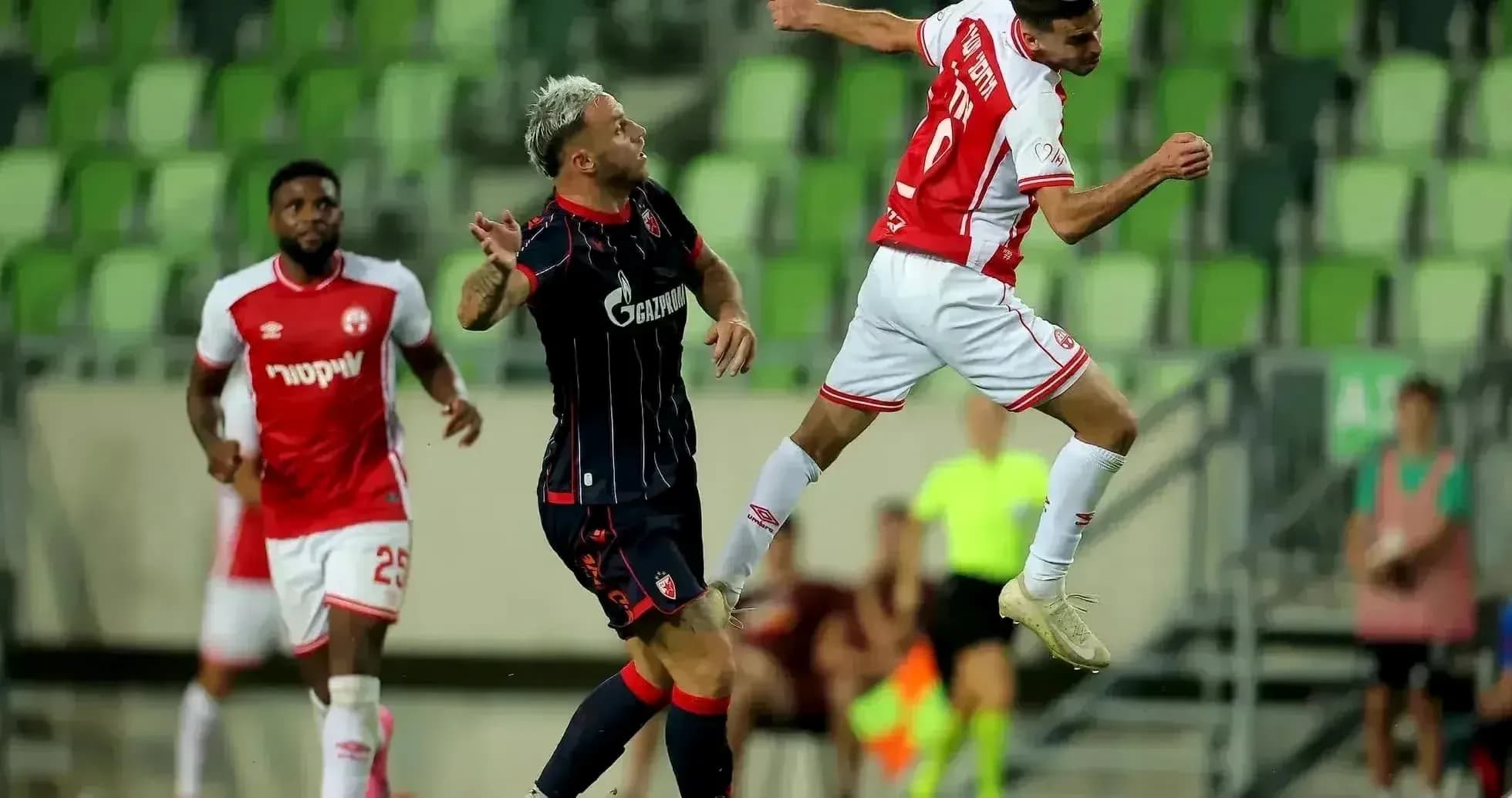
FK Crvena Zvezda’s 0-2 home defeat to Hapoel Beer Sheva at Stadium Rajko Mitić in the UEFA Champions League 3rd Qualifying Round was defined by an extraordinary territorial imbalance and a collapse in control once they went down to ten, then nine men. With Hapoel Beer Sheva enjoying 96% of the ball and outshooting the hosts 6-2 on goal, the Israeli side turned structural superiority in a 4-3-3 into a controlled, low-risk away win, while Dejan Stankovic’s 4-2-3-1 never established a pressing or counter-attacking platform.
Hapoel Beer Sheva’s 4-3-3 was built for long possession phases. The back four of G. Mizrahi, Miguel Vitor, I. Rotman and P. Amador had almost uninterrupted circulation time, reflected in the 96% possession figure. With FK Crvena Zvezda registering just 4% of the ball, the visitors could calmly construct from deep, repeatedly finding Lucas Ventura as the central reference in midfield. His positioning ahead of the centre-backs allowed easy progression into the half-spaces, while E. Peretz and N. Yehoshua formed a narrow three that pinned Zvezda’s double pivot.
In contrast, Zvezda’s 4-2-3-1 with Matheus in goal, a back four of Seol Young-Woo, D. Luckassen, S. Erakovic and N. Tiknizyan, and a double pivot of T. Elsnik and R. Krunic, never functioned as a unit. With so little possession, the nominal “three” behind J. Enem – O. Bukari, V. Kostov and Bruno Duarte – were forced deep, often creating a flat 4-5-1 block. Yet the defensive metrics show this block was more passive than disruptive: Hapoel Beer Sheva committed only 5 fouls to Zvezda’s 10, indicating that the visitors were rarely pressed into rushed decisions, while Zvezda had to foul more often just to slow transitions and cover structural gaps.
The shot profile underlines the tactical story. Hapoel Beer Sheva produced 6 shots on goal from a modest total shot volume (Total Shots not provided but at least 9 when combining on/off target and blocked), with only 1 effort blocked. That suggests clear shooting lanes created by good spacing in the final third. The front three of J. East, I. Zlatanovic and Z. Ahmed stretched the Zvezda back line horizontally, allowing late arrivals from midfield to attack the box. Zvezda, by contrast, managed only 2 shots on goal and 7 off target, with 2 blocked. For a side chasing a deficit at home, this is a very low on-target return, pointing to rushed, low-quality attempts rather than sustained, well-constructed attacks.
The disciplinary and numerical context is crucial. The first-half pattern – 0-0 at the break, with only a single yellow card to I. Rotman for “Holding” – still left the game theoretically balanced. But the second half flipped decisively. A red card to D. Stankovic at 57' removed leadership from the touchline and coincided with Zvezda’s attempt to change the game state through aggressive substitutions at 46' (M. Arnautovic (IN) for J. Enem (OUT) and M. Abu Fani (IN) for T. Elsnik (OUT)). These changes were clearly aimed at adding more verticality and energy in midfield and attack, but without the ball they only increased the distances between units. Hapoel Beer Sheva exploited the stretched shape to score through I. Zlatanovic at 61', assisted by J. East, and later through East himself at 79', assisted by E. Peretz, both classic products of a side able to patiently probe and then penetrate against a tiring, undermanned opponent.
The late red card to M. Abu Fani at 90+2' for “Roughing” confirmed Zvezda’s loss of control in duels and emotions. While Hapoel Beer Sheva also picked up a second-half yellow for Lucas Ventura (“Roughing”), their overall card profile – 2 yellows, 0 reds – contrasted sharply with Zvezda’s 0 yellows and 2 reds. This imbalance reflects how the visitors could commit tactical fouls selectively, whereas Zvezda’s resistance devolved into frustration and ill-discipline.
Set pieces and territoriality further emphasise Hapoel Beer Sheva’s dominance. Both sides recorded 3 corner kicks, which, given the 96–4 possession split, is striking: Zvezda’s rare forays forward tended to end in speculative shots (7 off target) rather than sustained pressure that would generate multiple corners. For Hapoel Beer Sheva, the equal number of corners despite near-total possession indicates they were able to create chances in open play without relying heavily on dead-ball situations.
From a structural perspective, Zvezda’s 4-2-3-1 never solved the spacing between the lines. With R. Krunic and T. Elsnik (later M. Abu Fani) outnumbered centrally by Hapoel Beer Sheva’s three midfielders, the home side were constantly forced to choose between protecting the half-spaces or stepping out to press the ball carrier. Whenever they stepped out, the ball was simply recycled through the back four, dragging Zvezda’s block from side to side and gradually wearing them down. The lack of any recorded offsides for either team (0-0) also suggests that Zvezda’s defensive line was not holding an aggressive offside trap to compress space; instead, they retreated, allowing Hapoel Beer Sheva to play in front of them and pick their moments to break lines.
For Hapoel Beer Sheva, the 4-3-3 functioned as a possession and control machine. With no data on passes or accuracy, the sheer possession share is the clearest indicator of their passing rhythm. The back line and midfield triangle created constant 3v2 and 4v3 overloads against Zvezda’s central block, while the wide forwards pinned full-backs, preventing Zvezda from stepping high to contest the build-up. Once ahead on the scoreboard, Hapoel Beer Sheva could lower the tempo, minimise risk, and use substitutions – such as H. Kanaan (IN) for G. Mizrahi (OUT), M. Abu Rumi (IN) for N. Yehoshua (OUT), and later D. T. Diop and A. Ohana entering – to maintain intensity without altering the basic structure.
In sum, this was a tactical defeat for FK Crvena Zvezda rooted in their inability to contest central spaces or impose any pressing identity, compounded by two red cards that turned a difficult night into a controlled away win for Hapoel Beer Sheva. The 0-2 scoreline, 96% possession against, and 6-2 shots-on-goal deficit collectively describe a tie in which the visitors dictated every major phase of play.
Related News
Sturm Graz vs Fenerbahçe: Tactical Analysis of UEFA Champions League Tie
Slovan Bratislava Secures 2-0 Victory Over Mjallby AIF

Celje Dominates Ararat-Armenia in UEFA Champions League Qualifier
Lyon Dominates Sparta Praha in 3-0 Victory: Tactical Analysis
Kauno Žalgiris vs Dinamo Zagreb Tactical Analysis
NEC Nijmegen Triumphs 2-1 Over Olympiakos Piraeus in Tactical Battle