
Hapoel Beer Sheva Overcomes Sabah FA in UEFA Champions League Clash
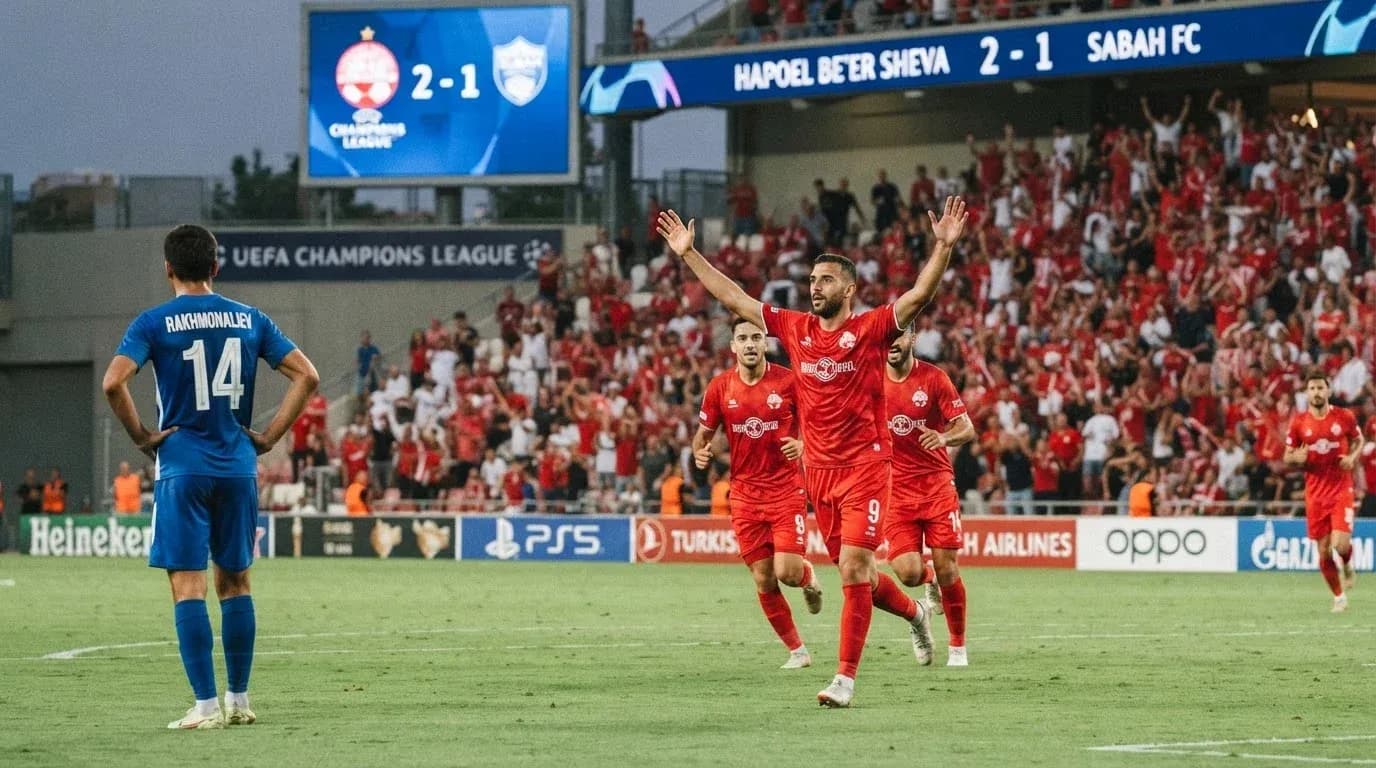
Hapoel Beer Sheva’s 2-1 win over Sabah FA at Rapid-Giulesti Stadium was a classic case of territorial and structural dominance eventually overwhelming a compact underdog. Across 90 minutes the Israelis imposed their 4-3-3 both with and without the ball, turning 67% possession, 18 total shots and 659 passes into sustained pressure that finally broke Sabah’s resistance in the final quarter of an hour.
Tactical Phases
Tactically, the game split into two clear phases. Early on, Sabah FA’s 4-2-3-1 was aggressive in transition and precise in its first counterpunch. The front four, led by J. Mickels as the nominal striker with V. Simic underneath, looked to exploit the space behind Hapoel’s advanced full-backs. That plan worked to perfection on 6 minutes: a quick release down the left allowed left-back T. Puchacz to push high and deliver for Simic, whose finish gave Sabah an early 1-0 lead and validated their counter-attacking blueprint.
From there, however, Hapoel Beer Sheva’s structure took over. In possession, Ran Kozuch’s 4-3-3 morphed into a 2-3-5. Full-backs P. Amador and G. Mizrahi pushed on, with N. Yehoshua stepping inside to form a midfield triangle alongside Lucas Ventura and E. Peretz. That gave Hapoel a clear 3v2 advantage against Sabah’s double pivot of U. Rakhmonaliyev and I. Lepinjica, which explains the stark passing numbers: 659 total passes at 90% accuracy for Hapoel against Sabah’s 305 at 78%. The hosts consistently pinned Sabah back, registering 16 shots inside the box out of 18 attempts, a sign of repeated deep entries rather than speculative efforts.
Equalizer
The equaliser on 43 minutes reflected that territorial squeeze. With Sabah’s block camped around their own area, Hapoel’s front three of J. East, I. Zlatanovic and Z. Ahmed rotated positions, dragging centre-backs S. Solvet and R. Dashdamirov into uncomfortable zones. East found the decisive space and levelled, sending the game to half-time at 1-1 with momentum clearly shifting towards the home side.
Defensive Strategy
Defensively, Hapoel managed risk by keeping a relatively high line but compressing the central lane. Miguel Vitor and I. Rotman were aggressive stepping into midfield, which limited Sabah to just 8 total shots and only 5 from inside the box. The cost was occasional exposure to counters, but Sabah lacked the volume of possession to turn those moments into sustained threat. Hapoel’s foul count (12 vs Sabah’s 6) underlines their proactive defending: they were willing to stop transitions early, even at the expense of bookings.
Game-State Management
Those bookings were clustered in the second half and spoke to game-state management. At 76 minutes, Miguel Vitor received a yellow card for “Tripping”, followed a minute later by Rotman’s caution for “Roughing”. Both incidents came with the score still level and Hapoel pushing hard; they were tactical fouls to prevent Sabah from breaking after rare turnovers. Later, at 84 minutes, substitute A. C. Ganah was booked for “Foul”, another instance of Hapoel accepting disciplinary risk to protect their lead and slow any potential Sabah momentum.
Substitutions
The substitutions sharpened the tactical edge. Sabah’s first change at 56 minutes saw O. Mbina (IN) come on for X. Severina (OUT), a move aimed at adding more direct running from attacking midfield. Hapoel’s response was more decisive. At 66 minutes A. C. Ganah (IN) replaced Z. Ahmed (OUT), adding fresh energy and dribbling on the flank. Five minutes later, at 71 minutes, M. Abu Rumi (IN) came on for J. East (OUT), injecting new legs into the front line.
Decisive Moment
The decisive moment came on 79 minutes. With Sabah tiring and their lines dropping ever deeper, Hapoel finally converted pressure into a winner: I. Zlatanovic finished from close range after service by E. Peretz, making it 2-1. The goal was the culmination of Hapoel’s inside-channel overloads, with Peretz repeatedly finding pockets between Sabah’s midfield and defence. Zlatanovic’s movement across the front of the centre-backs had been a theme all night; this time, the timing and delivery aligned.
Closing the Game
Kozuch then moved to lock the game down. At 85 minutes H. Kanaan (IN) replaced N. Yehoshua (OUT), and Y. Malede (IN) came on for Zlatanovic (OUT), effectively freshening both midfield and attack while preserving the 4-3-3 shape. Sabah’s final substitution at 89 minutes — E. A. Santos Junior (IN) for S. Solvet (OUT) — was a late attempt to tweak the back line and perhaps push an extra defender into more advanced positions, but by then Hapoel’s control of territory and tempo was entrenched.
Goalkeeper Performance
Between the posts, both goalkeepers were busy in different ways. Hapoel’s dominance in shot volume meant S. Pokatilov (Sabah FA) faced sustained pressure, and Sabah’s statistics show he made 4 saves, a respectable return under siege that kept the tie alive into the final stages. On the other side, Hapoel Beer Sheva’s numbers also record 4 saves, indicating that O. Marciano (Hapoel Beer Sheva) had to stay alert to the few but dangerous Sabah forays, particularly in the first half when the visitors’ transitions were sharper.
Statistical Summary
Statistically, the verdict is clear: Hapoel Beer Sheva’s 67% possession, 18 shots (7 on goal) and 5 blocked efforts reflect a side camped in the attacking third, while Sabah’s 8 shots (5 on goal) came mostly from sporadic counters and set pieces. Hapoel’s 595 accurate passes out of 659 (90%) underline a controlled, patient circulation against a low block; Sabah’s 237 accurate from 305 (78%) highlight their more direct, higher-risk passing under pressure.
Discipline tilted towards the hosts — 3 yellow cards for Hapoel Beer Sheva, none for Sabah FA, total 3 — but those cautions were tightly linked to their aggressive counter-pressing and game management rather than loss of control. With no red cards and a 2-1 full-time scoreline matching the goal sequence (0-1, 1-1, 2-1), the tactical story is of a superior possession side methodically wearing down a compact opponent, using structural advantages in midfield and bench depth to turn dominance into a narrow but deserved UEFA Champions League Play-offs victory.
Related News
NEC Nijmegen vs Bodo/Glimt: Tactical Analysis of a 3-1 Defeat

Slovan Bratislava vs Celje: Tactical Analysis of a Balanced Champions League Tie
Bodo/Glimt vs NEC Nijmegen Stats: Head-to-Head Record Before August 2026 Match

Celtic's Tactical Mastery in 3-0 Victory Over Lask Linz

Lask Linz vs Celtic Stats: Head-to-head Record Before Match
Sabah FA vs Hapoel Beer Sheva Stats: Head-to-Head Record and Insights