
Heart Of Midlothian vs Sturm Graz: Tactical Analysis of 2-0 Defeat

Heart Of Midlothian’s 2-0 defeat to Sturm Graz at Tynecastle Park in the UEFA Champions League 2nd Qualifying Round was defined by a stark contrast between territorial dominance and penalty-box efficiency. Hearts controlled long stretches of the match with 64% possession and a 15–17 shot count that was broadly competitive, but Sturm’s 4-4-2 block repeatedly funnelled play into low-yield areas and then struck decisively in transition. The Austrian side’s structure, pressing triggers and vertical running patterns systematically exposed Hearts’ 4-3-3 once the game became stretched after half-time.
The early tactical pattern was clear: Wouter Vrancken’s Hearts used their 4-3-3 to build patiently through the back four of H. Milne, S. Kingsley, M. Fagan-Walcott and J. Altena, with O. McEntee and S. Guendouz providing central outlets and B. Spittal looking to connect into the front three of C. Miller, C. Braga and A. Kyziridis. The 473 total passes at 80% accuracy underline that Hearts established a controlled possession game, often pinning Sturm back and forcing them into a compact 4-4-2 mid-block.
Fabio Ingolitsch’s Sturm Graz, however, were structurally better suited to the game’s demands. Out of possession, the front pair of S. Wlodarczyk and S. Jatta screened central access, while the midfield four of J. Hodl, J. Gorenc Stankovic, L. Weinhandl and S. Seidl shifted laterally to close passing lanes into the half-spaces. The back line of E. Soglo, J. Mitchell, A. Vallci and J. Heil held a relatively narrow shape, happy to concede wide zones but fiercely protecting the central corridor and the box. That approach is reflected in Hearts’ 8 shots inside the box from 15 total attempts, many of them contested, and 4 blocked shots as Sturm’s defenders stepped out aggressively at the edge of the area.
The key turning point came after the interval. A first-half VAR intervention had already served as a warning when a potential goal by Seedy Jatta was disallowed at 28', but Sturm’s attacking mechanisms were clearly troubling Hearts’ rest defence. With Hearts committing numbers forward, the Austrian side looked to play quickly into the front two and then attack the spaces behind the full-backs. The shot profile tells the story: Sturm generated 13 of their 17 shots from inside the box, an excellent ratio that speaks to the quality of their final-third entries and their ability to arrive in numbers in dangerous areas.
Hearts’ 4-3-3 struggled most in defensive transition. When possession was lost, the distances between the lines became too large, particularly once S. Kingsley was withdrawn at 45+2' for S. Findlay. The midfield trio found themselves chasing back towards their own goal rather than setting pressing traps higher up. That lack of compactness allowed Sturm’s midfield runners, especially S. Seidl, to arrive late into pockets around the D, combining with the forwards and full-backs to overload central zones.
Goals
The 64' opener encapsulated the tactical pattern. Sturm worked the ball through midfield, and S. Seidl broke into an advanced position to finish, assisted by J. Gorenc Stankovic. It was the reward for repeated attempts to get a midfielder beyond the forwards against a retreating Hearts back line. Just four minutes later, E. Soglo surged from the left side of the defence to score the second at 68', underlining how Sturm’s full-backs were encouraged to join attacks once the first line of pressure was broken. Those two goals, both from open play and both arriving from central or half-space incursions, punished Hearts’ inability to protect the zone in front of the centre-backs.
Vrancken’s reaction was immediate and aggressive: a triple substitution on 69' saw C. Miller (OUT) replaced by P. Kabore (IN), S. Guendouz (OUT) by A. Ba-Sy (IN), and B. Spittal (OUT) by T. Renaud (IN), followed by J. McCart (IN) for A. Kyziridis (OUT) on 80'. The intent was clear: inject fresh legs, add direct running and try to destabilise Sturm’s back four with more vertical play. Hearts did manage to sustain pressure, reflected in their 8 corner kicks to Sturm’s 2 and 4 shots on goal, but they struggled to consistently disorganise the well-drilled Austrian block.
By contrast, Ingolitsch’s substitutions were about energy management and preserving structural integrity. R. Fosso (IN) for L. Weinhandl (OUT) at 46' added fresh pressing in midfield. Later changes – B. Beganovic (IN) for S. Wlodarczyk (OUT) at 72', A. Malic (IN) for E. Soglo (OUT) at 76', G. Mamageishvili (IN) for J. Hodl (OUT) at 77', and J. Halwachs (IN) for J. Gorenc Stankovic (OUT) at 81' – kept the 4-4-2 shape intact while renewing the legs in every line. Sturm never lost their compactness, even as Hearts pushed more bodies forward.
In goal, A. Schwolow (Heart Of Midlothian) was heavily worked, making 7 saves. That figure, against 9 shots on target, underlines both Sturm’s attacking threat and Schwolow’s role in preventing a heavier defeat. At the other end, D. Khudyakov (Sturm Graz) made 3 saves, protected by a defensive unit that limited Hearts largely to shots from less dangerous positions and managed the box with authority.
Discipline also reflected the tactical tone. Sturm committed 15 fouls to Hearts’ 10, and A. Vallci’s yellow card on 61' for “Foul” was emblematic of a side willing to break up play and stop transitions at source when Hearts did threaten to break through the first line.
Statistically, the match is a textbook example of control without penetration versus efficiency built on structure and transitions. Hearts’ 64% possession, 473 passes at 80% accuracy and territorial dominance did not translate into clear chances at a rate to match Sturm’s 13 shots inside the box from 17 total. Sturm, with only 36% possession and 268 passes at 68% accuracy, used the ball far more ruthlessly, turning fewer phases of controlled possession into repeated high-quality entries and forcing 7 saves from A. Schwolow.
From a broader tactical lens, Heart Of Midlothian’s 4-3-3 offered a strong platform for circulation but left them vulnerable when attacks broke down, particularly against a 4-4-2 that was drilled to spring forward through its forwards and late-arriving midfielders. Sturm Graz’s win was built less on volume of possession and more on the clarity of their defensive organisation, the precision of their counter-attacking patterns, and the way their substitutions sustained intensity and shape across the full 90 minutes.
Related News

Luis Díaz Confident Bayern Munich Can Win Champions League

AFC Champions League Matchday One: Insights and Team Strategies

Vincent Kompany’s Bayern Munich Future Not Tied Solely to Champions League Success

Barcelona’s Camp Nou to Host 2029 Champions League Final, Munich Confirmed for 2028
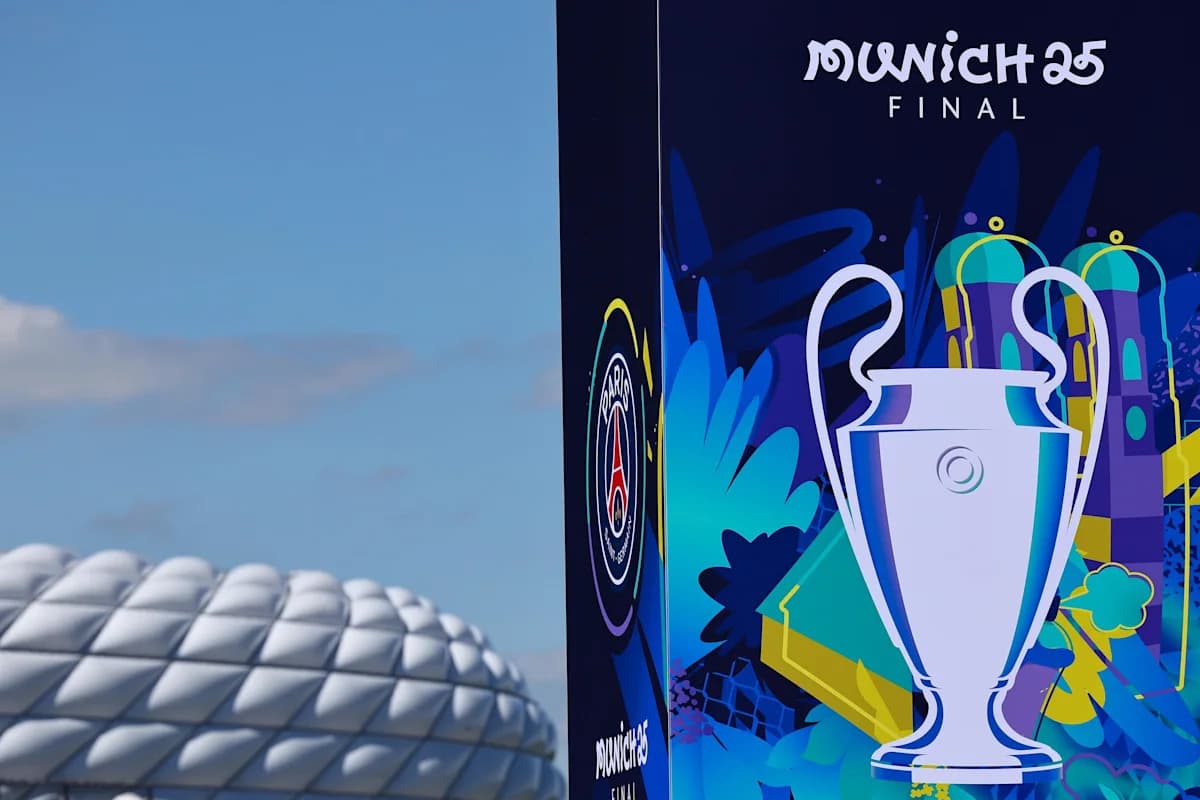
Bayern Munich's Allianz Arena Set to Host 2028 Champions League Final

Allianz Arena to Host 2028 Champions League Final for Third Time