
Hradec Králové's Tactical Approach Against Beşiktaş
Hradec Králové’s 3-4-2-1 at Malsovicka arena was built around territorial aggression and wide pressure, and the statistics bear out a plan to pin Beşiktaş back rather than simply survive. With 48% possession and 8 corners to 5, the hosts were not passive; they consistently advanced their wing-backs and outside centre-backs to lock Beşiktaş into their own half, especially before the red card. The early yellow card for Mick van Buren at 2' underlined how front-foot their pressing was, with the lone striker tasked to initiate the press and the two support forwards, T. Sloncik and O. Mihalik, stepping into the half-spaces to trap Beşiktaş’s single pivot.
In settled play, David Horejs’ side tried to overload the central lane with V. Darida and S. Dancak stepping inside from the midfield line, while J. Kucera and D. Horak provided width. The 3-4-2-1 morphed into a 3-2-5 in possession, with the back three holding a high line and the wing-backs almost joining the front line. That structure generated volume in the final third: 9 shots on goal from Hradec Králové versus Beşiktaş’s 5 is a striking imbalance for a side that ended up losing. However, the lack of blocked shots (0) suggests much of their shooting came in clearer lanes rather than through heavy traffic; the issue was not creating sightlines but converting them.
The substitutions on 42' and 59' were clearly tactical recalibrations rather than simple like-for-like changes. At 42', D. Ludvicek (IN) came on for J. Kucera (OUT), hinting at a desire for more defensive security or aerial presence on one flank without abandoning the 3-4-2-1 shape. On 59', M. Valenta (IN) for S. Dancak (OUT) and A. Umar (IN) for M. van Buren (OUT) refreshed the central lanes and the tip of the press. Valenta’s introduction suggested a push for more vertical running from midfield, while Umar offered a slightly different profile up front, likely more oriented towards attacking space behind rather than constant back-to-goal duels.
Beşiktaş, in contrast, set up in a 4-1-4-1 that prioritised control through the middle and protection of the back four. With 52% possession, Vincenzo Italiano’s side were marginally more ball-dominant, but their shot profile (5 on goal, 11 off target, 6 blocked) shows a team that often settled for lower-quality attempts from distance or under pressure. The single pivot, S. Ozcan, anchored the structure in front of a back line of M. Murillo, T. Djalo, E. Topcu and K. Ouattara, allowing the two advanced central midfielders, J. Olaitan and O. Kokcu, plus the wide midfielder Václav Černý, to operate higher.
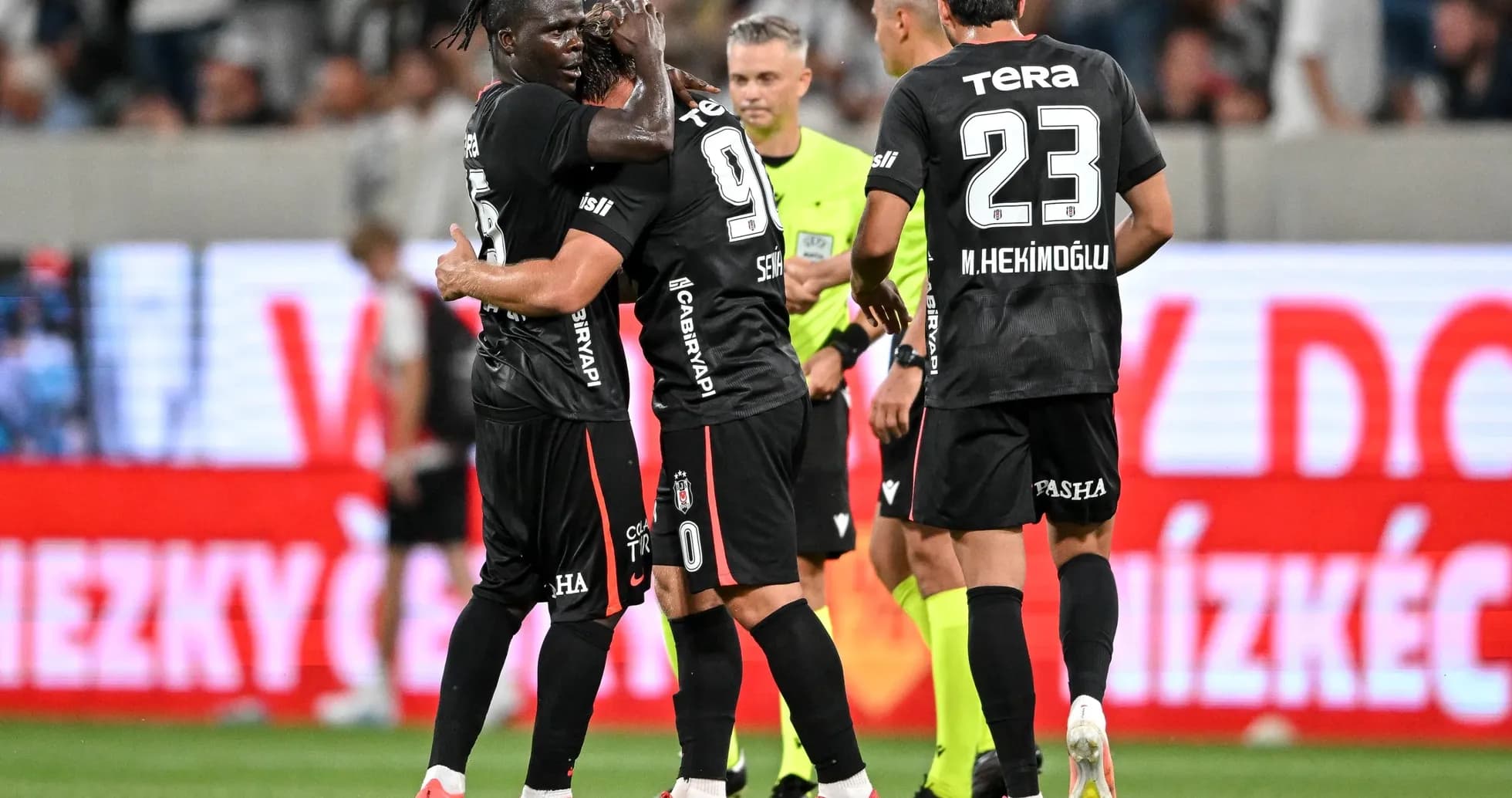
The disciplinary pattern around Kassoum Ouattara’s dismissal is tactically significant. His yellow cards at 65' and 71', followed immediately by a red card at 71', forced Beşiktaş to rewire their defensive shape down a man. Losing the left-back in a system that relies on full-backs to provide width meant Italiano had to compress his block and protect the half-spaces, ceding more initiative to Hradec Králové. That Beşiktaş still managed to score at 80' through S. Kilicsoy, after a triple substitution on 76' (W. Ndidi (IN) for O. Kokcu (OUT), R. Yilmaz (IN) for I. Fakili (OUT), S. Kilicsoy (IN) for V. Cerny (OUT)), underlines a deliberate shift to a more direct, transition-based approach: fresh legs in midfield and attack to exploit any over-commitment from the hosts.
The later Beşiktaş changes — E. Agbadou (IN) for S. Ozcan (OUT) and M. Hekimoglu (IN) for Oh Hyeon-Gyu (OUT) at 88' — were about closing the game down and adding defensive robustness and running capacity to protect the 0-1 scoreline. With a red card already on the board and 3 yellow cards in total, Beşiktaş accepted a scrappier, foul-prone closing phase (6 fouls overall) as the cost of maintaining compactness.
Without explicit goalkeeper statistics, the tactical picture still points to contrasting defensive philosophies. Hradec Králové’s back three plus aggressive wing-backs left them occasionally vulnerable to counters, but Beşiktaş’s finishing inefficiency (11 shots off goal, 6 blocked) meant those transitions rarely produced clear sights of goal. Conversely, Beşiktaş’s 4-1-4-1, even when reduced to 10 men, maintained a narrow, layered block that forced Hradec Králové into volume rather than precision; 9 shots on goal were allowed, but the Turkish side trusted their structure and last-line defending to absorb that pressure.
Set-piece dynamics also reveal intent. Hradec Králové’s 8 corners to Beşiktaş’s 5 show how consistently the hosts forced the visitors to defend deep. Their 3-4-2-1 is naturally strong on first and second balls from wide deliveries, with three centre-backs and multiple midfield runners attacking the box. Yet Beşiktaş’s aerial organisation and blocking (6 blocked shots overall, many likely in and around set-piece phases) prevented those restarts from turning into high-quality chances.
In summary, this Europa League 3rd Qualifying Round tie was defined by a clash of structures: Hradec Králové’s expansive 3-4-2-1 pressing and territorial play versus Beşiktaş’s possession-based 4-1-4-1 that morphed into a compact, counter-punching unit after the red card. The numbers — more shots on goal and corners for the hosts, more total attempts but less accuracy for the visitors, and a heavier Beşiktaş card count (3 yellows, 1 red against 2 yellows for Hradec Králové) — all align with a match where Hradec Králové drove the tempo, but Beşiktaş managed the key moments more ruthlessly and left Malsovicka arena with a narrow but tactically hard-earned 0-1 advantage.
Related News
PAOK vs Anderlecht Tactical Analysis: Dominance Without Reward

Red Bull Salzburg's Tactical Dominance Over Pafos
Hradec Králové's Tactical Approach Against Beşiktaş
KuPS vs. Craiova: Tactical Analysis of a 1-1 Draw
Larne and Saburtalo Battle to a 0-0 Draw in UEFA Europa League
Lech Poznan's Tactical Domination Over KI Klaksvik in UEFA Europa League