
Jagiellonia's Tactical Masterclass Against Rangers
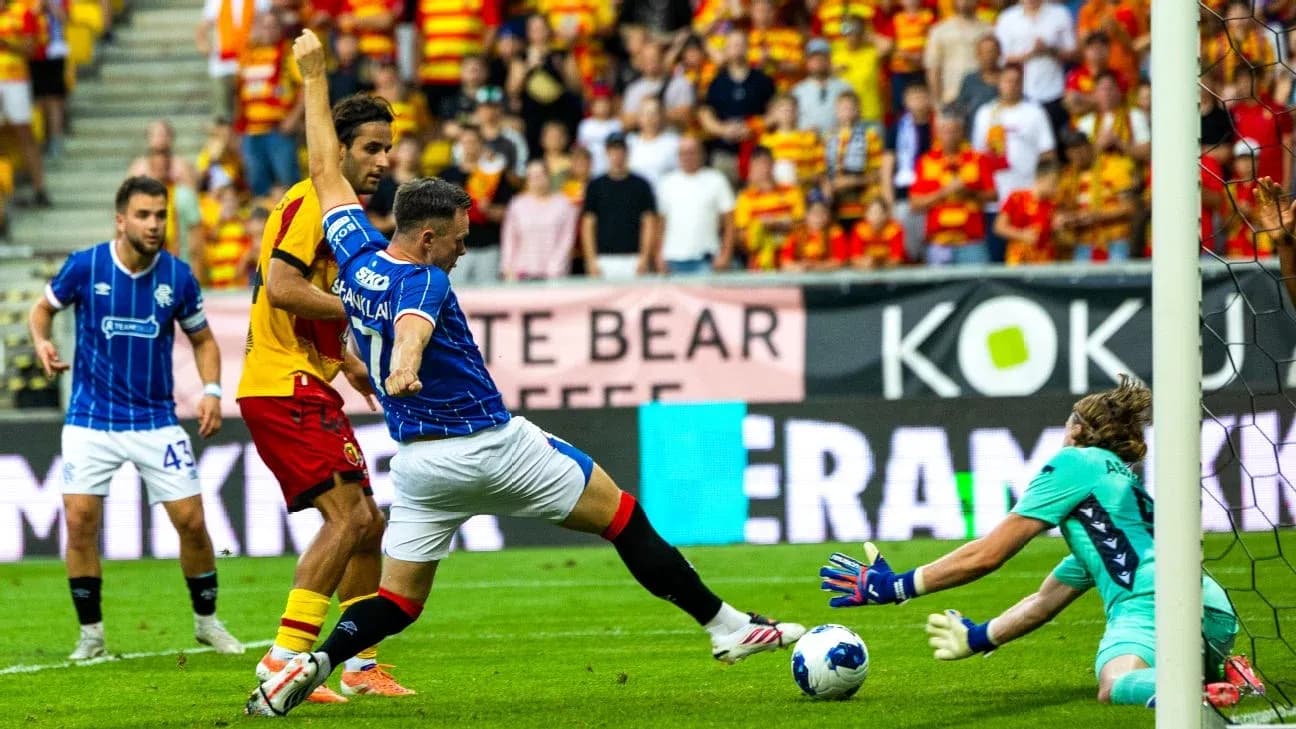
Jagiellonia’s 2-1 win over Rangers at Chorten Arena was built on structural clarity and superior control of key zones rather than sheer volume of chances. In a tie framed by Europa League 3rd Qualifying Round tension, Adrian Siemieniec’s 4-3-3 imposed its rhythm early, forced critical defensive errors from Rangers, and then managed the game with a compact mid-block and selective pressing. Rangers’ 4-2-3-1 never fully solved Jagiellonia’s central congestion and were repeatedly pushed into wide, lower-value attacks despite a decent share of the ball.
Structurally, Jagiellonia’s 4-3-3 was actually quite flexible. Out of possession, it resembled a 4-1-4-1 with T. Romanczuk anchoring in front of the back four and S. Lozano and R. Conceicao initially stepping up to screen Rangers’ double pivot of T. Chukwuani and D. Neil. The back line of N. Wojtuszek, A. Konstantopoulos, Y. Kobayashi and G. Montoia held a relatively high starting position, which allowed the team to compress the pitch and keep Rangers’ front four facing play rather than running in behind.
On the ball, Jagiellonia’s 52% possession was not about sterile circulation; it was about using short passing sequences to isolate the wide midfielders. K. Szmyt, nominally listed as a midfielder, often drifted into the right half-space, combining with Wojtuszek on overlaps and underlaps. On the left, J. Imaz played almost as a narrow playmaker, stepping inside to connect with Lozano and Romanczuk, leaving the flank for Montoia’s overlaps. This positional play created the platform for Jagiellonia’s 7 shots on goal from relatively modest overall shot volume, reflecting a focus on high-quality situations rather than speculative efforts.
The early chaos set the tactical tone. G. Montoia’s own goal at 4' could have destabilized Jagiellonia, but their structure held. They immediately pushed their full-backs higher in possession, trusting Romanczuk to cover transitions. Rangers, having been gifted the lead, did not adjust aggressively; their 4-2-3-1 remained fairly flat, with Chermiti isolated against two centre-backs and limited support from the wings. That passivity allowed Jagiellonia to regain territorial control and force Rangers deeper.
The equaliser via E. Fernandez’s own goal at 13' underlined Jagiellonia’s pressure on the visitors’ defensive line. Jagiellonia’s front three and advanced midfielders consistently pinned Rangers’ back four, forcing hurried clearances and risky defensive actions. When K. Szmyt then struck the decisive goal at 21', it was a logical outcome of this territorial squeeze: Jagiellonia had Rangers retreating into their own box, and the midfield line of Lozano and Imaz arriving late from deeper positions created overloads that the Scottish side’s double pivot could not track effectively.
Defensively, Jagiellonia were disciplined. They committed only 11 fouls and received a single yellow card (Yuki Kobayashi at 88'), a sign of controlled aggression rather than desperation. The back four stayed compact horizontally, with Kobayashi and Konstantopoulos rarely separating, which forced Rangers to work the ball into wide zones and cross rather than play incisive passes through the middle. With Rangers managing only 3 shots on goal, Jagiellonia’s defensive block successfully limited clear-cut opportunities despite conceding 5 corner kicks.
Rangers’ tactical approach never fully clicked. In the first half, the double pivot of Chukwuani and Neil struggled under Jagiellonia’s midfield pressure. Their build-up became predictable: centre-backs into full-backs, then long or hopeful passes into Chermiti or the wide players D. Yokota and T. Aasgaard. The early booking for Tuur Rommens at 5' further constrained their aggression on the left side, while Tochi Chukwuani’s yellow at 34' symbolised Rangers’ growing discomfort in midfield duels.
Derek McInnes’ triple substitution at 46' — C. Devlin (IN) for T. Chukwuani (OUT), N. Raskin (IN) for D. Neil (OUT), and F. Curtis (IN) for D. Yokota (OUT) — was a clear attempt to rebalance the midfield and add more verticality. Devlin and Raskin brought more energy and forward passing intent, and Curtis offered fresh legs between the lines. Structurally, Rangers tried to push their full-backs higher and use Raskin to connect defence and attack. However, Jagiellonia responded by slightly lowering their block, protecting the central corridor and inviting Rangers into wider, less dangerous zones.
The home side’s substitutions were aimed at maintaining intensity and defensive stability rather than changing the system. At 65', J. Agbonifo (IN) for R. Conceicao (OUT) and A. Klynge (IN) for S. Lozano (OUT) refreshed the midfield. Agbonifo brought legs to press Rangers’ build-up, while Klynge helped retain possession and slow the tempo. Later, at 80', D. Drachal (IN) for J. Imaz (OUT) and Y. Sylla (IN) for N. Prelec (OUT) further shifted the emphasis towards work rate and counter-pressure, with Sylla offering depth on transitions to stretch Rangers’ defensive line and create breathing space.
Rangers’ later changes, V. Dragojevic (IN) for T. Aasgaard (OUT) at 76' and L. Shankland (IN) for R. McCrorie (OUT) at 85', were attempts to tilt the game into a more direct attacking pattern. Shankland’s presence alongside Chermiti gave Rangers more penalty-box presence, but by then Jagiellonia had dropped into a compact 4-5-1 out of possession, with the wingers tracking back and the full-backs no longer overlapping as aggressively. The visitors’ 15 fouls and 3 yellow cards — including Nicolas Raskin at 90+2' — reflected growing frustration as their late pressure failed to translate into clear chances.
Statistically, the picture supports the tactical story. Jagiellonia’s 7 shots on goal to Rangers’ 3 underline their superior chance quality, even without total shot counts. Rangers’ 5 corner kicks versus Jagiellonia’s 1 show that the visitors did push territory at times, particularly after the break, but their attacks were largely channelled into wide, cross-heavy sequences that Jagiellonia’s centre-backs and screening midfielders coped with. The marginal edge in possession (52% to 48%) for Jagiellonia was significant not for volume but for where that possession occurred: higher up the pitch, forcing errors and sustaining pressure in the decisive first-half spell.
In the end, this was a tactically mature home performance. Jagiellonia used their 4-3-3 to dominate the central spaces early, capitalised on Rangers’ structural hesitancy, and then managed the second half with game-state intelligence — rotating midfield profiles, tightening the block, and accepting a lower share of territory without losing control of the key zones in front of their own penalty area. Rangers’ adjustments added energy but not clarity, leaving them reliant on set-pieces and hopeful deliveries rather than coordinated, high-quality chance creation.
Related News
Jagiellonia's Tactical Masterclass Against Rangers
PAOK vs Anderlecht Tactical Analysis: Dominance Without Reward

Red Bull Salzburg's Tactical Dominance Over Pafos
Hradec Králové's Tactical Approach Against Beşiktaş
KuPS vs. Craiova: Tactical Analysis of a 1-1 Draw
Larne and Saburtalo Battle to a 0-0 Draw in UEFA Europa League