
Lech Poznan vs Aarhus: Champions League Qualifying Round Analysis
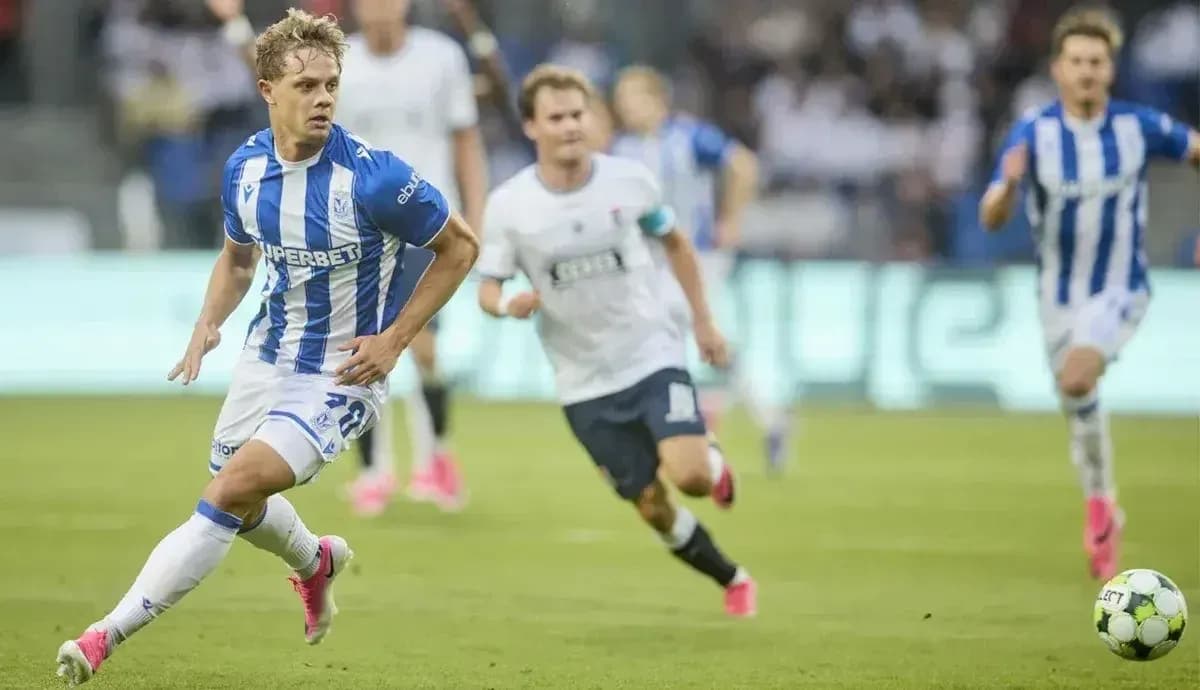
Lech Poznan’s 4-2-3-1 against Aarhus’s 3-4-2-1 produced a structurally clear but emotionally wild Champions League 2nd Qualifying Round tie at Enea Poznań, decided 3-4 on penalties after a 1-3 home loss in regular time and 1-1 in extra time. The numbers underline how the game tilted: Lech had more territorial and final-third pressure (18 total shots, 16 from inside the box, 14 corners) but Aarhus controlled key moments and transitions, pairing efficiency with defensive resilience.
Aarhus’s 3-4-2-1 was built on a compact back three of Jonas Jensen-Abbew, Frederik Tingager and Eric Kahl, screened by a hard-working midfield box. With 51% possession and 495 total passes (397 accurate, 80%), they were not purely reactive; instead, they used controlled build-up to draw Lech’s 4-2-3-1 forward and then attack the spaces behind the full-backs. The first goal at 32' encapsulated this: Tobias Bech found a pocket to exploit Lech’s advanced wide defenders, finishing from a K. Arnstad assist once Aarhus had progressed through the lines.
Lech’s structure with double pivot Radosław Murawski and Antoni Kozubal was designed to stabilise central spaces and release a narrow three of Patrik Wålemark, Pablo Rodríguez and Luis Palma behind Mikael Ishak. In practice, their 456 total passes (359 accurate, 79%) and 49% possession show a side that had enough of the ball but struggled to convert circulation into clean, high-quality shots until the game state forced them to chase. The 16 shots inside the box point to volume rather than clarity; Aarhus’s six blocked shots and eight saves from Mads Hedenstad (Aarhus) highlight how often Lech’s attacks were met by a well-set block.
The penalty for Aarhus at 55', converted by K. Arnstad, was a turning point tactically. At 0-2 (and 0-1 at half-time), Lech’s full-backs Robert Gumny and Michał Gurgul had to push even higher, and the wingers narrowed to overload the half-spaces. This increased Lech’s attacking volume and corner count but also made them vulnerable to counters, a risk Aarhus accepted given their three centre-backs and the work rate of wing-backs and midfielders.
Jakob Poulsen’s in-game management for Aarhus was conservative but coherent. At 60', Christian Storch (IN) came on for J. Jensen-Abbew (OUT), freshening the back line without changing shape. Later, the double change at 70' — Rasmus Carstensen (IN) for J. Jønsson (OUT) and Stefen Tchamche (IN) for J. Bogere (OUT) — was about energy and pressing height, maintaining the front line’s ability to harry Lech’s build-up as the hosts chased the game. The 75' goal by F. Tingager, assisted by E. Kahl, underlined Aarhus’s set-piece and aerial threat: the back three’s size and timing became a decisive offensive weapon, pushing the regular-time score to 0-3 and effectively forcing Lech into an all-or-nothing attacking posture.
Niels Frederiksen’s response was a cascade of attacking substitutions. At 68', Allahyar Sayyadmanesh (IN) came on for L. Palma (OUT), adding direct running from wide areas. At 81', Joel Pereira (IN) replaced R. Gumny (OUT) and Filip Jagiełło (IN) replaced P. Rodríguez (OUT), rebalancing the right flank and injecting a more creative profile between the lines. Daniel Håkans (IN) for P. Wålemark (OUT) at 87' and Yannick Agnero (IN) for M. Ishak (OUT) at 88' turned the front line into a more fluid, mobile unit rather than a classic focal-point system.
These changes paid off in phases. Lech’s late push produced Filip Jagiełło’s goal at 95', reducing the deficit and validating the increased central creativity and second-line arrivals. By then, Aarhus had also rotated key pieces: M. Camara (IN) for E. Kahl (OUT) at 90+3' to add fresh legs on the flank, and in extra time Janni Serra (IN) for M. Anderson (OUT) and Tómas Óli Kristjánsson (IN) for F. Emmery (OUT) at 97', plus T. Kristjánsson’s goal at 100' from a T. Bech assist. That strike, making it 1-1 in extra time after Lech had finally broken through, showed Aarhus’s capacity to strike back quickly even under pressure, exploiting the stretched shape of a Lech side throwing numbers forward.
In extra time, Lech’s last structural tweak saw Gisli Thordarson (IN) for R. Murawski (OUT) at 98', trading some positional discipline in the pivot for more vertical passing. The pattern remained: Lech piled on crosses and box entries, Aarhus protected the central lane and relied on Mads Hedenstad (Aarhus), whose eight saves were critical in keeping Lech to one open-play goal across 120 minutes. At the other end, Mateusz Lis (Lech Poznan) made two saves; with Aarhus registering six shots on goal and scoring three times in regular/extra time, their finishing and shot selection were notably sharper.
Discipline also shaped the rhythm. The card count finished Lech Poznan: 2 yellows; Aarhus: 4 yellows; Total: 6. Chronologically, the bookings were:
- 40' Antoni Kozubal (Lech Poznan) — Roughing
- 45' James Bogere (Aarhus) — Roughing
- 86' Mikael Anderson (Aarhus) — Unsportsmanlike conduct
- 91' Frederik Emmery (Aarhus) — Roughing
- 105+1' Yannick Agnero (Lech Poznan) — Roughing
- 107' Mouhammade Camara (Aarhus) — Roughing
Lech’s early yellow for Kozubal constrained the aggression of one pivot in duels, while Aarhus’s cluster of cards reflected the increasing reliance on tactical fouls and game management as Lech surged. Yet Aarhus never lost structural integrity; their 14 fouls were spread enough to break rhythm without collapsing into chaos.
The penalty shootout, ending 3-4, was the final expression of the game’s underlying tactical story: Lech created more volume and pressure but lacked the ruthless edge and composure that Aarhus showed in both open play and from the spot. Tingager and T. Kristjánsson, already influential in open play, converted in the shootout, while misses from Sayyadmanesh and Kozubal underlined the psychological and technical gap at decisive moments. In pure statistical terms, the match was balanced in possession and passing accuracy, but Aarhus’s superior efficiency in both boxes — backed by structure, set-piece strength and a standout display from Hedenstad (Aarhus) — carried them through.
Related News
Luis Díaz Confident Bayern Munich Can Win Champions League
AFC Champions League Matchday One: Insights and Team Strategies
Vincent Kompany’s Bayern Munich Future Not Tied Solely to Champions League Success
Barcelona’s Camp Nou to Host 2029 Champions League Final, Munich Confirmed for 2028
Bayern Munich's Allianz Arena Set to Host 2028 Champions League Final
Allianz Arena to Host 2028 Champions League Final for Third Time