
Lech Poznan's Tactical Masterclass Against FC Thun
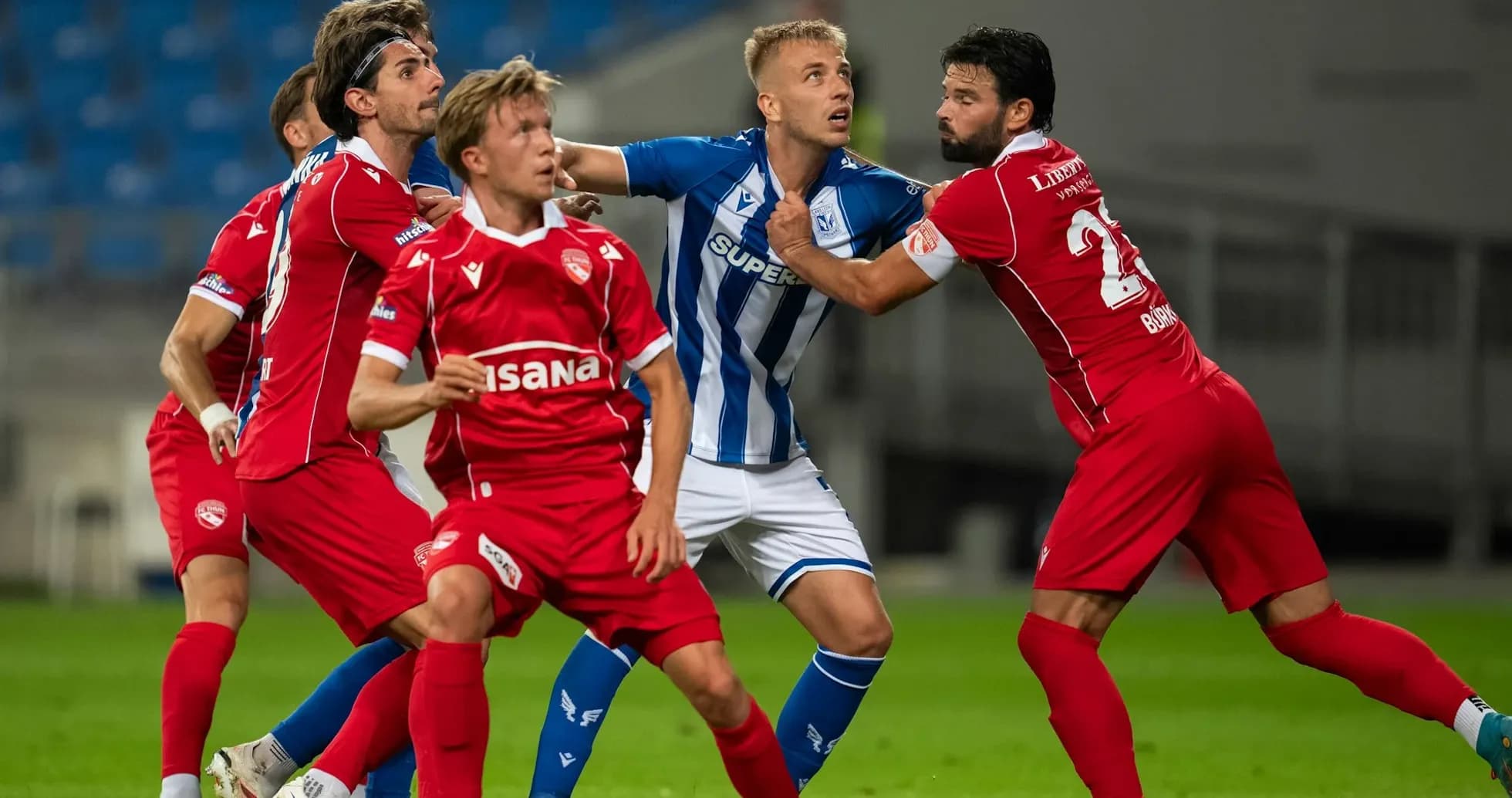
Lech Poznan’s 7–0 dismantling of FC Thun at Enea Poznań was a tactical rout built on structure, tempo and ruthless use of wide spaces. Within a 4-2-3-1, Niels Frederiksen’s side used their double pivot to control rhythm and their three attacking midfielders to constantly overload the half-spaces, turning 56% possession into 11 shots on goal and five first-half strikes. Thun’s 4-4-2, by contrast, was stretched and reactive, conceding territory between the lines and suffering under Lech’s superior pressing coordination and circulation.
Structurally, Lech’s 4-2-3-1 was extremely aggressive without the ball. The back four of J. Pereira, W. Monka, M. Skrzypczak and M. Gurgul held a relatively high line, trusting the compactness in front of them. The double pivot of A. Kozubal and R. Murawski screened passes into Thun’s front two, while also acting as the launchpad for attacks. With Thun limited to 44% possession and forced into 16 fouls, the pattern was clear: Lech dictated the zones of play and Thun chased.
Key Tactical Weapon
The key tactical weapon was the trio behind the striker: P. Walemark from the right, P. Rodriguez centrally and L. Palma from the left (before later changes), with A. Sayyadmanesh as the nominal central forward. Walemark’s brace and early influence reflected a clear plan: isolate him 1v1 against the Thun full-back line, then attack the box with second-line runners. His first goal at 10' came from Lech’s ability to pin Thun’s midfield four narrow, freeing the flank. The second at 25' again highlighted how often he received between full-back and centre-back, exploiting the space created by Sayyadmanesh’s movements.
Sayyadmanesh’s role was more of a mobile nine than a pure penalty-box striker. By dropping off the centre-backs, he dragged J. Bamert and M. Burki into uncomfortable areas, opening lanes for Walemark and Palma to attack inside. His goal at 20', assisted by Rodriguez, underlined the value of that rotation: Rodriguez, operating as a classic No. 10, could receive between the lines, draw a midfielder, and then slide vertical passes into the channel. Later, his assist for Murawski at 45' showed the same pattern – central overload, quick release, late midfield run.
On the left, Palma’s initial positioning was slightly narrower, allowing Gurgul to advance from left-back and provide width. Gurgul’s assist for Walemark’s second goal and later for R. Gumny at 79' encapsulated Lech’s full-back aggression: as Thun’s wide midfielders were dragged inside to deal with the No. 10 and opposite winger, the full-backs could step into crossing positions with little pressure.
Defensive Pressing
Defensively, Lech’s pressing was selective but effective. With Thun in a 4-4-2, the trigger was often a backward pass from the full-back into the centre-back. Sayyadmanesh and the ball-near winger would jump to lock the ball on one side, while Murawski shifted across to cut the passing lane into midfield. The result was a series of rushed clearances and second balls that Lech’s double pivot routinely recovered. Thun’s four shots on goal came more from sporadic direct play and transitions than from any sustained possession.
In Possession
In possession, Lech’s build-up used the double pivot asymmetrically: Kozubal often dropped closer to the centre-backs to form a three in the first phase, allowing Pereira and Gurgul to push high. Murawski stayed slightly higher to connect with Rodriguez and the wingers. This 2-3-2-3 or 3-2-2-3 shape in build-up constantly asked Thun’s front two to choose between pressing the centre-backs or screening the pivot; they rarely managed both. Once the first line was broken, Lech could drive forward with numbers, which is why 11 shots on goal translated into seven actual goals.
Second Half Substitutions
The second half substitutions did not dilute the structure; they refreshed and even sharpened it. D. Hakans (IN) came on for Walemark (OUT) at 37', and later scored at 47', assisted by Sayyadmanesh. This kept the right flank as a primary attacking lane, with Hakans inheriting the same brief: attack the channel outside Thun’s left centre-back. The introduction of R. Gumny (IN) for Rodriguez (OUT) at 64' and G. Berggren (IN) for Palma (OUT) at the same minute slightly rebalanced Lech towards more control and protection, but the sixth goal at 79' via Gumny showed that even the nominally more conservative setup still carried a strong offensive edge.
Thun’s Tactical Adjustments
Thun’s tactical adjustments were largely reactive and ineffective. M. Gutbub (OUT) for F. Dursun (IN) at 45+1', followed by M. Heule (OUT) for T. Strannegård (IN) and N. Zoukit (OUT) for F. Saiz (IN) at 46', signalled a search for more energy and verticality. However, the basic structural issues remained: the midfield line could not protect the space in front of the defence, and the back four struggled to defend the width. The disallowed potential goal by Furkan Dursun at 66' after VAR intervention was one of the few moments where Thun managed to exploit Lech’s high line, but it did not alter the tactical balance.
Discipline Numbers
Discipline numbers underline the imbalance in control. Lech committed 8 fouls to Thun’s 16, and while both sides finished with no reds, Thun’s two yellow cards reflected repeated late challenges as they tried to halt transitions. Lech’s single yellow for Radosław Murawski at 87' came in a phase where game state and scoreline had long been decided.
Without explicit data on saves, xG or passing accuracy, the clearest statistical story is territorial and behavioural: more possession, more shots on goal, fewer fouls, and more corners (5 to 3) for Lech Poznan. Combined with a coherent 4-2-3-1 that maximised wide overloads and second-line runs, this produced not just a heavy scoreline but a performance that was tactically stable from first minute to last.
Related News
AC Milan vs Benfica: A Clash of Two Philosophies in UEFA Europa League
Five Standout Europa League Players to Watch in 2026/27
AC Milan vs Benfica Europa League Clash: Team Updates, Lineups & Broadcast Info
Omonia Nicosia vs Benfica Predicted Lineups: Team News for UEFA Europa League
Red Bull Salzburg vs Ararat-Armenia Predicted Lineups and Team News
Celje vs Red Bull Salzburg Predicted Lineups and Team News