
Liverpool and Nottingham Forest Draw 2–2: Tactical Insights
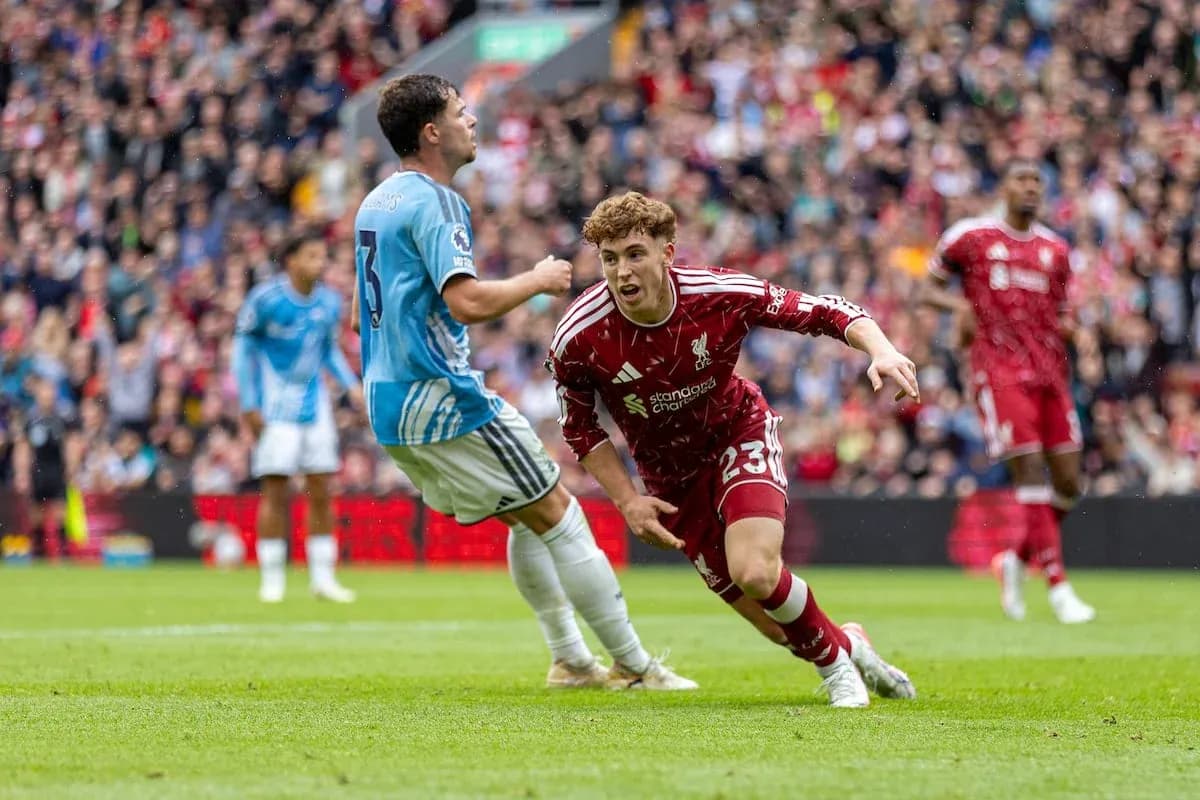
Under a grey Merseyside sky at Anfield, Liverpool and Nottingham Forest played out a 2–2 draw that said as much about their evolving identities as it did about the early Premier League table. After two rounds of the regular season, Liverpool sit 13th with 2 points, Forest 15th with 1, both still winless but revealing distinct tactical blueprints.
I. The Big Picture – Structures and Seasonal DNA
Liverpool are already settling into Andoni Iraola’s 4-2-3-1 as their default shape, used in both league matches so far. The numbers underline a side tilted towards front-foot football but still searching for control: overall they have scored 4 goals and conceded 4, with an average of 2.0 goals for and 2.0 against both at home and on their travels. The goal difference is exactly 0, a statistical mirror that matches the sense of a team capable of hurting anyone yet not fully secure.
Nottingham Forest, under Oliver Glasner, have gone all-in on a 3-4-2-1 that has also been their constant across the opening two fixtures. Overall they have 2 goals for and 3 against; the goal difference of -1 reflects a side that has been competitive but brittle at key moments. At home they have failed to score, with 0 goals for and 1 against, while away they have been far more expansive: 2 goals for and 2 against, averaging 2.0 goals both scored and conceded on their travels.
At Anfield, those season-long tendencies converged into a contest where Liverpool’s layered attacking lines met Forest’s compact back three and aggressive wing-backs.
II. Tactical Voids – Absences and Discipline
Liverpool arrived with a lengthy absentee list that subtly reshaped Iraola’s options. S. Bajcetic (hamstring), C. Bradley (knee), F. Chiesa (back), H. Ekitike (Achilles), H. Elliott (coach’s decision), J. Gomez (injury) and G. Leoni (knee) all missed the fixture. That cluster of absences particularly affected the right flank and depth in the attacking and defensive rotations, placing more responsibility on Jeremie Frimpong at right-back and on the creative trio behind Alexander Isak.
Forest were without I. Sangare (calf) and N. Savona (knee), removing a key ball-winner and an additional midfield option from Glasner’s toolbox. In a 3-4-2-1 that leans heavily on central stability, Sangare’s absence was especially significant, forcing more defensive work onto X. Schlager and J. McAtee in the central band.
Disciplinary trends from the opening two rounds also framed the risk profiles. Liverpool’s yellow cards are spread across the middle of games: 28.57% of their bookings have come between 16–30 minutes, another 28.57% between 46–60, and 28.57% again between 76–90, with 14.29% between 61–75. That pattern suggests a side that spikes in aggression at the start of each half and again in the closing stages, often as they raise the tempo or chase a result.
Forest’s yellow cards are more front-loaded into the second half. Half of their bookings overall have arrived between 46–60 minutes, with 25.00% between 16–30 and another 25.00% between 31–45. The danger zone for Glasner is clearly the first quarter-hour after the restart, when their press can become overzealous and structurally exposed.
Neither team has seen a red card in the league so far, and both have perfect penalty records to this point: Liverpool have scored their only spot-kick overall, while Forest have also converted their single penalty overall.
III. Key Matchups – Hunter vs Shield, Engine Room Battles
The headline duel at Anfield revolved around Liverpool’s attacking quartet and Forest’s back three. Alexander Isak, with 1 league goal from 5 shots (3 on target) and a 7.15 rating, led the line. Behind him, Cody Gakpo, Florian Wirtz and Víctor Muñoz formed a fluid band of creators and finishers.
Gakpo has emerged as Liverpool’s early all-phase reference: 1 goal, 1 assist, 3 shots, 5 key passes and 51 total passes at 78% accuracy, plus 3 tackles and 3 interceptions. His role drifting inside from the left half-space tested Forest’s right-sided defender Cunha and the covering angles of N. Milenkovic. Any lapse in tracking his underlaps or delayed runs threatened to pull Forest’s line out of shape.
Muñoz has been one of the revelations: 1 goal, 3 shots, 1 key pass and 18 duels overall, winning 7, while also blocking 1 shot and making 3 interceptions. His willingness to attack the inside-right channel and then counter-press immediately is central to Iraola’s vertical transitions. Against Murillo on Forest’s left, this became a high-intensity micro-battle of acceleration versus timing in the tackle.
Wirtz, with 1 assist, 2 shots on target and 85 passes at 81% accuracy, is the rhythm-setter between the lines. His capacity to receive on the half-turn between Forest’s midfield and defence forced Schlager and McAtee to constantly decide whether to step out or hold the line, a decision that shaped how deep Morgan Gibbs-White could operate.
On the Forest side, Gibbs-White has been their creative heartbeat: 1 goal, 1 assist, 4 shots, 57 passes at 82% accuracy and 8 successful dribbles from 8 attempts across the first two matches. Operating as one of the dual 10s behind Igor Jesus, he repeatedly sought to isolate Liverpool’s centre-backs, particularly J. Jacquet, in wide pockets. His interplay with D. Ndoye, who also has 1 goal and 3 shots, provided Forest’s primary counter-attacking threat.
Out wide, O. Aina’s dual identity as both a top yellow-card collector (2 bookings) and an attacking outlet with 7 dribble attempts and 4 successes added edge to Forest’s right flank. Up against M. Kerkez, who has already blocked 3 shots and made 2 interceptions, this flank became a trench of repeated one-v-one duels, with every Aina surge testing Liverpool’s rest defence.
IV. Statistical Prognosis – Where the Numbers Point
Following this result, the underlying numbers sketch two sides on parallel but contrasting paths. Liverpool’s overall profile of 4 goals for and 4 against in 2 matches, no clean sheets and no failures to score, paints a picture of a high-variance team: they will almost always be in games, but often need to outscore rather than simply edge opponents. Their card distribution, with 28.57% of yellows in the final 15 minutes, hints at a team willing to take tactical fouls late on to protect or chase a result.
Forest’s split between home and away is stark. At home they have 0 goals for and 1 against overall; away they have 2 goals for and 2 against, with no clean sheets in any context and 1 overall failure to score. They are more dangerous on their travels, but their away average of 2.0 goals conceded overall underlines the fragility of a back three that is still synchronising with an aggressive midfield line.
In terms of penalty reliability, both sides remain flawless so far, which matters in finely balanced contests like this. With neither team yet finding a winning formula, the statistical prognosis is of two projects still in construction: Liverpool already possess a multi-layered attack led by Gakpo, Wirtz, Muñoz and Isak, but must tighten the defensive details; Forest have a clear identity through Gibbs-White, Ndoye and their wing-backs, yet need to reduce the defensive cost of their ambition, especially in that volatile 46–60 minute window.
At Anfield, the 2–2 draw felt like a fair reflection: Liverpool’s firepower against Forest’s resilience and counter-punching. The numbers suggest that if both coaches can solve their respective structural leaks, these early-season stalemates may soon give way to more decisive outcomes.
Related News
Ipswich vs Liverpool Stats: Head-to-head Record and Historical Context
Crystal Palace vs Manchester City: Tactical Analysis of Premier League Clash
Aston Villa vs Arsenal Predicted Lineups: Team News and Insights
Aston Villa vs Arsenal: Premier League Clash Overview

Aston Villa vs Arsenal Prediction: Preview and Key Stats
Manchester United vs Ipswich: Predicted Lineups and Team News