
Liverpool's Struggles with Rest Defence Under Andoni Iraola
Andoni Iraola walked into Liverpool with one word hanging over him: scalability.
The high-octane, front-foot football that had impressed at mid-table clubs in La Liga and the Premier League was one thing. Doing it at a club that expects to chase titles, control games and live with the ball? That’s a different sport entirely.
By the time Liverpool kicked off their Premier League season away at Newcastle United, the questions had been asked a hundred different ways. Could this model stretch to the elite? Could a team built on intensity without the ball survive when they were suddenly favourites to have it?
What nobody had on their bingo card was that the opening chapter of the Iraola era would be dominated by a concept borrowed from German coaching jargon: rest defence.
Liverpool escaped St James’ Park with a 2-2 draw that felt more like a warning than a platform. They created enough to win, but were ripped open twice in transition. By full-time, the conversation had moved away from pressing triggers and verticality and landed squarely on what happens when Liverpool attack — and lose it.
What ‘rest defence’ really means
Strip football back and it’s simple: you’re either with the ball or without it. Attack or defend. One phase ends, the other begins.
But those phases aren’t neat, sealed boxes. The moment a team loses the ball in attack, they’re defending. The moment they win it back, they’re attacking. The game lives in those flips.
Rest defence sits exactly in that hinge. It asks a blunt question: while you’re attacking, how well are you set up for the instant you lose the ball?
The term is a straight lift from the German restverteidigung. The “rest” here isn’t about relaxing; it’s about what’s left over. In practical terms, it refers to the players not directly involved in the attack — the ones behind the ball, the ones supposed to control the space and the counter.
Their job? Be close enough to potential counter-attackers to kill transitions before they become full-blown breaks. Be positioned so that, when possession turns over, the team doesn’t collapse like a house of cards.
At St James’ Park, that “rest” was Liverpool’s problem.
How Liverpool’s structure cracked for Newcastle’s opener
Both Newcastle goals started the same way: Liverpool in promising attacking positions, then suddenly scrambling back towards their own goal.
For the first, the warning signs were there even before the turnover.
Ryan Gravenberch collected the ball as Liverpool’s deepest midfielder, turned neatly and drove into space. Dominik Szoboszlai had already pushed high, almost on the last line, threatening to run in behind. Florian Wirtz advanced to the left. All three surged towards goal.
The picture behind them told a different story. Space opened up in front of Liverpool’s defence, a huge pocket waiting to be exploited if Newcastle could win the ball and find a free man.
That free man was Will Osula.
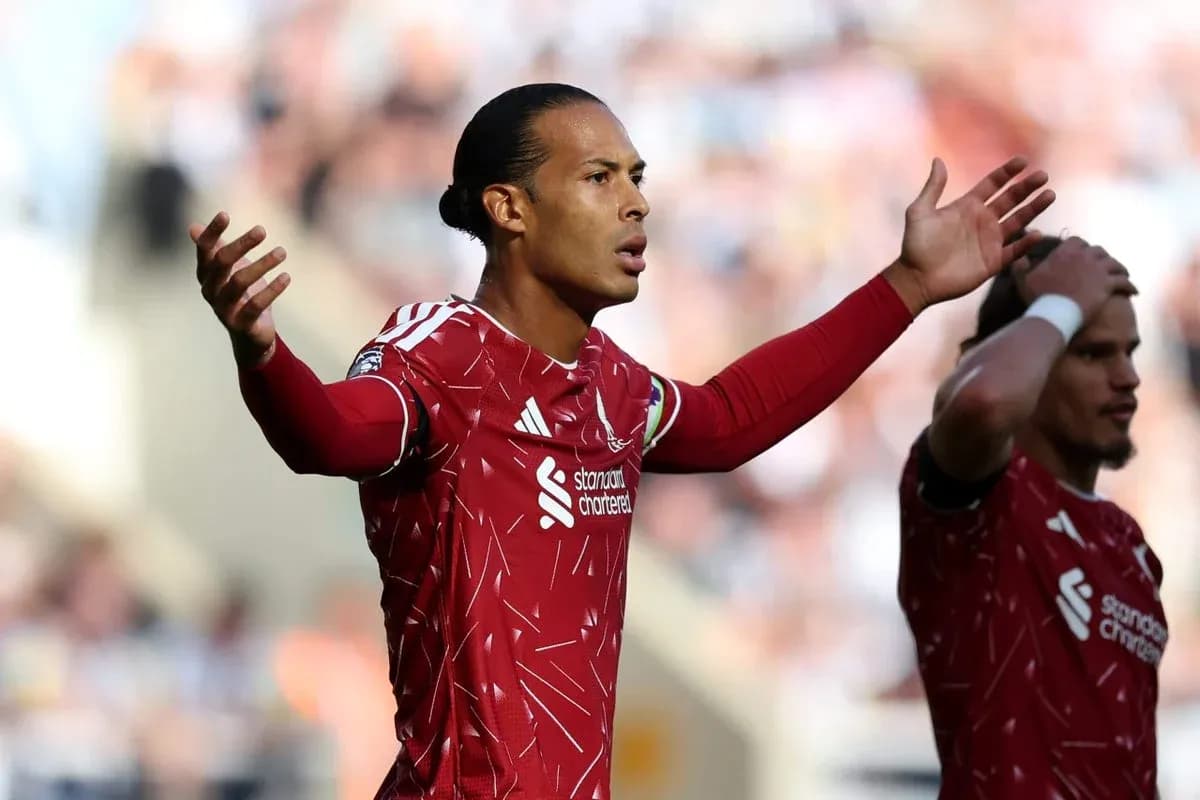
From a rest-defence standpoint, this is where Liverpool lost control. Osula drifted into a zone with enough room to hurt them, and nobody in red had realistic access to him. Virgil van Dijk sat too deep — something he later admitted — while Wirtz had gone too aggressive, given how high Szoboszlai already was.
So when the ball broke, Osula received it under no pressure, able to turn, build speed and force Liverpool’s centre-backs to retreat.
And all of this flowed from what happened when Liverpool still had the ball.
Gravenberch, driving centrally, had options. He could try to slide Szoboszlai in on his right — not easy, given his body shape and right-footedness, but available. He could shoot himself. Either choice would probably have ended the move in a way that neutralised Newcastle’s counter threat: a shot off target, a blocked effort, a ball into a less dangerous area.
Instead, he tried a risky pass into Alexander Isak. It didn’t come off. The ball bobbled on the edge of the Newcastle box and Amar Dedic stabbed it loose, straight into Osula’s path. Counter-attack triggered.
Liverpool’s problems didn’t end with structure. They continued with duels and positioning.
Milos Kerkez wasn’t tight enough to Anthony Elanga to cut out Dedic’s weak touch. Had he been closer, he might have intercepted and killed the move. Instead, Elanga received, turned and accelerated.
From there, Van Dijk couldn’t shepherd Osula wide, allowing the forward to thread a pass into Elanga’s stride. Kerkez, now chasing, never got close enough to affect him. One of the quickest players in the division ran at goal with a clear lane.
Elanga finished calmly. Five minutes gone. 1-0 Newcastle. And all from a Liverpool attack that had looked promising seconds earlier.
The second goal: same theme, different details
Newcastle’s second exposed many of the same fault lines, even if the starting picture looked slightly more stable.
This time, Liverpool’s rest defence had improved. Szoboszlai had better access to Yoane Wissa in the central space that opened when Gravenberch pushed forward and Wirtz dropped in to cover — almost certainly a tweak after half-time instructions about protecting that zone.
Even so, the centre-backs again sat a touch too deep. In that scenario, one could have stepped up to compress space while the other covered behind. They didn’t.
Then came the decision that tipped the balance. Gravenberch, once more at the heart of things, opted for a backheel. It was ambitious. It was also high-risk for the area of the pitch he was in and the game state Liverpool were managing.
He lost it.
Wirtz and Szoboszlai reacted quickly, snapping back to cover. On paper, Liverpool had the numbers to deal with the break. In reality, Wissa surged past both, brushing off pressure and driving into space.
At that point, the obvious question arises: why didn’t one of them take the tactical foul? A pull of the shirt, a clipped heel, a yellow card. The move dies, Liverpool reset.
Perhaps they trusted the coverage behind them. On the chalkboard, they were numerically sound. On the grass, they weren’t.
The overload didn’t matter. Newcastle played through, and Joe Willock arrived on the edge of the box to sweep in a sharp finish. Another Liverpool attack, another transition, another punishment.
Tactical teething, not tactical betrayal
It would be easy to file all this under “defensive errors” and move on. Missed tackles. Poor duels. Bad decisions.
But that misses the point. These weren’t isolated mistakes in a vacuum. They were the direct consequence of how Liverpool attacked, how they positioned their “rest” players, and how they weighed risk on the ball.
That’s why rest defence sits at the heart of this performance.
None of these concerns dogged Iraola at Bournemouth in quite the same way. The reason is straightforward: expectation. At Bournemouth, his side didn’t dominate the ball against most opponents. They weren’t spending long stretches camped in the final third, leaving themselves open to repeated counters.
At Liverpool, that flips. This team will have more of the ball, more of the territory, more of the initiative. That magnifies every structural flaw behind the attack.
The encouraging part for Liverpool is that Iraola has already shown he can build aggressive teams that still protect themselves when possession turns over. Bournemouth under his watch didn’t unravel every time they lost it. There’s no reason that knowledge disappears just because the shirt is red.
Where the fixes lie
The solutions here are not exotic.
Tactically, Liverpool can tighten their spacing. Midfielders can be more conscious of each other’s positioning when one drives forward. One centre-back can step up in certain situations to compress space on potential counter-attackers, with the other sweeping behind.
On the ball, players like Gravenberch can recalibrate their risk profile. The instinct to carry and attack is valuable — it’s part of why Liverpool signed him. But it has to be balanced against game state and structure. Not every backheel or tight pass is worth the exposure it creates behind.
None of this cuts across Iraola’s attacking ideals. You can still play fast, vertical football and organise your rest defence properly. You can still commit numbers forward and keep a sensible structure behind the ball. The two are not mutually exclusive.
Personnel will play a role too.
Gravenberch’s natural urge is to drive forward and open up the pitch. That can leave big spaces in front of his back line if others don’t adjust around him. That doesn’t make him the villain of the piece, but it does mean that, in certain games or phases, a different profile might suit the deeper role better.
Within the current squad, there are candidates. Trey Nyoni has looked the most naturally suited to that deeper midfield slot in pre-season, reading danger and recycling possession. Alexis Mac Allister, if his workload allows, has also shown he can anchor play with more positional discipline.
Those tweaks don’t require a transfer spree. They require clarity, repetition and selection.
A different Liverpool than expected
The irony is that many expected Liverpool to look ragged in their pressing and clumsy with the ball in these early Iraola weeks. Instead, at Newcastle, they dominated possession and carved out enough chances to win the game.
They weren’t overrun. They weren’t suffocated. They were undone, twice, in the very moments when their own attacks should have given them control.
That’s the story of this 2-2: not a system in crisis, but a structure that hasn’t yet learned how to protect itself at full speed.
If Iraola can hardwire that rest defence into Liverpool’s attacking DNA, this opening-day wobble will be remembered as a lesson. If he can’t, those transitions will keep asking the same brutal question of a team with title ambitions.
Related News

Fantasy Premier League 2026/27: Insights from Gameweek 1

Jed York Jailed After Prostitution Sting in Ohio

Liverpool's Stefan Bajcetic and Calvin Ramsay Face Uncertain Futures
Liverpool's Struggles with Rest Defence Under Andoni Iraola
Arsenal's Dressing Room Unrest: Martinelli's Situation Explained
Rio Ferdinand Questions Manchester United's Transfer Strategy After Hull Defeat