
Manchester Derby VAR Controversy: When Speed Compromised Accuracy
“Quick, quick, quick, quick! Go, go, go, go, go!”
The soundtrack to the moment the Manchester derby was decided. Not from the stands, not from a dugout, but from the VAR booth, where Matt Donohue rushed through the check that allowed Erling Haaland’s winning goal to stand.
He thought he was being efficient. Instead, he walked straight into one of the most calamitous VAR mistakes the Premier League has seen.
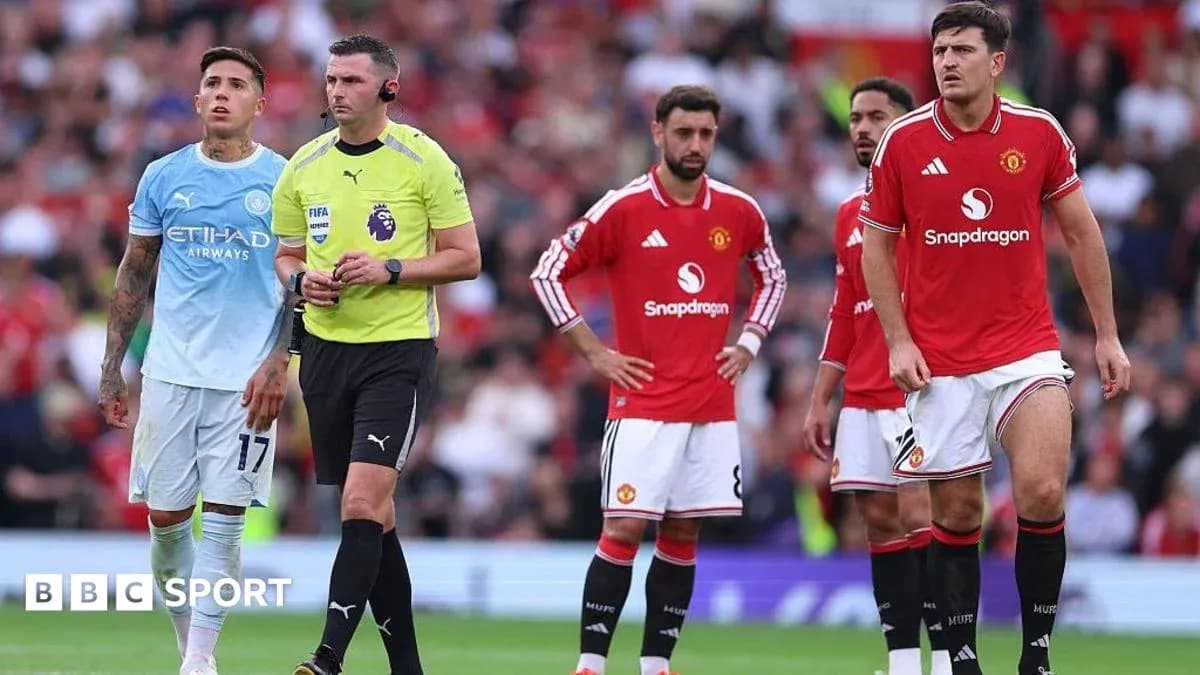
Because amid the panic and the push for speed, nobody in that room spotted what millions saw on the replay: Enzo Fernandez standing three yards offside before he tried to head the ball.
The goal stood. Manchester City 1-0 Manchester United. And another firestorm over VAR.
When speed beats sense
Refereeing has always been a pressure job, a goldfish bowl with nowhere to hide. VAR was supposed to help, to add clarity. It has done the opposite on nights like this.
The Premier League set out this season with a clear aim: make VAR quicker. Less delay, less frustration, less time with everyone in the stadium staring at a big screen and wondering what on earth is going on.
But when the mantra becomes “faster, faster, faster”, what gets lost?
The urgency in Donohue’s voice told its own story.
“Let’s go, let’s go, let’s go, let’s go!”
This was not the calm, forensic environment VAR is supposed to be. It sounded rushed. It sounded chaotic. It sounded exactly like what it turned into: a mess.
The pressure is real. Fans demand quicker checks. Pundits hammer long delays. Phone-ins rage about stoppages. In the Premier League’s own stakeholders’ survey, managers, coaches and supporters all pushed the same message: speed up the decisions.
That pressure seeps into Stockley Park. But it cannot excuse what happened.
City head coach Enzo Maresca, who benefited from the error, still acknowledged the strain.
“To make a decision in 10, 20 seconds is not easy for them,” he said. “Sometimes they make mistakes. I make mistakes, players make mistakes. It’s part of our job.”
Howard Webb, head of referees, has tried to respond to that demand for speed. The numbers say it’s working. VAR delays, including the time taken for the referee’s stadium announcement, have dropped from an average of 46 seconds per game to 36 seconds this season.
Yet the only other admitted VAR error so far – the failure to award Arsenal a penalty at Aston Villa – also came from an incident cleared too quickly.
The pattern is hard to ignore.
The moment it went wrong
The crucial failure in the derby did not come when Donohue began to race through the attacking phase. The damage was done even earlier.
On the first replay of Josko Gvardiol crossing the ball, Donohue told the replay operator to stop. He froze the image at the moment of the touch and jumped straight into the semi-automated offside system.
That is not how the protocol is supposed to work.
The VAR team should have watched the whole sequence: the cross, the movement in the box, the attempted header, and finally Haaland’s finish. Only by seeing the full picture could they appreciate where Fernandez was, what he did, and how it affected the play.
They didn’t. The action inside the penalty area – including Fernandez’s offside position – only came into focus once they were already deep into the attacking phase check.
By that stage, their world had shrunk to a single question: did Fernandez touch the ball? If he did, that would create a new phase and leave Haaland offside. If he didn’t, the original phase continued and the goal stood.
Everything else fell away.
Donohue has absorbed most of the public criticism, but assistant VAR Blake Antrobus’ role – or lack of one – was just as telling.
His entire contribution to the review boiled down to two words: “no, yeah”, a comment on whether Fernandez had made contact. One second later, Donohue said: “final decision is goal, check complete”.
The AVAR is supposed to act as the safety net, the second pair of eyes, the person who spots what the VAR might miss. That safeguard failed.
There was also a support VAR in the operations room at Stockley Park, sitting away from the match hub but able to step in on matters of protocol. They could see what was unfolding. They did nothing.
And even then, there was a final escape route. Between the goal being awarded and the restart from kick-off, the decision could still have been pulled back. It wasn’t.
A system under strain
Pro Ref has poured time, money and training into VAR. The idea is to make it sharper, slicker, more reliable. But when an error of this size explodes on the biggest stage, the investment feels irrelevant. The process has failed.
Calls to appoint VAR “specialists” have grown louder. Yet that is exactly what Donohue is under the Premier League’s own structure.
Three seasons ago, Pro Ref invited referees to apply to become dedicated video officials. Candidates went through aptitude tests, then an intensive training programme. Around 15 reached the final phase. Ten have gone on to work as VARs in the Premier League.
Donohue is one of them. Sunday was his 65th match as the video official. His progress has been such that he is now on the international list, trusted by Uefa for club competition qualifiers in the summer.
He has made mistakes. Almost all VARs have. The job is unforgiving. Only Nick Hopton and Neil Davies, both from the same accelerated programme, have gone the last two seasons without a clear error on record.
Convincing referees to abandon the pitch and spend their careers in a dark room watching replays is not straightforward. Nor is it a guarantee of excellence. Lee Mason and Mike Dean, appointed as full-time VARs after retiring from on-field duty, were both removed by Webb within months after a string of high-profile blunders.
Spain offers another warning. La Liga and the Segunda División use a full team of officials who work only as VARs, never as on-pitch referees. The controversy is just as fierce. At the start of last season, VAR there completely missed that a goalscorer was offside when the ball was played.
Specialists alone do not solve the problem.
Haunted by a four-minute delay
Antrobus’ recent history adds another layer. The only truly lengthy VAR delay in the Premier League this season came in Brentford v Sunderland, when a Dan Ballard goal was disallowed for a subjective offside against Kevin Danso.
That review took more than four minutes. Antrobus was AVAR that day as well. The wait drew heavy criticism in parts of the media, even though VAR Tim Wood, guided by Antrobus, eventually reached the correct offside call.
Did that experience linger in his mind on derby day? Was he determined not to be part of another long stoppage? Only he knows.
What is clear is that this time, nobody hit the brakes. Nobody said: slow down, watch it all, check the positions, check the impact. Nobody reset.
Contrast that with West Ham’s stoppage-time equaliser at Arsenal last season. That VAR check also dragged on for more than four minutes. The goal was eventually ruled out – and, crucially, the decision was right. Nobody liked the wait, but the process worked.
Here, the obsession with shaving seconds off the review ripped a hole in the system.
Football’s own contradiction
Pro Ref now faces sharp questions. Why was a VAR in one of the biggest games of the season rushing so desperately through a review? Why was protocol bent to serve speed? Why did the checks and balances sit silent?
The drive to make VAR quicker is not going away. Fans want it. Clubs want it. Broadcasters want it. The league itself has made it a pillar of its approach.
But Sunday at the Etihad showed the cost when that drive goes too far. The work, the training, the technology – all of it is undermined if the people using it treat “quick” as more important than “right”.
This doesn’t feel like a problem that belongs to one official in one booth. It feels like a contradiction the whole sport has created for itself.
Related News
Kendry Paez: From Prodigy to Chelsea's Next Gen
Manchester United Faces Stand-Off with 15-Year-Old Gabriel
Manchester Derby VAR Controversy: When Speed Compromised Accuracy
Georgios Donis Names Squad for Gulf Cup 27 in Jeddah
Millwall vs West Ham: A Rivalry Renewed with High Stakes
JJ Gabriel transfer storm: Arsenal, Chelsea and Europe’s elite circle 'Kid Messi'