
NEC Nijmegen Triumphs 2-1 Over Olympiakos Piraeus in Tactical Battle
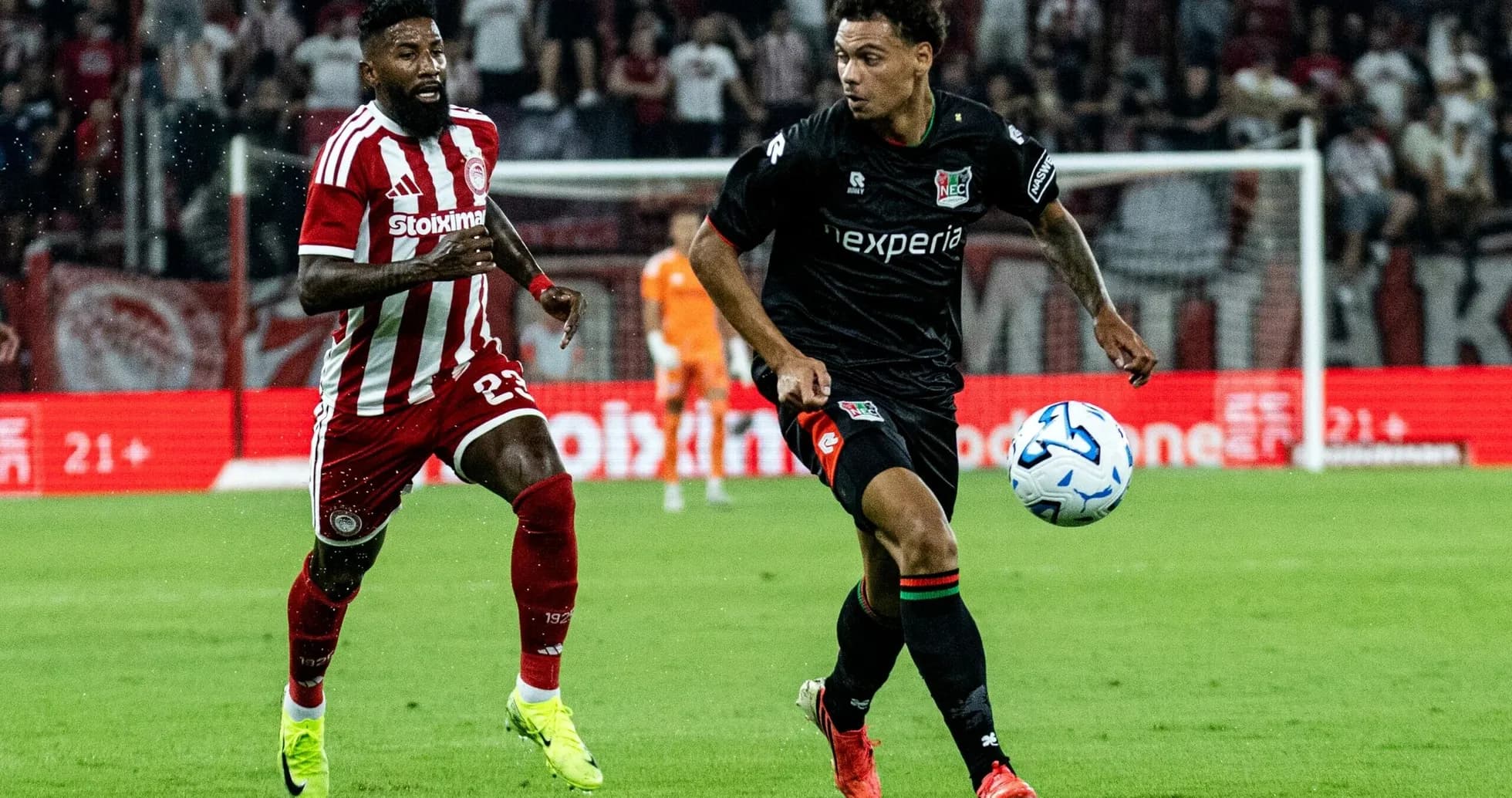
NEC Nijmegen’s 2-1 after-extra-time win over Olympiakos Piraeus at Stadion de Goffert was built on structural clarity and superior control of key zones rather than sheer volume of chances. Across 120 minutes, NEC leaned into a 3-1-4-2 that progressively pinned Olympiakos’ 4-2-3-1 deeper, translating a 54% share of possession and a 16–10 shot advantage into a late extra-time winner. Where the visitors threatened in transition through A. El Kaabi, NEC’s layered midfield and wing-backs gradually suffocated those outlets, especially once Olympiakos went down to ten men.
Olympiakos struck first, but NEC’s tactical persistence—adjusted smartly through substitutions—flipped the momentum. The Dutch side generated 11 shots inside the box to Olympiakos’ 6, an indicator of sustained territorial pressure and more consistent access to dangerous central spaces. The match’s turning point was not only the red card for Kostas Fortounis but also NEC’s ability to reorganize their attacking structure around fresh legs without sacrificing their rest-defence against counter-attacks.
NEC's Tactical Structure
Structurally, NEC’s 3-1-4-2 gave them a natural plus-one in the first phase. With three centre-backs (T. Storm, P. Sandler, D. Fonville) and D. Nejasmic as the single pivot, they could circulate around Olympiakos’ lone striker A. El Kaabi and the first pressing line. The wing-backs and advanced midfielders—S. Ouaissa and then E. Mor on the right, C. Bischoff on the left, plus N. Lebreton and D. Tadic centrally—formed a broad line of four behind the front pair T. Chery and B. Linssen.
This shape created two recurring advantages. First, NEC could find D. Tadic and N. Lebreton between Olympiakos’ double pivot (D. Garcia, S. Hezze) and the back four, particularly when the visitors’ wingers were dragged back by the wing-backs. Second, with two forwards occupying both centre-backs, NEC often forced Olympiakos’ full-backs into narrow, reactive positions, opening lanes for crosses and cut-backs. That dynamic underpinned the volume of shots in and around the area and culminated in B. Linssen’s 70' equaliser, assisted by D. Tadic, a textbook example of the No.10 finding a pocket and feeding the forward on the move.
Olympiakos' Approach
Olympiakos’ 4-2-3-1, by contrast, was initially geared towards verticality. With Rodinei and B. Onyemaechi as full-backs and G. Martins, G. Sa and Jota Silva supporting A. El Kaabi, their best moments came when they broke NEC’s first line and attacked quickly into the channels. The 46' goal from A. El Kaabi reflected that: exploiting the space behind NEC’s back three at the start of the second half, when the hosts briefly lost compactness between defence and midfield.
However, as NEC increased their passing tempo and positional discipline, Olympiakos’ midfield began to stretch. The visitors completed 505 passes to NEC’s 603 and at a lower accuracy (350 accurate, 69% versus NEC’s 457 accurate, 76%), a sign of more forced passes and a higher defensive workload. NEC’s 17 fouls to Olympiakos’ 19 further underline how often the Greek side were defending on the edge of their own third, resorting to interventions to halt combinations around the box.
Disciplinary Patterns
The disciplinary pattern mirrored the tactical story. Olympiakos collected four yellow cards and one red, with early cautions for Dani García (12', Foul), Rodinei (55', Foul) and Gustavo Sá (59', Foul) signalling increasing strain in their defensive block. The VAR “Card upgrade” on Kostas Fortounis at 79', followed by his straight red at 80' for “Foul”, was decisive: down to ten men, Olympiakos’ 4-2-3-1 flattened into a deeper 4-4-1, with even less capacity to contest NEC’s overloads between the lines.
NEC’s own bookings—Brayann Pereira at 88' for “Foul” and Kaj Sierhuis at 90+4' (reason not specified)—came in moments where they were aggressively chasing the winner and managing transitions. Importantly, the VAR intervention at 90+4' that cancelled a potential goal by Kaj Sierhuis did not destabilise their structure; instead, NEC maintained pressure and finally broke through in extra time, with E. Mor’s 95' strike (assisted by K. Sierhuis) reflecting both fresh energy and sustained territorial dominance.
Chance Quality and Control
From a chance-quality perspective, NEC’s 7 shots on goal to Olympiakos’ 2 is a stark indicator of attacking control. Even though expected goals and goals prevented are not provided, the shot-on-target differential aligns with the tactical pattern: NEC’s multi-lane attacks, driven by their advanced midfield four and dual strikers, consistently generated clearer looks. Olympiakos, reliant on sporadic transitions, produced fewer accurate finishes.
In possession, NEC’s 54% share and superior passing volume (603 total passes) allowed them to dictate rhythm, especially after the first 20 minutes and then again once Olympiakos went down to ten men. Their three centre-backs plus D. Nejasmic ensured stable rest-defence against A. El Kaabi, while the wing-backs could push high without leaving the back line exposed. Olympiakos’ 46% possession and lower pass accuracy highlight a side more often reacting than imposing, particularly in the final half-hour and extra time.
Set-Pieces and Overall Tactical Verdict
Set-pieces and wide play were secondary but telling. Olympiakos had a slight edge in corners (4 to 3), reflecting their occasional surges, yet NEC’s 11 shots inside the box compared to Olympiakos’ 6 show that the hosts converted their territorial pressure into more central, higher-value attempts. Both teams kept offsides relatively controlled (NEC 4, Olympiakos 2), suggesting well-timed runs and reasonably well-organised defensive lines.
Overall, the tactical verdict is clear: NEC Nijmegen leveraged a structurally coherent 3-1-4-2, superior passing game and intelligent in-game adjustments to wear down Olympiakos’ 4-2-3-1. The visitors’ early lead and sporadic transitions were not enough to offset NEC’s control of central spaces, shot quality and the numerical advantage after the red card, making the 2-1 after-extra-time scoreline a logical reflection of the tactical balance.
Related News
Slovan Bratislava Secures 2-0 Victory Over Mjallby AIF
Hapoel Beer Sheva Dominates FK Crvena Zvezda in UEFA Qualifiers
Celje Dominates Ararat-Armenia in UEFA Champions League Qualifier
Lyon Dominates Sparta Praha in 3-0 Victory: Tactical Analysis
Kauno Žalgiris vs Dinamo Zagreb Tactical Analysis
NEC Nijmegen Triumphs 2-1 Over Olympiakos Piraeus in Tactical Battle