
Newcastle vs Liverpool: Tactical Insights from Premier League Draw
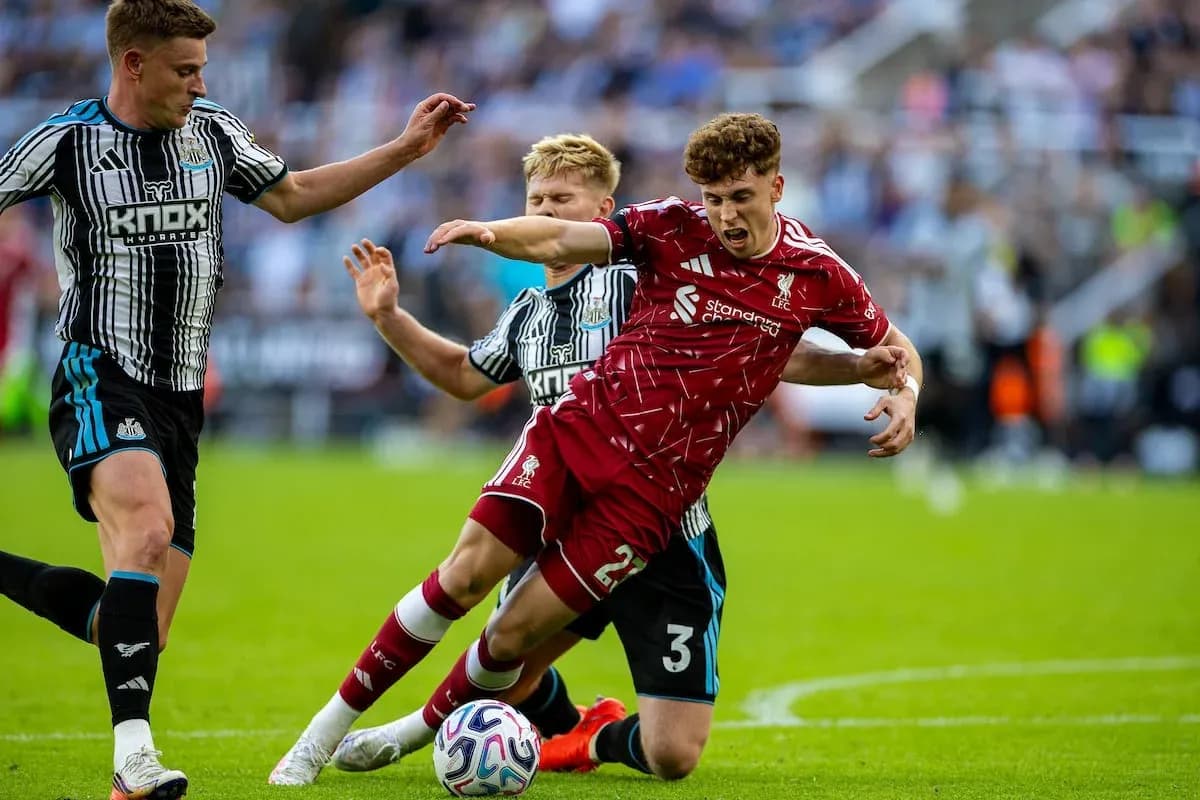
St James’ Park under late-summer light, Round 1 of the Premier League, and already Newcastle and Liverpool have shown their hands. A 2–2 draw leaves both on 1 point, Liverpool in 10th and Newcastle in 11th, but beneath that symmetry lies two very different tactical stories – and the blueprint for how these sides will try to navigate the season.
I. The Big Picture – Two 4-2-3-1s, two identities
Both managers opened the campaign in a mirrored 4-2-3-1, but the shapes carried contrasting intentions.
Newcastle, under Matthias Jaissle, leaned into verticality and aggression. At home they have, in total this campaign, scored 2 and conceded 2, with an average of 2.0 goals both for and against at St James’ Park. That alone tells you this side is built to trade punches rather than suffocate games. The front four of W. Osula, H. Barnes, Y. Wissa and A. Elanga was constructed for direct running and quick combinations rather than patient circulation.
Liverpool, with Andoni Iraola in charge, also used a 4-2-3-1 but with a more structured possession base. On their travels they have, in total this campaign, scored 2 and conceded 2, again at an away average of 2.0 goals for and 2.0 against. The spine of Alisson, V. van Dijk and J. Jacquet behind the double pivot of D. Szoboszlai and R. Gravenberch is designed to give Liverpool a high technical floor and allow the front four to press without fear.
The table confirms the parity: both have a goal difference of 0, each with 2 goals for and 2 against across 1 match. But the way they arrive at that balance is telling.
II. Tactical Voids – Absences that shape the structure
The absentees list reads like a subtle map of tactical compromise.
Newcastle were without Joelinton and V. Livramento. Joelinton’s absence removes a ball-carrying, duelling monster from midfield – the kind of player who can both break pressure and win second balls. In his place, Jaissle leaned on youth and mobility: L. Miley and S. Steur as the double pivot. Miley, already booked once this season, is being asked to grow quickly into a tempo-setter and breaker of lines, while Steur provides legs and coverage. Without Joelinton, Newcastle’s central presence becomes more about passing angles and pressing triggers than raw physical dominance.
Livramento’s hamstring injury deprives them of a dynamic, inverted full-back option. Instead, A. Dedic and L. Hall formed the full-back pair. Hall’s left-footed balance and Dedic’s willingness to step high suit Jaissle’s preference for aggressive wide pressing, but they also leave space behind when Newcastle commit numbers forward.
Liverpool’s list is longer and more structural. C. Bradley, J. Gomez, H. Ekitike and G. Leoni were all missing. Without Gomez and Bradley, the right side of the defence is locked into J. Frimpong as an adventurous full-back with J. Jacquet inside him. That makes Liverpool more explosive in transition but potentially lighter in pure defensive security on that flank. The absence of Ekitike removes a different profile of forward – a penalty-box specialist – which makes A. Isak’s role as the lone striker even more central to their vertical threat.
Discipline-wise, Newcastle’s season card map already hints at an edge. In total this campaign they have spread their yellow cards across almost the entire match: 20.00% between 16–30 minutes, 20.00% between 31–45, another 20.00% from 61–75, 20.00% from 76–90 and 20.00% from 91–105. That late-game cluster – especially the 76–90 and 91–105 windows – signals a side that keeps pushing and tackling aggressively deep into matches, even as fatigue sets in.
Liverpool’s yellows, in total this campaign, are front-loaded: 66.67% of their cautions arrive between 16–30 minutes, and 33.33% from 76–90. That early spike suggests an aggressive press that sometimes steps over the line as they try to impose tempo, while the late cards mirror Newcastle’s willingness to contest every duel in the closing stages.
No red cards have appeared for either side so far, and Liverpool’s penalties record is pristine: in total this campaign they have taken 1 penalty, scored 1 and missed none, a genuine 100.00% conversion rate so far.
III. Key Matchups – Hunter vs Shield, Engine Room battles
Hunter vs Shield
For Newcastle, the “hunter” role is distributed rather than centred on a classic No. 9. A. Elanga and J. Willock share top-scorer status in the league so far with 1 goal each. Elanga, starting from the right in this match, is the vertical threat: 2 shots, both on target, 9 duels with 5 won and 3 fouls drawn underline his direct, confrontational style. Willock, who came from the bench, added 1 goal from 1 shot and a 7.6 rating, proving he can arrive late and finish moves.
Their task across the season will be to find gaps around centre-backs like V. van Dijk and J. Jacquet. Van Dijk remains Liverpool’s defensive metronome, while Jacquet is being groomed as the aggressive front-foot partner. The duel is clear: Elanga’s willingness to attack space behind full-backs and between centre-backs against Liverpool’s high line, and Willock’s late box runs against a defence that sometimes steps out to compress space.
On Liverpool’s side, the nominal No. 9 is A. Isak. His movement between lines, pulling onto full-backs or dropping into pockets, is designed to drag S. Botman and M. Thiaw into uncomfortable zones. Botman’s left-footed distribution is key to Newcastle’s build-up, but he must balance that with tracking Isak’s drifting. If Isak can isolate A. Dedic or L. Hall in wide channels, Liverpool’s wingers and attacking midfielders can flood the box.
Engine Room – Playmaker vs Enforcer
The central battle is where the tactical identities crystallise.
For Newcastle, L. Miley is emerging as the quiet conductor. Across his 76 minutes he completed 36 passes with 83% accuracy in one dataset and 35 at 82% in another – the message is consistent: he keeps the ball moving with reliability, adds 2 key passes and contributes defensively with 1 tackle, 1 block and 1 interception. S. Steur, alongside him, offers the legs and coverage, freeing Miley to look forward.
Ahead of them, Y. Wissa is the hybrid: listed as a midfielder but playing as an advanced connector. He has, in total this campaign, 1 assist, 4 shots (1 on target), 17 passes at 70% accuracy, 4 tackles and an immense 19 duels with 11 won in one record, and 18 duels with 11 won in another. The through-line is that Wissa is Newcastle’s chaos engine: he presses, he fouls (3 committed, 4 drawn), and he forces games into broken phases that suit Newcastle’s runners.
Liverpool’s engine is more classically technical. R. Gravenberch has 1 assist, 47 passes at 91% accuracy, 1 tackle, 2 interceptions and 10 duels with 4 won. He is the side’s metronome and progressor, tasked with breaking Newcastle’s first line and feeding the attacking trio. D. Szoboszlai, alongside him, adds vertical passing and late arrivals into the box, though his statistical imprint here is more about presence and positioning than headline numbers.
The key intersection is obvious: Newcastle’s aggressive mid-block and duelling intensity, personified by Wissa and Miley, against Liverpool’s smooth double pivot. If Newcastle can drag Gravenberch into physical duels and disrupt his rhythm, Liverpool’s structure wobbles. If Liverpool can bypass that press and find F. Wirtz and C. Gakpo between the lines, Newcastle’s young pivot will be forced to turn and chase.
IV. Statistical Prognosis – What the numbers whisper
With only 1 league match played for each side, the sample is thin but not meaningless.
Newcastle at home have, in total this campaign, played 1, drawn 1, scored 2 and conceded 2. Their average of 2.0 goals for and 2.0 against at St James’ Park points to volatility rather than control. They have yet to keep a clean sheet, but they have also not failed to score, underlining a high-risk, high-reward profile.
Liverpool away mirror that: 1 played, 1 draw, 2 scored, 2 conceded, with the same 2.0 averages for and against. They too have no clean sheets and have scored in every match so far. Their penalty record adds a small but sharp edge: 1 taken, 1 scored, 0 missed in total, meaning any foul in the box is likely to be punished.
Card timing deepens the picture. Newcastle’s yellows spread into the final quarter and even into 91–105 minutes, suggesting they will keep tackling and pressing late – a blessing for intensity, a curse for risk management. Liverpool’s heavy 66.67% of yellows between 16–30 minutes shows an early-game ferocity that can either smother opponents or hand them set-piece platforms.
Put together, the statistical prognosis for these squads is of two sides built to attack, each with a defensive line still calibrating. In xG terms – though not explicitly provided – the shot volumes, penalty involvement and chance creation from players like Elanga, Willock, Wissa and Gravenberch hint at matches that will regularly tilt above 2.5 goals.
Following this result, both Newcastle and Liverpool emerge as protagonists rather than spoilers in the Premier League narrative. Newcastle’s youth-infused aggression, Liverpool’s structured but adventurous 4-2-3-1 and the duel between their respective engines promise a season where neither will die wondering. The numbers say they will score; the eye test says they will concede. The story of their campaigns will be written in whether the hunters can stay just one step ahead of the shields.
Related News
Manchester United vs Ipswich: Head-to-Head Stats and Historical Context
Manchester City Begins New Era with 2–1 Win Over Bournemouth
Chelsea vs Brighton Stats: Head-to-Head Record and Recent Meetings
Brentford Dominates Tottenham 3-0 in Premier League Opener

Hull City Defeats Manchester United 2-0: Tactical Insights
Liverpool vs Nottingham Forest Stats: Head-to-Head Record