
Nice's Relegation Playoff: From Champions League Dreams to Ligue 2 Edge
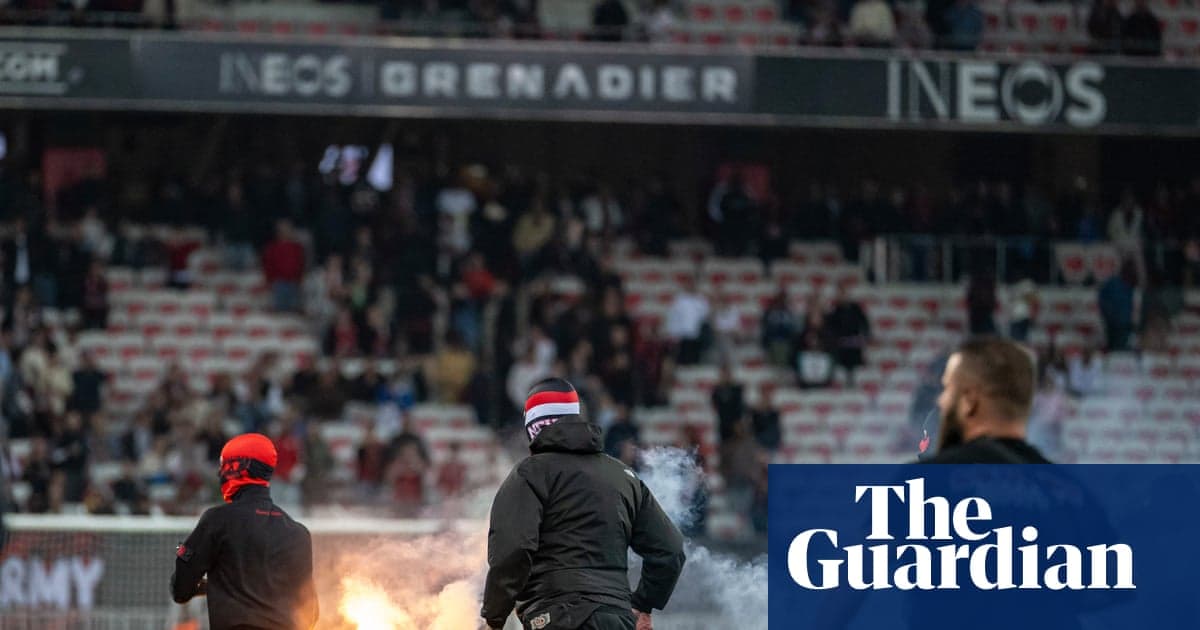
The final whistle had barely cut through the noise when the dam burst.
From the second tier of the Allianz Riviera, Nice’s ultras poured down towards the pitch, a furious tide in red and black. Players sprinted for the tunnel. Staff followed. Security scrambled. A goalless draw with already-relegated Metz had just condemned Nice to a relegation playoff, and the stadium turned into a live indictment of the Ineos era.
This was supposed to be the project that challenged PSG. Instead, it now flirts with Ligue 2.
From Champions League dreams to the edge of the trapdoor
Nice opened the season thinking about Champions League qualifiers. They will end it fighting to stay in Ligue 1, with a two-legged playoff against Saint-Étienne looming later this month. Failing to beat a Metz side already doomed to the drop, on the final day, completed a collapse that has been months in the making.
For Ineos, the timing could hardly be worse. The owners, who paid €100m for the club in 2019 and spoke openly of breaking PSG’s domestic stranglehold, are now looking for a way out. Instead of a sleek, modern contender, they have created a club in open revolt, a fanbase at war with its own team, and a squad stumbling into the most dangerous fixtures of its season.
The task on Sunday should have been simple. Win at home, for the first time in the league since 29 October, against a Metz team that had forgotten how to win altogether.
Metz arrived with nothing left to save. Relegated, drained, and carrying a bleak record: just three league victories all season, none under Benoît Tavenot, who took over in January. His personal tally for the campaign is brutal: no wins, nine draws, 18 defeats and two relegations across spells at Bastia and Metz. A season-long freefall without a single victory to break the fall.
Nice still made it look like climbing a mountain in flip-flops.
“Get your arses into gear”
The tone was set before kick-off. “Get your arses into gear,” roared the home fans, a chant that cut through the pre-match ceremony. The mood swirled between anger, celebration and a kind of nervous expectation.
One banner urged: “Everyone to Paris,” a nod to Friday’s Coupe de France final against Lens at the Stade de France. Another huge tifo honoured captain Dante, who had spoken of the possibility this would be his final home game before retirement at 42. A legend saluted, a final bow imagined.
Yet the romance lasted minutes. The anger swallowed everything else. Just as the playoff with Saint-Étienne now threatens to swallow the cup final.
Nice co-president Jean-Pierre Rivère did not hide it: the Coupe de France “is no longer a priority at all.” The club goes to Paris with its mind elsewhere, just as Reims did last season. They lost the cup final to PSG, then crashed in the relegation playoff against Metz. One man knows that script all too well: Yehvann Diouf, the goalkeeper who played in all three of those Reims matches and now finds himself at Nice, staring down the same nightmare.
A slow-motion car crash
The warning signs have been blinking for months, even if few believed it would spiral this far.
Targets at the start of the season were deliberately vague. A return to Europe, somewhere, somehow, without specifying the competition. Ambition without a plan. As Ineos shifted its attention and resources towards Manchester United, the money tap in Nice began to run dry.
Key players left. Evann Guessand and Marcin Bulka departed; their replacements never convinced. Kevin Carlos, signed to fill Guessand’s role, has not scored a single league goal. Potential signings turned away. Mahdi Camara chose Rennes over Nice.
Franck Haise, then head coach, warned early. In the autumn he complained he did not have the players to push for Europe. Later he went further, admitting he simply could not “create a group” from the squad he had. It was a damning verdict on the club’s recruitment and direction.
The fans turned their fury mostly on the players, but not only. Sporting director Florian Maurice came under fire. So did Fabrice Bocquet, who briefly replaced Rivère as president.
Then came November and an ugly escalation. As the team bus returned to the training ground after a defeat at Lorient, Terem Moffi and Jérémie Boga were attacked by their own supporters as they stepped off. Both players later left the club. Bocquet was gone soon after. By the end of the year, so was Haise.
Puel’s return, and a team without a pulse
Rivère decided to bring back Claude Puel, convinced Haise had lost his edge. It has been a catastrophic miscalculation.
Puel has managed just two league wins in 18 matches. His tactical approach and team selections have drawn fierce and sustained criticism. The football has been as flat as the atmosphere has been toxic.
On Sunday, boos poured down from the stands almost without pause. Each miscontrol, each sideways pass, each wasted attack fed the hostility. It became impossible to tell who the fans were targeting. Players, coach, directors, owners – everyone seemed to be in the crosshairs.
At half-time, the ultras moved from the second tier to the first. No one believed they were going in search of a better view. The goalless stalemate dragged on, tension coiled tighter, and when the final whistle confirmed the playoff, it snapped.
The pitch invasion was the culmination, not the start. Trouble spread around the stadium and into the night. Staff, guests and journalists were kept inside until after midnight, locked in by a fury that had finally spilled over.
Puel called the supporters’ “disappointment legitimate”. Rivère appealed for “unity”. Both sounded hollow against the scenes unfolding around them.
The fracture at Nice runs too deep for slogans. With talks ongoing over a potential sale, Ineos may soon be gone, leaving behind a club battered, divided and facing the real possibility of dropping into Ligue 2. If they walk away this summer, they will not be remembered for their ambition. They will be remembered for the wreckage.
Chaos in Nantes, a farewell for “Coach Vahid”
Nice were not alone in seeing their season end under a cloud of violence.
In Nantes, the final day never even reached the half-hour mark. Already relegated, the club hosted Toulouse in a match that lasted just 22 minutes before being abandoned. The owners stayed away, citing safety concerns. Events proved them right.
Ultras hurled black flares and then stormed the pitch in large numbers. Players, officials and staff sprinted for the dressing rooms. One man stayed.
Vahid Halilhodžić, Nantes manager and a veteran of four decades in the game, stood his ground. Surrounded by masked fans, he tried to reason with them, gesturing, pleading. Eventually he, too, turned and walked towards the tunnel, his face carved with anguish and disbelief.
“In the 40 years of my career as a player and then a manager, I have never experienced that. It will be deeply engraved in my memory,” he said afterwards. He then confirmed it would be his last memory in football. That is how “Coach Vahid” leaves the stage: not with a lap of honour, but with a pitch invasion and a match abandoned.
PSG celebrate in the shadows
Elsewhere, the images were less violent, but no less striking.
In the Paris derby, PSG turned up as newly crowned Ligue 1 champions, having sealed the title in midweek with victory over Lens. They expected to lift the trophy on Sunday night. The script, though, belonged to Paris FC.
The hosts had their own party planned after securing survival, and they were in no mood to hand over their pitch for PSG’s grand ceremony. So the champions built their own little stage, a makeshift stand set up in front of the away end before kick-off.
The result was a strangely subdued coronation. No great spectacle, no sweeping celebration – just a modest platform, a quick lift of the trophy, and the sense that this title, like so many before it, is only a prelude to the real judgement.
Luis Enrique has already said his eyes are on the Champions League final against Arsenal. His team played like it. PSG slipped to a 2-1 defeat against Paris FC, a result that meant nothing in the table but said plenty about where their energy is directed.
On a night when France saw flares, pitch invasions, protests and makeshift podiums, the league season closed with one club clinging to its place in the top flight, another saying goodbye to a legend in chaos, and the champions looking beyond the borders of their own competition.
Nice now head into a playoff that will define their future. The question is not just whether they can survive it, but what, exactly, will be left of the club when it is over.
Related News
Carlos Alcaraz Urges an End to Matches Ending in the Early Hours
Carlos Alcaraz Criticizes Late US Open Finish After 3:30 a.m. Match
Jannik Sinner Set for ATP 500 Return in Beijing with Novak Djokovic Also Competing
Meet Iva Jovic: The American Tennis Prospect Making Waves
Flavio Cobolli Shares Insights on Practice Session with Jannik Sinner Ahead of Comeback
Till vs Romero: Fight Details, Undercard, and Viewing Info for This Weekend