
PAOK vs Anderlecht Tactical Analysis: Dominance Without Reward
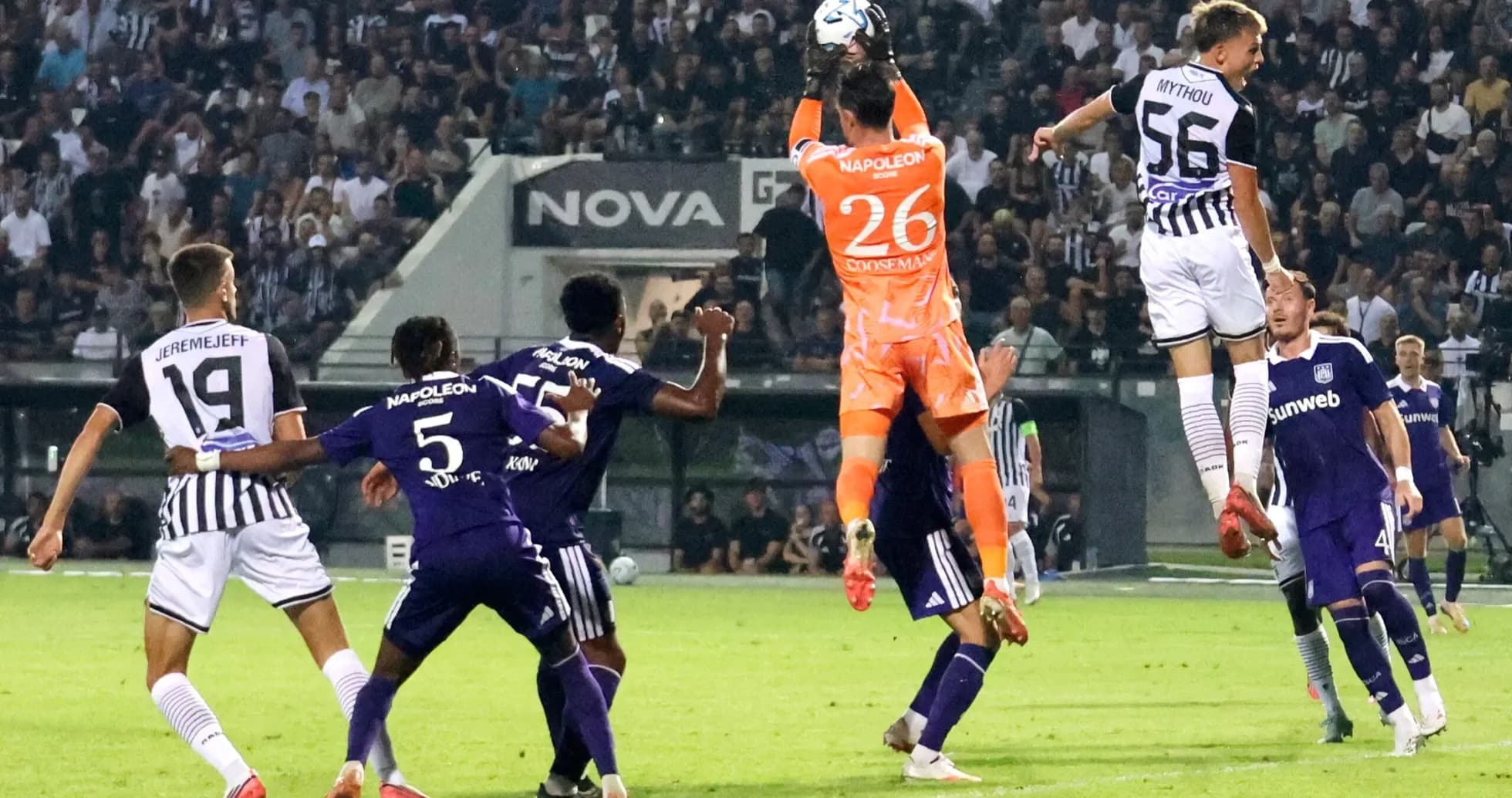
PAOK’s 4-2-3-1 against Anderlecht’s 4-3-3 produced a territorial siege at Toumba Stadium but not the cutting edge the hosts needed. The match finished 0-1 in the UEFA Europa League 3rd Qualifying Round, with PAOK dominating possession (65% to 35%) and volume of attempts yet undone by Anderlecht’s early punch and subsequent defensive control.
The decisive tactical event came almost immediately. At 1', M. Cvetkovic, starting nominally from the right side of Anderlecht’s front line, finished a move assisted by E. Llansana. That early “Normal Goal” allowed Vitor Bruno’s side to tilt the entire game script towards compactness and counter-control. From then on, Anderlecht’s 4-3-3 often behaved like a 4-1-4-1 or even 4-5-1 without the ball, with M. Kana stepping in as a screening presence in front of the back four and both wide forwards dropping deep.
PAOK’s structure was clear: J. Pavlenka behind a back four of Jogo, G. Michailidis, P. Hatzidiakos and J. Kenny, with the double pivot of B. Santamaria and C. Zafeiris tasked with first-phase buildup. Ahead of them, the creative triangle of Taison (left), G. Konstantelias (central) and A. Zivkovic (right) supported lone forward A. Mythou. The 65% possession figure reflects how PAOK pushed their full-backs high and tried to lock Anderlecht into their own half, especially after going behind so early.
However, the shot profile underlines a recurring problem: PAOK produced 3 shots on goal and 11 shots off goal, with 3 blocked. The volume suggests territorial dominance and sustained pressure, but the ratio of off-target efforts points to rushed or low-quality finishing and difficulties in creating clear central looks. With no data on total shots or xG, the precision we do have still indicates a team forced into a lot of speculative attempts rather than repeated high-value chances.
Anderlecht, by contrast, were brutally efficient and selective. They registered just 2 shots on goal and 2 off goal, with no blocked efforts. One of those on-target attempts was Cvetkovic’s early strike, which changed the dynamic of the contest. From that point, Anderlecht’s priority was game-state management. Their low shot count is not a sign of offensive failure but of a deliberate strategy: protect the box, compress space between lines, and only commit numbers forward when transitions were clearly on.
Defensively, Anderlecht’s back four of M. N’Diaye, G. Biancone, L. Petrot and A. Maamar held a relatively narrow line, inviting PAOK to circulate the ball wide and cross rather than play through central channels. The midfield trio of E. Llansana, L. Ambros and M. Kana provided horizontal coverage; Llansana’s role was particularly important, as he not only assisted the goal but also anchored the central block, stepping out to press PAOK’s pivots when the trigger came from a backward or square pass.
The foul count—23 for Anderlecht versus 15 for PAOK—shows how aggressively the visitors protected their lead. Anderlecht were willing to disrupt rhythm, especially in midfield, rather than allow PAOK to build fluid combinations between the lines. The three yellow cards for Anderlecht and two for PAOK fit this picture of a match where the away side leaned into tactical fouling and duels to slow tempo and break up attacks.
Alessio Lisci’s in-game adjustments reflect a search for more thrust and balance. At 46', A. Elustondo (IN) came on for P. Hatzidiakos (OUT), a like-for-like defensive change that also responded to Hatzidiakos’ first-half yellow. On 63', there was a double move: A. Baba (IN) for Jogo (OUT) and G. Taylor (IN) for B. Santamaria (OUT). These shifts pushed fresher legs into the full-back line and adjusted the midfield profile, with Taylor offering more drive from deeper zones. At 71', A. Jeremejeff (IN) replaced Taison (OUT), adding a more penalty-box-focused forward presence, and at 83' D. Pelkas (IN) came on for A. Mythou (OUT), giving PAOK another technical player between the lines to combine with Konstantelias and Zivkovic.
Despite these changes, Anderlecht’s block largely held. Vitor Bruno’s substitutions were aimed at energy and maintaining compactness rather than chasing additional goals. At 57', O. Antman (IN) replaced J. Onia Seke (OUT), refreshing the wide role for transition moments. On 71', N. Saliba (IN) came on for L. Ambros (OUT) to stabilize midfield legs, and T. Degreef (IN) replaced goalscorer M. Cvetkovic (OUT), signaling a tilt further towards control and defensive coverage in the final phase.
Set pieces were another key battleground. PAOK earned 5 corner kicks to Anderlecht’s 1, but the visitors defended their box effectively, with no statistical evidence of those corners turning into a significant on-target threat. The 3 blocked shots for PAOK also suggest that Anderlecht’s defenders stepped out aggressively to close shooting lanes around the edge of the area.
Offside numbers (3 each) indicate that both sides tried to exploit the space behind the defensive lines at times, but PAOK’s main pattern remained territorial encirclement rather than repeated runs in behind. Anderlecht’s forwards, meanwhile, were mostly isolated after the early goal, prioritizing defensive positioning over constant depth runs.
Without recorded goalkeeper saves, passes, or passing accuracy, we cannot quantify the distributional influence of J. Pavlenka (PAOK) or C. Coosemans (Anderlecht), nor the exact circulation patterns. However, the possession split and foul profile allow a clear tactical reading: PAOK controlled the ball and the pitch, Anderlecht controlled the scoreboard and the defensive zones that mattered most.
In statistical verdict, the match is a classic example of dominance without reward versus efficiency and game management. PAOK’s 65% possession, higher shot volume, and 5-1 advantage in corners point to a side that imposed territory and tempo but lacked incision and composure in the final third. Anderlecht’s 35% possession, 2 shots on goal, and 2 shots off goal, combined with 23 fouls and 3 yellow cards, outline a pragmatic, results-first away performance: score early, compact the block, foul when needed, and deny central, high-quality chances.
In a two-legged or qualifying context, this 0-1 at Toumba Stadium gives Anderlecht a valuable platform, while PAOK leave with a clear tactical lesson: territorial control and shot volume must be matched by sharper chance creation and more efficient finishing if they are to turn dominance into progression in the UEFA Europa League.
Related News
AC Milan vs Benfica: A Clash of Two Philosophies in UEFA Europa League
Five Standout Europa League Players to Watch in 2026/27

AC Milan vs Benfica Europa League Clash: Team Updates, Lineups & Broadcast Info
Omonia Nicosia vs Benfica Predicted Lineups: Team News for UEFA Europa League
Red Bull Salzburg vs Ararat-Armenia Predicted Lineups and Team News
Celje vs Red Bull Salzburg Predicted Lineups and Team News